Pradhan Mantri Awaas Yojana Gramin
Selection-based housing support for eligible rural households, with unit assistance of ₹1.20 lakh in plains and ₹1.30 lakh in eligible hill and north-eastern areas.
Eligibility: Check beneficiary selection, housing approval, instalments and verification through the local rural development office.
What Is Pradhan Mantri Awaas Yojana–Gramin?
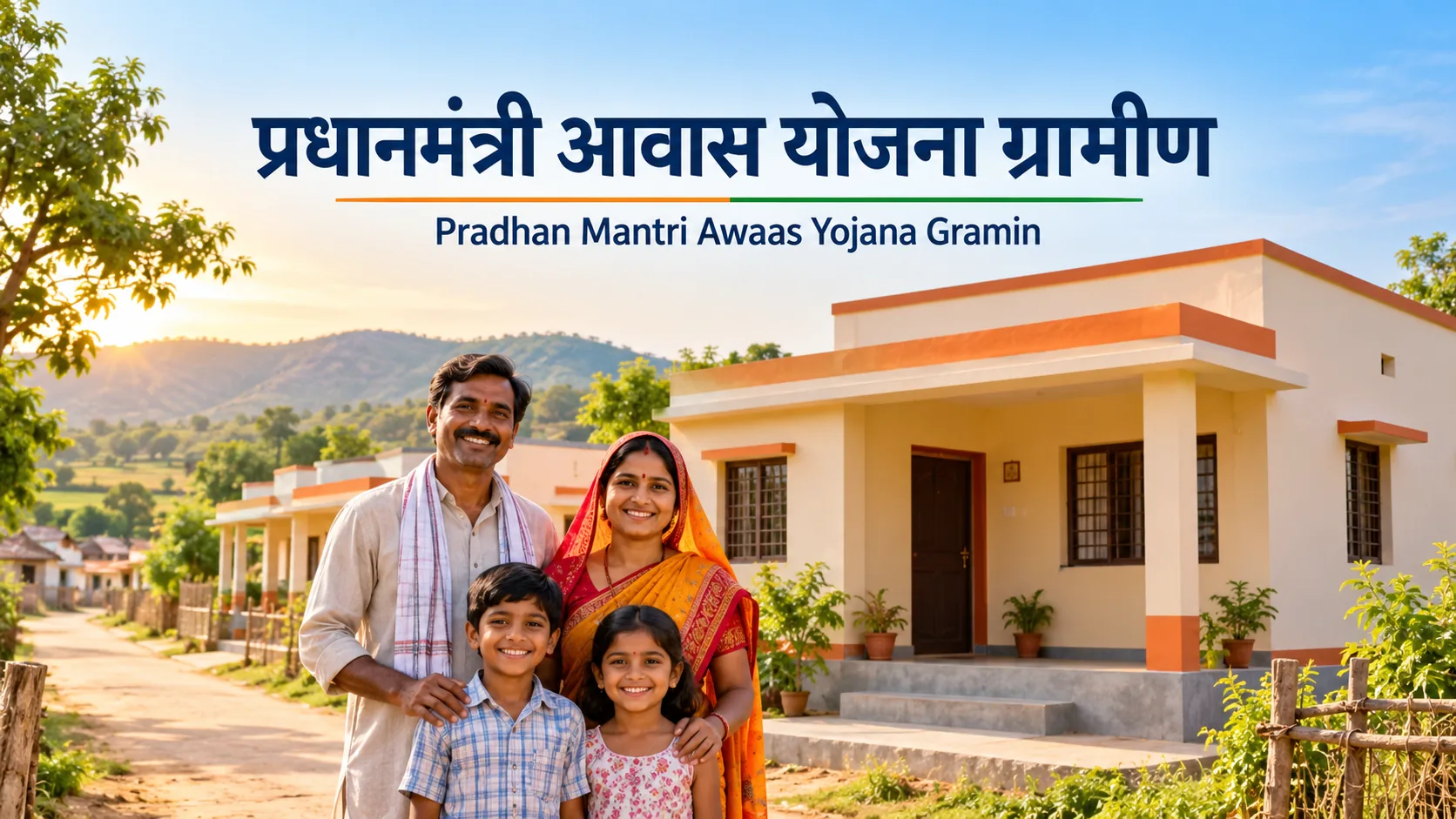
Pradhan Mantri Awaas Yojana–Gramin (PMAY-G) is a Government of India rural housing scheme that provides financial assistance to eligible households for constructing permanent houses with basic amenities. The programme is administered by the Ministry of Rural Development and implemented through State Governments, Union Territory administrations and the relevant local authorities.
PMAY-G began on 1 April 2016 with the objective of improving housing conditions for rural families that do not have a permanent house or live in kutcha and dilapidated dwellings. Its design focuses on beneficiary identification, government-approved construction assistance and monitoring of housing progress.
The scheme offers unit assistance of ₹1.20 lakh in plain areas and ₹1.30 lakh in eligible North Eastern and hill areas. Other support may be available through convergence with the Mahatma Gandhi National Rural Employment Guarantee Scheme (MGNREGS), Swachh Bharat Mission–Gramin and programmes providing essential amenities.
In August 2024, the Union Cabinet approved the continuation of PMAY-G during financial years 2024–25 to 2028–29, with a target of providing assistance for two crore additional rural houses. This is a national programme target rather than a promise that every rural household will receive a house automatically.
Important: PMAY-G is a selection-based housing assistance programme. A household must satisfy the applicable housing-deprivation criteria, avoid relevant exclusions and pass the government's verification and sanction process. A survey entry or online submission alone does not guarantee a housing grant.
PMAY-G Scheme 2026: Key Details
| Feature | Details |
|---|---|
| Full name | Pradhan Mantri Awaas Yojana–Gramin |
| Abbreviation | PMAY-G |
| Responsible ministry | Ministry of Rural Development |
| Implementation started | 1 April 2016 |
| Target beneficiaries | Eligible houseless rural households and households living in qualifying kutcha or dilapidated houses |
| Unit assistance in plain areas | ₹1,20,000 |
| Unit assistance in eligible hill and North Eastern areas | ₹1,30,000 |
| Minimum house size | 25 square metres, including a cooking space |
| Toilet assistance | ₹12,000 through applicable scheme convergence |
| MGNREGS support | 90 or 95 person-days of unskilled wages |
| Extended implementation period | FY 2024–25 to FY 2028–29 |
| Additional approved target | Two crore rural houses |
| Beneficiary identification | SECC 2011, Awaas+ records and updated survey arrangements |
| Official portal | PMAY-G Government Website |
The housing unit assistance, toilet-related support and MGNREGS wages are separate programme provisions. Their combined value should not be advertised as a guaranteed single cash payment to every beneficiary.
What Is the Main Objective of PMAY-G?
A permanent house provides protection against weather and can improve safety, hygiene and long-term living conditions. Yet many rural households cannot afford the full cost of constructing an adequate home.
PMAY-G seeks to reduce this housing gap by assisting eligible families through an organised government selection and construction process.
Supporting Safe and Permanent Housing
The central objective is to help eligible households move from temporary or inadequate shelter into pucca housing that meets basic standards.
A safer house can offer greater protection during heavy rain, high temperatures and other difficult conditions.
Improving Access to Essential Amenities
The scheme emphasises convergence with other public programmes. This helps eligible households access sanitation, electricity, drinking water and related services through the appropriate government arrangements.
Supporting Rural Livelihoods During Construction
House construction can involve considerable labour. PMAY-G therefore includes a provision to link eligible beneficiaries with MGNREGS unskilled wage employment during construction.
Encouraging Better Housing Quality
Housing assistance is linked with basic standards for minimum size, suitable construction and progress monitoring.
The programme is not intended to be an unrestricted payment that a household may use for unrelated purchases.
How Much Financial Assistance Is Available Under PMAY-G?
The Central Government has maintained the approved unit assistance rates for the extended phase of PMAY-G.
| Eligible area | Housing unit assistance |
|---|---|
| Plain areas | ₹1,20,000 |
| North Eastern States | ₹1,30,000 |
| Eligible hill states, including Himachal Pradesh and Uttarakhand | ₹1,30,000 |
| Eligible areas of Jammu & Kashmir and Ladakh | ₹1,30,000 |
These amounts were reaffirmed in a Ministry of Rural Development parliamentary response published on 24 July 2026.
Assistance is provided to sanctioned beneficiaries under the relevant government disbursement arrangements. Payment depends on the approval record and the construction-stage verification process.
State-specific additional assistance, where available, should be checked separately. A State benefit should not be automatically included in the standard Central unit assistance figure.
What Additional Benefits Can PMAY-G Beneficiaries Receive?
PMAY-G is designed to work with other government programmes so that approved houses can include essential facilities.
Toilet Construction Support
The scheme provides for ₹12,000 in toilet construction support through convergence with Swachh Bharat Mission–Gramin, MGNREGS or another dedicated funding source.
This support follows the applicable rules of the relevant programme. It should not be interpreted as an automatic unrestricted cash addition for every selected household.
Unskilled Wage Support Under MGNREGS
Eligible PMAY-G households are facilitated with 90 or 95 person-days of unskilled wage employment through the appropriate MGNREGS arrangement.
The number represents days of labour, not a fixed payment of ₹90,000 or ₹95,000.
Actual wages depend on the notified wage rate, recorded work and relevant programme procedures.
Electricity, Water and Other Amenities
Where applicable, households may be linked to programmes intended to provide electricity, drinking water and other essential services.
These facilities are governed by their respective schemes and implementation conditions rather than being universally included in the housing grant itself.
Who Is Eligible for PMAY-G?
Eligibility is based primarily on rural housing deprivation and the approved exclusion criteria. The scheme seeks to identify households without suitable permanent housing that meet the applicable conditions.
The original beneficiary identification system used the Socio Economic and Caste Census (SECC) 2011 data. A Permanent Wait List was prepared using housing-deprivation information and prescribed exclusions.
Later, Awaas+ 2018 helped identify additional potentially eligible rural households.
With the 2024 continuation of PMAY-G, the Government approved updated Awaas+ identification using modified exclusion criteria.
Each stage has its own meaning. A household being surveyed, found eligible, placed on a priority list or issued a housing sanction represents different points in the process.
A household should not treat a survey receipt as proof that money has already been approved.
What Changed in the PMAY-G Eligibility Rules in 2024?
The Government revised certain automatic exclusion criteria when approving the programme's additional housing target in August 2024.
The revisions were intended to make identification more appropriate for current rural housing conditions and to ensure that additional eligible households could be considered.
According to the Ministry's December 2024 parliamentary response, previous exclusions based on owning a motorised two-wheeler, mechanised fishing boat, landline phone or refrigerator were removed.
The income-related exclusion was also revised, and land-related parameters were simplified.
This does not mean every rural household owning these items now qualifies. Applicants must still satisfy all the other requirements.
What Are the Revised Automatic Exclusion Criteria?
The Government's 3 December 2024 statement describes an initial housing-based filter and a further list of ten automatic exclusion conditions.
Households living in houses with a pucca roof or pucca wall, or in houses with more than two rooms, are excluded under the relevant initial screening described in that framework.
For the remaining households, the following conditions can result in automatic exclusion:
- Ownership of a motorised three- or four-wheeler.
- Ownership of mechanised three- or four-wheeler agricultural equipment.
- A Kisan Credit Card with a credit limit of ₹50,000 or more.
- Any household member being a government employee.
- Having a government-registered non-agricultural enterprise.
- Any family member earning more than ₹15,000 per month.
- Payment of income tax.
- Payment of professional tax.
- Ownership of 2.5 acres or more of irrigated land.
- Ownership of five acres or more of unirrigated land.
These are official exclusion parameters used within the identification framework. Final assessment still requires the relevant government verification and beneficiary selection process.
What Is the Awaas+ 2024 Survey?
Awaas+ 2024 is the updated survey arrangement intended to identify additional rural households that may qualify for housing support under the expanded PMAY-G programme.
The Government introduced the Awaas+ 2024 mobile application on 17 September 2024.
The survey uses digital tools to collect prescribed household details and support identity and housing-condition verification.
Official procedures recognise both assisted surveys carried out by authorised surveyors and a self-survey option for citizens.
Assisted Survey
Under the assisted-survey arrangement, authorised personnel mapped to relevant Gram Panchayats can record household information according to the Government's procedures.
Families should verify the identity and authority of people collecting survey details rather than sharing personal information with an unknown visitor.
Self-Survey
The Government's Standard Operating Procedure also provides for a self-survey using the relevant official application, subject to Aadhaar-based eKYC and the specified requirements.
Whether a new survey can be completed at a particular time depends on the survey's current operational status and the applicable instructions.
A self-survey submission does not bypass the subsequent verification or sanction process.
How Can a Household Check Its Awaas+ Survey Status?
A family seeking housing assistance should begin by asking its Gram Panchayat or Block Development Office whether the household is already included in the relevant survey or beneficiary records.
The official Awaas+ 2024 information page provides details about the survey application and supporting procedures.
If survey activity is open and the household is eligible to participate, the relevant authorised instructions should be followed.
Where the survey window is closed, an unofficial website's claim that everyone can apply immediately should not be relied upon.
Families should also distinguish survey inclusion from subsequent eligibility verification and housing sanction.
How Are PMAY-G Beneficiaries Selected?
The beneficiary selection process is intended to make rural housing assistance more transparent and focused on households with genuine housing deprivation.
Government records are screened through the relevant housing-deprivation criteria and exclusion parameters.
Gram Sabha verification and the prescribed appeal process form part of the original beneficiary identification structure. Relevant authorities then manage the selection and sanction process.
The final approved household list and housing sanction are therefore more important than an unverified online statement that the applicant is eligible.
Difference Between Survey, Selection and Sanction
Survey: The household's circumstances and housing details are recorded.
Eligibility verification: The information is checked against the applicable conditions and exclusions.
Priority or beneficiary list: The household may be placed in the relevant verified list according to the programme rules.
Sanction: An authorised housing approval is issued through the applicable administrative system.
Only after the required approval and disbursement conditions are satisfied can the housing-assistance process proceed.
How to Check the PMAY-G Beneficiary List in 2026
The official PMAY-G reporting system can provide information about beneficiaries and housing progress, subject to the public services currently available.
- Open the official PMAY-G website.
- Look for the AwaasSoft or relevant reporting section.
- Locate the beneficiary or rural housing report offered by the portal.
- Where available, select the relevant State, district, block, Gram Panchayat and reporting year.
- Review the available records for the appropriate locality.
- Ask the Gram Panchayat or Block Development Office to clarify any missing or disputed entry.
Government portals can change their menus and report interfaces. Use the current official website rather than depending on an old screenshot or a third-party copy of a beneficiary list.
How to Check Housing Status Using a Registration Number
If the household has received a PMAY-G registration number or beneficiary identifier, that information can help the authorised department locate the housing record.
Beneficiary details, sanction status and construction progress may be available through the appropriate official AwaasSoft service.
Where online information is unavailable or does not match the household's records, the Gram Panchayat or Block Development Office should be contacted.
A registration number is not the same as a sanction order. Do not assume that receiving an acknowledgement automatically means the housing assistance has been approved.
How Are PMAY-G Instalments Paid?
The approved housing unit assistance is generally released in instalments associated with the construction process.
Progress is recorded through the Government's monitoring system, including geo-tagged construction photographs and related administrative checks.
AwaasSoft supports the monitoring of housing construction and transactions at different stages.
The precise number of instalments and the conditions for each release may differ according to the State's approved administrative arrangements. It would therefore be misleading to publish an identical fixed instalment table for every State without verification.
What If an Instalment Has Not Arrived?
A beneficiary should first confirm that the housing sanction is valid and that the relevant construction stage has been correctly recorded.
The responsible Block Development Office can help clarify whether the delay involves construction verification, beneficiary information, account details or another administrative issue.
Keep relevant sanctioned housing records and payment acknowledgements available for verification.
What Is the Minimum House Size Under PMAY-G?
The minimum housing unit size under PMAY-G is 25 square metres, including a hygienic cooking space.
This represents an increase compared with the earlier rural housing programme's minimum size.
The aim is to provide a functional and durable home rather than only a temporary shelter. Construction may take account of local geography, materials and approved technical designs.
Beneficiaries should follow the applicable housing standards and seek technical guidance where provided by the implementing authorities.
What Documents May Be Required?
Document requirements can vary depending on whether the household is undergoing a survey, eligibility verification, beneficiary registration or sanction process.
Relevant records may concern household identification, Aadhaar-related verification, bank details, current housing conditions, local residence and land availability.
For some households, land-related records or arrangements can be especially important. Landless households may require assistance through separate provisions or local government arrangements.
These examples should not be presented as a universal compulsory document list. The Gram Panchayat or Block Development Office can confirm the information needed for the household's actual case.
What If Your Name Is Missing From the PMAY-G List?
The first step is to determine which list is being checked. An old Permanent Wait List, Awaas+ survey record and sanctioned-beneficiary list do not necessarily contain the same entries.
If a household believes it meets the requirements but cannot find its name, it should ask the relevant Gram Panchayat whether the household's survey information exists and whether any verification is pending.
Where the government provides an objection or appeal procedure, the concerned household can ask how to use that authorised route.
Do not pay an intermediary who claims to be able to add a name to the approved list without official verification.
PMAY-G Versus PMAY-Urban: What Is the Difference?
Pradhan Mantri Awaas Yojana has distinct rural and urban arrangements with different administering ministries, eligibility rules and assistance structures.
| Feature | PMAY-G | PMAY-Urban |
|---|---|---|
| Area covered | Rural areas | Urban areas |
| Responsible ministry | Ministry of Rural Development | Ministry of Housing and Urban Affairs |
| Primary assistance | Construction assistance for selected eligible rural households | Housing assistance under separate urban programme components |
| Beneficiary identification | SECC/Awaas+ and prescribed verification | Relevant urban scheme rules |
| Official website | pmayg.gov.in | pmaymis.gov.in |
The urban programme's income classifications and application procedures should not be applied automatically to a rural household seeking assistance under PMAY-G.
Common Misunderstandings About PMAY-G
Every rural family can obtain ₹1.20 lakh by filling out an online form: Assistance is subject to the prescribed beneficiary identification, verification and sanction process.
Having a motorcycle automatically makes a family ineligible: The revised automatic exclusion rules removed the earlier motorised two-wheeler criterion, although other exclusions continue to apply.
Survey inclusion means the house has been approved: Survey, eligibility assessment, selection and sanction are separate stages.
The Government deposits every housing instalment at once: Payments are linked to the applicable disbursement and construction monitoring procedures.
MGNREGS provides ₹90,000 or ₹95,000 for every house: The scheme refers to 90 or 95 person-days of unskilled wage employment, not those fixed rupee amounts.
Frequently Asked Questions About PMAY-G
1. What is PMAY-G?
PMAY-G is the Government of India's rural housing assistance programme for selected eligible households that lack suitable permanent housing.
2. How much housing assistance is available?
Unit assistance is ₹1.20 lakh in plain areas and ₹1.30 lakh in eligible hill and North Eastern areas.
3. Is PMAY-G active in 2026?
The Union Cabinet approved continuation during FY 2024–25 to FY 2028–29, with a target of two crore additional rural houses.
4. Can a household apply through any online website?
No. Use official survey and government verification channels. A third-party application does not establish entitlement.
5. What is Awaas+ 2024?
It is an updated digital survey initiative designed to help identify additional potentially eligible rural households under revised criteria.
6. Does ownership of a refrigerator automatically exclude a household?
The revised exclusion criteria removed the earlier refrigerator-based automatic exclusion, but the remaining rules still apply.
7. Is MGNREGS wage support available?
Eligible beneficiaries can receive support linked to 90 or 95 person-days of unskilled wage employment under the applicable arrangement.
8. Is toilet construction assistance included?
There is a provision for ₹12,000 in toilet construction assistance through appropriate scheme convergence, subject to applicable requirements.
9. How can a household check the beneficiary list?
Use the official PMAY-G reporting system or consult the relevant Gram Panchayat and Block Development Office.
10. Why might a sanctioned housing instalment be delayed?
Possible issues include pending construction-stage verification, administrative processing or beneficiary-record discrepancies. The responsible office should confirm the actual reason.
11. What is the minimum house size?
The minimum housing unit size is 25 square metres, including a cooking space.
12. Where can official PMAY-G information be found?
Consult the Ministry of Rural Development's official PMAY-G portal, government survey information and verified programme notices.
Official Government Sources
- Pradhan Mantri Awaas Yojana–Gramin — Official Website
- Official Awaas+ 2024 Survey Information and Procedures
- Ministry of Rural Development — PMAY-G Financial Assistance, 24 July 2026
- PIB — Revised Automatic Exclusion Criteria, 3 December 2024
- Union Cabinet — PMAY-G Continuation and Additional Housing Target
Last reviewed: 19 October 2026. Household eligibility, survey status, beneficiary selection, housing sanction and payment details must be confirmed through the current official programme records and responsible authorities.
Disclaimer: eSarkariYojna is an independent informational website and is not operated by the Government of India or a rural housing approval authority. This guide explains publicly available scheme information and does not guarantee a house, grant, instalment or additional benefit.
Always check the official website for final and accurate information.
Visit official website: www.pib.gov.in ↗Last updated: 23 Oct 2026