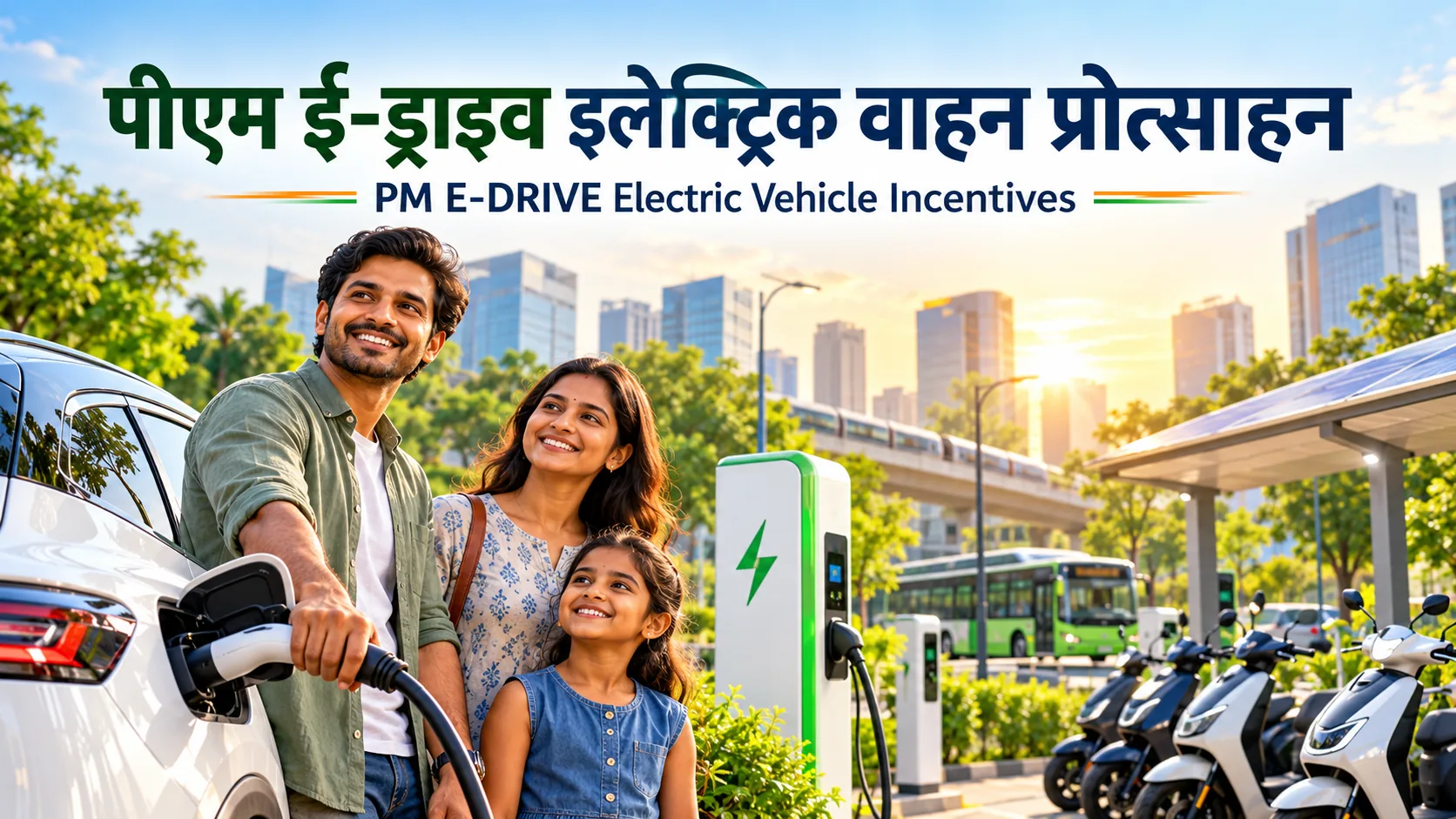
PM E-DRIVE Electric Vehicle Incentives
Demand incentives for eligible electric vehicle categories; the e-two-wheeler timeline was amended in August 2026 and conditions vary by category.
Eligibility: Verify the eligible model, registration period, e-voucher and dealer-level incentive application.
What Is the PM E-DRIVE Scheme?
The PM E-DRIVE Scheme is an Indian Government programme that encourages the adoption of eligible electric vehicles and supports the development of electric mobility infrastructure. Its full name is PM Electric Drive Revolution in Innovative Vehicle Enhancement. Administered by the Ministry of Heavy Industries, the scheme covers several types of electric vehicles, alongside public charging infrastructure and selected technology-development measures.
For someone planning to buy an electric scooter, the most relevant part of PM E-DRIVE is the demand incentive available on approved electric two-wheelers. However, the programme extends beyond personal vehicles. It also includes specified commercial three-wheelers, electric ambulances, trucks, buses and charging infrastructure projects, each with its own eligibility and implementation requirements.
The programme was notified on 29 September 2024 and initially operated within a shorter approval period. Subsequent government amendments extended the overall scheme timeline to 31 March 2028. A notification dated 10 August 2026 also extended the terminal date for eligible electric two-wheelers to 31 March 2028.
These extensions are important, but they do not guarantee an incentive on every electric vehicle bought before that date. A buyer must still check the approved model, variant, applicable incentive, registration rules and current validity period.
PM E-DRIVE Scheme 2026: Key Facts
| Item | Information |
|---|---|
| Scheme | PM Electric Drive Revolution in Innovative Vehicle Enhancement |
| Abbreviation | PM E-DRIVE |
| Ministry | Ministry of Heavy Industries |
| Original notification | 29 September 2024 |
| Implementation began | 1 October 2024 |
| Extended overall scheme period | Up to 31 March 2028 |
| Revised e-two-wheeler terminal date | 31 March 2028, subject to applicable conditions |
| Key vehicle categories | Eligible e-2Ws, e-3Ws, e-ambulances, e-trucks and e-buses |
| Other components | Public charging infrastructure and testing-agency upgrades |
| Incentive verification | Approved vehicle records, applicable notification and prescribed purchase process |
| Official portal | PM E-DRIVE Government Portal |
The scheme duration and the eligibility window for a specific vehicle are not necessarily identical. Treat the official model approval record and the latest category-specific notification as essential checks before making a purchase.
Why Was PM E-DRIVE Introduced?
Electric vehicles can reduce tailpipe emissions and help diversify India's transport system, but their adoption involves several practical challenges. Purchase prices may be higher than comparable conventional vehicles, charging access varies between locations, and buyers need confidence in battery technology and after-sales support.
PM E-DRIVE addresses these barriers through a combination of incentives, infrastructure support and technical requirements. Instead of treating every electric vehicle in the market as eligible, it uses defined vehicle categories and approval procedures.
Reducing the Upfront Cost of Eligible Vehicles
Demand incentives are designed to support the purchase of qualifying vehicles. Where applicable, this support may reduce the effective upfront price under the prescribed sales process. The amount is not simply a flat payment given to every customer.
Supporting Public and Commercial Mobility
Electric buses, ambulances, trucks and three-wheelers serve different transportation needs. By including these segments, the scheme addresses commercial fleets and essential services in addition to individually owned electric scooters.
Expanding Charging Infrastructure
A reliable charging network is an important factor in electric vehicle adoption. PM E-DRIVE provides a separate framework for eligible public charging infrastructure projects, helping address the needs of multiple vehicle categories.
Encouraging Approved Vehicle Technologies
The scheme includes technical and manufacturing requirements. For buyers, this makes the official approved-model list a critical reference. A vehicle carrying an electric badge is not automatically a PM E-DRIVE-approved product.
Which Vehicles Are Covered by PM E-DRIVE?
The government portal identifies several categories, but their incentive mechanisms are not interchangeable. Understanding these differences prevents confusion between individual buyer support and institutional projects.
| Category | How eligibility works |
|---|---|
| Electric two-wheelers | Approved registered models may qualify, including eligible privately owned vehicles. |
| Electric three-wheelers | Specified commercial e-rickshaw, e-cart and L5 categories have separate targets and conditions. |
| Electric ambulances | Applicable vehicle standards and specialised programme conditions determine eligibility. |
| Electric trucks | Defined N2 and N3 vehicle classes are subject to their own technical and documentation requirements. |
| Electric buses | Support is linked to approved public transport initiatives and their implementing arrangements. |
| Public charging infrastructure | Institutional or project-level support under separate infrastructure guidelines. |
A privately owned electric scooter and a fleet of electric trucks should not be evaluated using the same incentive formula or documentation checklist. Check the rules for the exact category involved.
Who Can Receive an Electric Two-Wheeler Incentive?
Electric two-wheelers are particularly relevant to individual buyers because the scheme permits eligible privately owned and registered vehicles. However, the vehicle must meet the applicable advanced-battery, technical and approval requirements.
Before discussing price with a dealer, confirm that the specific make, model and variant appear in the official approved-model database. Vehicle variants can carry different approval validity dates, even when they share a familiar commercial model name.
Also check the intended registration type. Eligibility for privately owned e-2Ws should not be confused with the conditions applicable to commercially registered three-wheelers or heavy vehicles.
Useful questions to ask the dealer include whether the model is currently approved, whether the incentive is included in the displayed price, what identification procedure is required, and what confirmation you will receive once the transaction has been processed.
How Much Subsidy Is Available Under PM E-DRIVE?
There is no single PM E-DRIVE subsidy amount for every vehicle. Incentive calculations depend on the relevant government notification, battery capacity, maximum permitted incentive and vehicle-price limits.
The original programme framework specified rates of ₹5,000 per kilowatt-hour for certain e-2W and e-3W purchases in FY 2024-25 and ₹2,500 per kilowatt-hour for the subsequent financial-year period. Other limits, including vehicle-wise maximum amounts and an ex-factory-price percentage cap, were also applicable.
Those historical rates should not be applied automatically to every purchase in late 2026 or later. Amendments have changed some dates, targets and financial provisions. A buyer must confirm the currently applicable rate for the intended vehicle and registration period.
Why Battery Capacity Is Not the Only Factor
Consider two scooters with different battery capacities. Even if the programme uses a per-kWh formula for the relevant period, the final incentive may be restricted by a maximum amount per vehicle or by an ex-factory price cap. It would therefore be misleading to estimate the benefit using battery capacity alone.
The safest approach is to request a clear dealer quotation showing the vehicle price, applicable government incentive, any separate dealer discount and other charges.
Subsidy Versus Dealer Discount
Government demand incentives and commercial discounts serve different purposes. A manufacturer may run its own promotional offer, while a dealer may negotiate an additional price reduction. Neither should be presented as a guaranteed government benefit unless it is actually supported under the relevant scheme rules.
Compare the final payable amount, including registration, insurance and other legitimate charges. Keep a copy of the invoice and any incentive-related acknowledgement.
PM E-DRIVE Deadline: What Changed in 2026?
Older online articles may still state that PM E-DRIVE ended on 31 March 2026. Others may quote a July 2026 date for e-two-wheelers. These figures reflect earlier stages of the programme rather than the complete amendment history.
In August 2025, the Government extended the overall scheme to 31 March 2028. A March 2026 notification subsequently addressed the terminal dates of certain two-wheeler and three-wheeler segments. The later notification of 10 August 2026 extended the e-two-wheeler terminal date to 31 March 2028.
The current official portal prominently displays the revised e-2W deadline. However, the same deadline must not automatically be attributed to every three-wheeler subcategory.
For example, the e-3W L5 sub-component was reported as having reached its target and closed earlier. Registered e-rickshaws and e-carts are governed by their own notified provisions.
The practical lesson is simple: verify the latest notification for the exact vehicle category, not just the headline expiry date of the overall scheme.
Use the official notification archive for the amendment history.
How to Check the Official Approved EV Model List
For most personal buyers, model approval is one of the most useful steps in the entire purchase process. A manufacturer's general advertising may not distinguish between approved variants, expired approval periods or models that are still awaiting confirmation.
- Open the PM E-DRIVE approved-model database.
- Search for the vehicle manufacturer and commercial model name.
- Match the exact variant shown in the record.
- Check its vehicle segment and registration classification.
- Review the approval start and end dates.
- Ask the dealer to explain how the active approval relates to your proposed purchase date.
- Obtain a written quotation before paying a booking amount.
An approval record is not a substitute for checking available funding, current operational instructions and the final incentive amount. It is one essential part of the verification process.
How to Apply for PM E-DRIVE Benefits
Buying an eligible electric scooter under PM E-DRIVE is not the same as submitting a conventional welfare application for a bank-account transfer. The incentive is connected to an approved vehicle purchase and a prescribed digital verification process.
Step-by-Step Process for an Electric Scooter Buyer
- Select a vehicle: Compare range, charging requirements, service support and purchase price.
- Verify approval: Check the exact make and variant against the government database.
- Confirm current eligibility: Ask about the applicable incentive and whether funds and the relevant purchase window remain available.
- Review the quotation: Request a breakdown separating the government incentive from the manufacturer's or dealer's discount.
- Complete identity verification: Follow the authorised buyer authentication process.
- Complete the e-Voucher procedure: Ensure the required digital confirmation is generated and processed correctly.
- Complete registration: Verify vehicle registration and invoice information.
- Retain records: Keep the invoice, relevant acknowledgement and purchase documents for future reference.
Do not pay an unrelated intermediary merely because they claim to provide instant subsidy approval. Use the official portal and the appropriate participating sales channel.
What Is the PM E-DRIVE e-Voucher?
The e-Voucher is part of the scheme's mechanism for verifying an eligible vehicle purchase. Under the original notified procedure, individual buyers undergo Aadhaar-based e-KYC using face authentication through the designated PM E-DRIVE process. For non-individual buyers, the procedure can use the scheme portal.
The government describes the e-Voucher as being generated in connection with the transaction, with a link sent to the registered mobile number where applicable.
This is not an unrestricted coupon that any visitor can download and use on any electric vehicle. It is connected to the qualifying transaction and its prescribed verification requirements.
If authentication fails or the incentive is not reflected correctly, seek assistance through the authorised dealer and official scheme support channels instead of repeatedly entering personal identification details on unrelated websites.
Documents and Information Buyers May Need
The exact documentation depends on the buyer and vehicle category. An individual electric scooter purchase may involve identification and contact details, Aadhaar authentication where required, purchase records and registration information.
- Identity details required for the prescribed verification process.
- A registered mobile number for applicable digital communication.
- The vehicle invoice and complete price breakdown.
- Vehicle registration information.
- Any generated e-Voucher or relevant acknowledgement.
- Additional records requested under the current rules for the buyer category.
Commercial fleet operators may face substantially different requirements. For example, an electric truck incentive may involve a qualifying scrapping certificate. Do not assume the electric scooter checklist is sufficient for an ambulance, bus or truck purchase.
How Do Electric Trucks Qualify?
PM E-DRIVE includes specific provisions for eligible electric trucks, with categories defined under the Central Motor Vehicle Rules. The government notification identifies N2 vehicles with a gross vehicle weight above 3.5 tonnes and up to 12 tonnes, and N3 vehicles above 12 tonnes and up to 55 tonnes.
For relevant e-truck incentives, the official rules include requirements involving a Certificate of Deposit issued by an authorised registered vehicle scrapping facility for a qualifying conventional truck.
The incentive framework includes comparisons involving battery capacity, a share of the ex-factory price and other category-specific limits. These rules belong to heavy commercial vehicles and should not be used when calculating a personal electric scooter incentive.
What About Electric Ambulances and Buses?
Electric ambulances are treated as a specialised category. Eligibility depends on the applicable standards, vehicle type and notified programme requirements. The scheme website identifies patient transport, basic life support and advanced life support ambulance categories.
Electric buses are also included under the wider PM E-DRIVE framework. However, public bus procurement and operations involve government bodies and designated agencies rather than ordinary personal vehicle buyers.
For readers interested in local electric bus availability, the separate PM-eBus Sewa programme should also be considered. It focuses on city bus services and related infrastructure. Readers can explore our Transport & Mobility Assistance category for related government programmes.
Does PM E-DRIVE Cover Public EV Charging Stations?
Yes. Charging infrastructure is a separate component of the programme. Its purpose is to help develop public charging facilities for qualifying vehicle segments rather than simply subsidise a household's private charging socket.
Infrastructure projects follow their own operational guidelines, technical standards and implementing-agency arrangements. A resident planning to install a private charger at home should not assume the same financial support applies.
Users can consult the scheme guidelines and relevant charging-infrastructure documents for the current project framework.
What Should Buyers Check Beyond the Subsidy?
A subsidy may reduce the initial cost, but choosing the right electric vehicle requires a broader calculation. Consider your typical daily distance, charging access, warranty conditions, service network and expected operating expenses.
Ask whether the advertised range reflects real-world conditions similar to your intended use. Consider the time needed to recharge the battery and whether servicing is available locally.
Battery warranty terms deserve particular attention. Confirm what the warranty covers, which exclusions apply and what happens if performance declines outside the coverage conditions.
It is also useful to compare insurance premiums, registration expenses, accessories and financing charges. A scooter with a larger advertised incentive may not necessarily have the lowest overall ownership cost.
Common PM E-DRIVE Mistakes to Avoid
Assuming every electric scooter qualifies: Only approved models meeting the current conditions should be treated as eligible.
Using outdated incentive rates: Government notifications have changed since the scheme's launch. A historical rate is not automatically the current rate.
Confusing scheme duration with model validity: The overall programme extension does not override every individual model's approval details.
Believing incentives are always deposited later: PM E-DRIVE uses a prescribed purchase and e-Voucher mechanism. The process should be confirmed before payment.
Sharing Aadhaar information with unofficial agents: Use the designated verification process and avoid unverified intermediaries.
Ignoring after-sales costs: Charging, battery maintenance, service access and insurance can affect the value of a purchase.
Frequently Asked Questions
1. Is the PM E-DRIVE Scheme active in 2026?
The Government has extended the overall programme to 31 March 2028. Availability for a specific vehicle category still depends on its current notification, targets and eligibility conditions.
2. Can an individual get a subsidy on an electric scooter?
Eligible privately owned electric two-wheelers can qualify when the exact vehicle and transaction satisfy the scheme requirements.
3. Are all electric vehicles eligible?
No. Eligibility depends on approved categories, technical requirements, vehicle models, registration and the applicable programme conditions.
4. What is the current e-two-wheeler terminal date?
The official portal lists 31 March 2028 following the amendment dated 10 August 2026. Model validity and other conditions must also be checked.
5. Is the incentive the same for every scooter?
No. Rates and maximum limits depend on the relevant notification, battery capacity, vehicle price and applicable category conditions.
6. Is the e-Voucher optional?
Buyers should follow the prescribed verification and e-Voucher process applicable to their transaction. Do not assume a dealer advertisement replaces the official procedure.
7. Where is the approved model list?
The Ministry maintains an approved-model database on the official PM E-DRIVE portal, including variant and validity information.
8. Does the scheme provide a subsidy on every private electric car?
No general private passenger-car purchase incentive should be assumed from the listed e-2W rules. Vehicle demand incentives and public charging infrastructure support are separate components.
9. What should I do if a dealer makes an unclear subsidy claim?
Ask for a written price breakdown, verify the model and contact the official scheme support mechanism when necessary.
10. Does PM E-DRIVE also cover commercial EVs?
Yes. It includes specified electric three-wheelers, trucks, ambulances and buses, but these categories follow their own eligibility and implementation requirements.
Official Government Sources
- Ministry of Heavy Industries — PM E-DRIVE Portal
- PM E-DRIVE Notifications and Amendments
- PM E-DRIVE Operational Guidelines
- Official Approved Vehicle Models
- Ministry of Heavy Industries Scheme Guidelines
Reviewed: 19 October 2026. Incentive rates, vehicle approvals and deadlines are subject to government amendments. Check the current official notifications before buying a vehicle or relying on a proposed incentive.
Disclaimer: eSarkariYojna is an independent information website, not a government agency or authorised subsidy-approval service. This guide does not guarantee eligibility, financial assistance or approval.
Always check the official website for final and accurate information.
Visit official website: pmedrive.heavyindustries.gov.in ↗Last updated: 19 Oct 2026