PM-eBus Sewa Scheme
Urban electric bus infrastructure and operations programme for participating cities, not a direct individual vehicle purchase subsidy.
Eligibility: Approved bus counts and active routes can change; confirm routes and fares with the local transport operator.
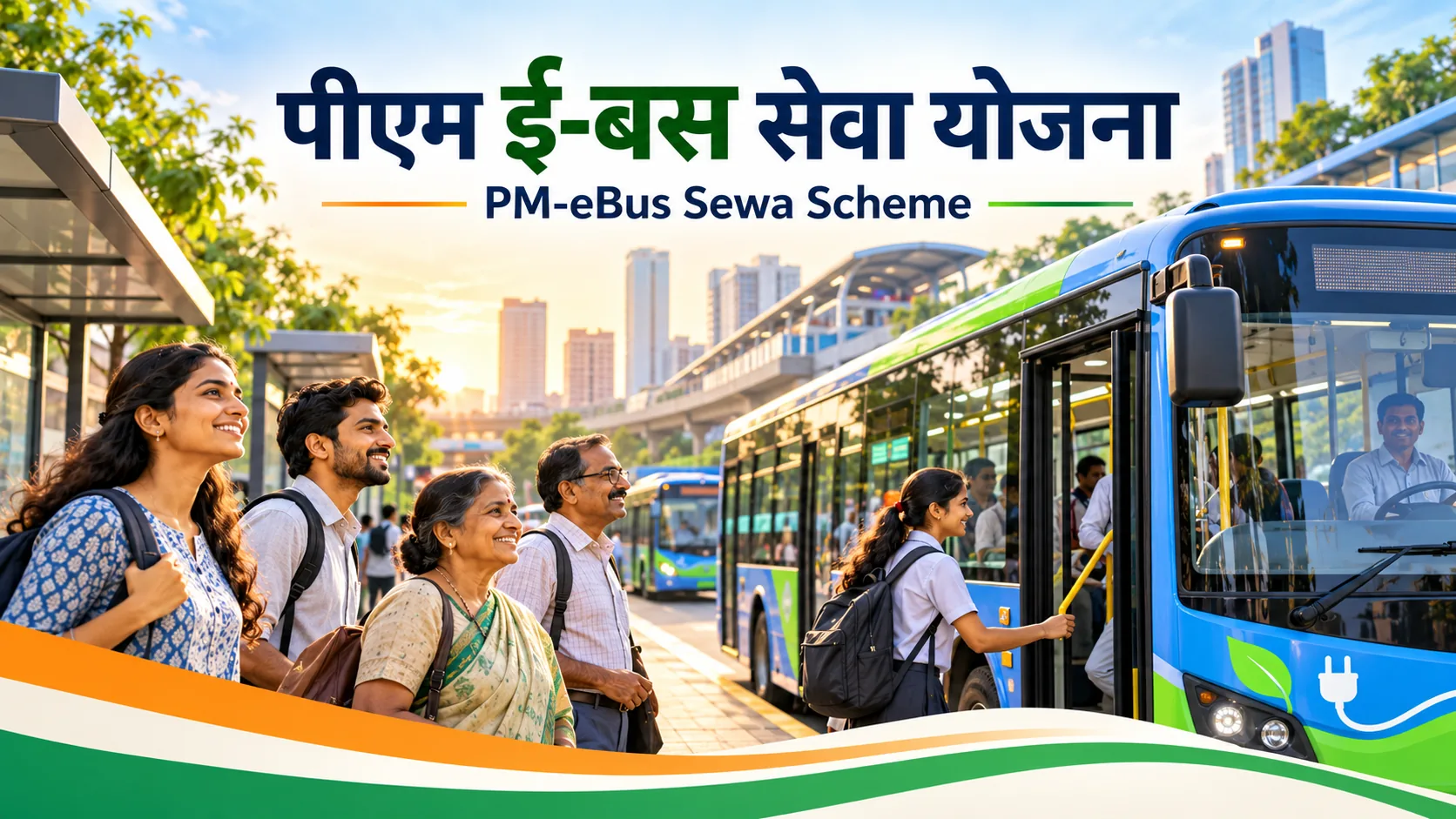
What Is the PM-eBus Sewa Scheme?
The PM-eBus Sewa Scheme is a Government of India initiative designed to improve public bus transport in cities through the deployment of electric buses. Approved by the Union Cabinet in August 2023, the programme aims to support the operation of 10,000 electric buses under a Public Private Partnership (PPP) model. It also provides support for bus depots, electricity infrastructure and improvements that can make urban transport cleaner, more reliable and easier to use.
The scheme is implemented by the Ministry of Housing and Urban Affairs (MoHUA). Its focus is primarily on cities where organised bus services are limited or where introducing electric buses can significantly improve public transport availability.
Unlike many government welfare schemes, PM-eBus Sewa does not provide a direct cash payment to individual citizens. There is no general application form through which a person can claim a free electric vehicle or a personal subsidy under this programme. Instead, Central assistance supports eligible cities and their designated public transport authorities in establishing and operating electric bus services.
For residents, the practical benefit is access to improved public transport once buses are deployed and routes become operational in their city. For participating authorities, the scheme provides a framework for securing buses, developing necessary infrastructure and managing transport operations.
PM-eBus Sewa Scheme: Key Details
| Particular | Details |
|---|---|
| Scheme name | PM-eBus Sewa Scheme |
| Responsible ministry | Ministry of Housing and Urban Affairs |
| Cabinet approval | 16 August 2023 |
| Approved electric bus target | 10,000 buses |
| Estimated programme cost | ₹57,613 crore |
| Announced Central Government support | ₹20,000 crore |
| Implementation model | Public Private Partnership for bus operations |
| Operational assistance | Up to 10 years, subject to scheme guidelines |
| Primary beneficiaries | Participating cities and their public transport users |
| Individual application | No general individual cash-benefit application |
| Official website | PM-eBus Sewa Government Portal |
The financial figures above refer to the approved programme framework, not an amount payable to an individual. Actual expenditure and the number of operational buses depend on implementation progress.
Objectives of the PM-eBus Sewa Scheme
Public buses are an essential part of urban mobility. However, bus availability, network coverage and service quality differ considerably between Indian cities. The PM-eBus Sewa Scheme seeks to address these gaps by supporting electric bus operations and the infrastructure required to keep those services running.
1. Improve Organised City Bus Services
A major objective is to expand organised public transport, particularly in cities where a structured city bus network is absent or insufficient. Better bus availability can give residents another option for commuting to workplaces, educational institutions, markets and other everyday destinations.
2. Encourage Cleaner Urban Transport
Electric buses do not produce exhaust emissions while operating on the road. Replacing or supplementing conventional buses with electric vehicles can help reduce local tailpipe pollution. The overall environmental effect also depends on electricity generation, vehicle production and actual usage, so it should not be described as automatically eliminating all transport emissions.
3. Develop Supporting Infrastructure
Buying buses alone is not enough to create a functioning electric transport system. Cities need suitable depots, electricity connections, charging arrangements and maintenance facilities. The scheme includes assistance for relevant depot and behind-the-meter power infrastructure.
4. Improve the Passenger Experience
The programme also considers wider urban mobility improvements. These may include accessible bus stops, technology-supported transport management, fare collection systems and connections between different transport services. The actual facilities available to passengers depend on local implementation.
How Does the PM-eBus Sewa Scheme Work?
The programme uses an institutional implementation model rather than enrolling individual households. Eligible cities participate through State Governments, urban authorities or designated implementing agencies. Electric bus operations are arranged through a PPP framework, with public authorities responsible for the necessary contractual and administrative arrangements.
Under the scheme guidelines, electric bus operations can be supported through a Gross Cost Contract model. In broad terms, an operator supplies and operates buses under a defined agreement, while the relevant authority manages responsibilities such as service planning, oversight and payment arrangements according to the contract.
Central assistance for operations is linked to bus kilometres and applicable programme conditions. This approach is intended to support service delivery rather than provide a one-time grant directly to passengers.
The Ministry's framework also separates electric bus operations from associated infrastructure and other green mobility measures. As a result, a city can be at different stages of implementation: bus allocation, contracting, depot construction, charging readiness, vehicle delivery or actual passenger operations.
Who Is Eligible Under PM-eBus Sewa?
Eligibility under PM-eBus Sewa primarily concerns cities and their public transport institutions, not the income or age of an individual citizen.
According to the official scheme framework, participating cities generally include cities with populations between 3 lakh and 40 lakh under the applicable Census 2011 criteria. Certain State capitals with populations below 3 lakh are also eligible. The guidelines and subsequent addendum provide for specified urban agglomerations and clusters of adjoining statutory towns that satisfy the relevant conditions.
Selection is not automatic simply because a city falls within the population range. Participating locations must meet the scheme requirements and complete the applicable approval and implementation process.
Which Cities Receive Priority?
The programme gives priority to cities without organised bus services. This is significant because electric buses can serve two purposes in such locations: introducing structured public transport and supporting a shift towards cleaner urban mobility.
A city that already operates buses may also participate when it meets the applicable criteria, but allocation and rollout remain subject to official decisions.
Indicative Bus Allocation by City Size
| Population category | Indicative bus allocation ceiling |
|---|---|
| 3–5 lakh population | 50 buses |
| 5–20 lakh population | 100 buses |
| 20–40 lakh population | 150 buses |
These are allocation categories stated in the scheme information, not guarantees that every qualifying city will receive the maximum number of buses. Relevant special provisions, selection decisions and subsequent approvals must also be considered.
Benefits of the PM-eBus Sewa Scheme
Benefits for Commuters
When electric bus services begin operating in a city, residents may gain access to new or expanded public transport routes. This can be particularly useful for people who rely on shared transport for regular journeys.
Modern electric buses can also offer a different travel experience from older conventional vehicles. However, accessibility facilities, air conditioning, journey frequency and ticketing arrangements should be verified for the buses actually introduced by the local operator.
PM-eBus Sewa does not automatically provide free tickets. Fares, concessions and passenger eligibility for discounted travel are matters to verify with the city or State transport authority.
Benefits for Cities
For participating cities, the programme supports the transition towards electric bus operations without requiring every element of the system to be developed independently. Central support for approved operations and associated infrastructure can help authorities plan a more comprehensive public transport network.
Depot improvements, charging readiness, transport technology and operational coordination can create the foundation for long-term service delivery. The outcome ultimately depends on local planning, maintenance, electricity availability and consistent operations.
Potential Employment and Economic Benefits
The Government's original approval announcement projected significant direct employment from electric bus deployment and operations. Such opportunities may involve driving, maintenance, depot operations, charging infrastructure, administration and supporting services.
These are programme-level projections, not guaranteed jobs for individual applicants. Anyone seeking transport-sector employment should use official recruitment announcements issued by the relevant operator, transport undertaking or authorised contractor.
PM-eBus Sewa Funding and Financial Assistance
The approved scheme has an estimated overall cost of ₹57,613 crore, with ₹20,000 crore announced as Central Government support. These amounts cover the wider programme framework and should not be confused with a personal subsidy available through an online application.
The official guidelines provide per-kilometre operational assistance for supported electric bus services. The government's FAQ lists the following assistance levels:
- 12-metre electric buses: ₹24 per kilometre.
- 9-metre electric buses: ₹22 per kilometre.
- 7-metre electric buses: ₹20 per kilometre.
These figures represent assistance under the operating framework and are subject to the applicable guidelines and contractual conditions. They are not bus fares, payments to passengers or amounts that a person can claim.
The programme also provides specified assistance for behind-the-meter electricity infrastructure and civil depot works. The level of support for depot-related infrastructure varies by the category of State or Union Territory.
Two Major Components of the Scheme
Segment A: City Bus Services and Infrastructure
Segment A focuses on increasing electric city bus operations and developing associated infrastructure. It covers the deployment of 10,000 electric buses under the PPP model, together with relevant depot and power infrastructure support.
Implementation requires coordination between transport authorities, operators, electricity utilities and other responsible agencies. Vehicle delivery alone does not mean public services have started.
Segment B: Green Urban Mobility Initiatives
Segment B supports complementary improvements that can make urban public transport more efficient and convenient. The programme framework identifies areas such as bus-priority infrastructure, suitable fare collection technology and other green mobility measures.
These initiatives are intended to complement electric bus operations. Their availability, project approval and completion status can vary between cities.
PM-eBus Sewa Implementation Status in 2026
The official PM-eBus Sewa dashboard provides a useful distinction between sanctioned buses and buses actually operating on city roads.
According to the dashboard status dated 13 October 2026, the programme reported:
- 10,000 buses under the reported sanction framework.
- 115 cities covered across 26 States and Union Territories.
- More than 1,050 electric buses deployed.
- 28 cities with operational services.
These are time-specific figures. The number of operational cities and deployed vehicles may increase as additional depots are completed, vehicles are delivered and service contracts become operational.
To check the latest progress, visit the official PM-eBus Sewa dashboard. Do not assume that every city listed under the programme already has passenger services available.
How Can Citizens Use PM-eBus Sewa Buses?
Citizens do not generally need to register on the Central scheme portal to become passengers. Once a city begins electric bus services, travel arrangements are handled through the relevant local transport system.
- Check whether the service is operational: Look for official announcements from your State or city transport authority.
- Find the applicable routes: Confirm the nearest bus stops, service routes, starting points and destinations.
- Check service timings: Use the local transport operator's timetable or passenger information channels.
- Verify the fare: Check the current ticket price and available payment methods before travelling.
- Ask about accessibility: If wheelchair access or other assistance is required, verify the facilities of the service operating on your route.
- Use official updates: Route changes, service interruptions and new launches should be checked with the transport operator.
Passengers should not rely on unofficial websites claiming to sell a special nationwide PM-eBus Sewa membership or guarantee free transport.
Can Individuals Apply for an Electric Bus Subsidy?
No general individual electric vehicle purchase subsidy is provided through PM-eBus Sewa. This is one of the most important distinctions for readers searching for the programme online.
If your actual interest is financial assistance for purchasing an eligible electric vehicle, you should research the separate PM E-DRIVE Electric Vehicle Incentives programme and check whether the relevant vehicle type and purchase meet its current rules.
PM-eBus Sewa is primarily about strengthening public bus transport, while vehicle demand incentives operate under a different policy framework. The two should not be treated as interchangeable.
For more information about government programmes related to transportation, visit our Transport and Mobility Assistance category.
How Do Cities Participate in the Scheme?
For a city authority, participation involves substantially more than submitting a personal-style application form. The process depends on government selection, formal proposals, operational planning and infrastructure readiness.
The responsible State or implementing agency must follow the applicable Ministry guidelines. Depending on the project stage, required activities may include city eligibility assessment, bus allocation requests, depot identification, electricity infrastructure planning, formal agreements, procurement arrangements and project reporting.
Relevant records can include approved project proposals, depot land details, electricity connection arrangements, concession documentation and other institutional approvals. The precise checklist is determined by the competent authorities and scheme documents.
These are administrative requirements for governments and their designated agencies. They should not be presented as documents that an ordinary bus passenger must upload.
Officials should consult the PM-eBus Sewa official guidelines and related amendments before preparing or reviewing proposals.
Common Misunderstandings About PM-eBus Sewa
Misunderstanding 1: Every citizen receives money. The scheme finances approved public transport operations and infrastructure. It is not a universal personal cash-transfer programme.
Misunderstanding 2: All eligible cities already have electric buses. Eligibility, approval, sanction, delivery and passenger operations are different stages. Check the current operational status.
Misunderstanding 3: Tickets are automatically free. Passenger fares and concessions are determined under applicable local transport arrangements. The scheme does not establish a universal free-ticket entitlement.
Misunderstanding 4: Electric vehicle buyers can apply directly. Personal vehicle incentive programmes are separate from PM-eBus Sewa.
Misunderstanding 5: A Central Government announcement gives the exact local route schedule. Routes and timetables must be confirmed with the operator responsible for the city's services.
Frequently Asked Questions About PM-eBus Sewa
1. What is the main purpose of PM-eBus Sewa?
Its principal purpose is to strengthen urban bus services by supporting the operation of 10,000 electric buses and associated infrastructure under an approved government framework.
2. Is PM-eBus Sewa a Central Government scheme?
Yes. It is a Government of India initiative under the Ministry of Housing and Urban Affairs, implemented with the participation of eligible cities, States and designated agencies.
3. Can I apply as an individual beneficiary?
There is no general individual cash-benefit application. Individual citizens primarily benefit by using the services introduced in participating cities.
4. Which cities are eligible?
The scheme generally covers cities in the specified 3–40 lakh population categories, eligible smaller State capitals and other locations permitted under the official guidelines and amendments. Final inclusion depends on selection and approval.
5. How many electric buses are planned?
The approved scheme target is 10,000 electric buses. The number deployed and in daily passenger service is lower than the target while implementation continues.
6. How do I find the PM-eBus Sewa cities list?
Visit the official programme portal and dashboard for sanctioned and operational city information. For city-specific routes, consult the local transport authority.
7. Is travelling on these buses free?
Not automatically. The actual fare and any eligible passenger concession depend on the applicable local transport rules.
8. Does PM-eBus Sewa provide an EV purchase subsidy?
No general individual vehicle purchase subsidy is provided through this programme. Personal electric vehicle incentives, where applicable, must be checked under separate schemes.
9. When will electric buses start in my city?
There is no single nationwide passenger-service launch date. Operations depend on city approvals, depot readiness, vehicle delivery and local service scheduling.
10. Where can I verify official information?
Use the Ministry's official PM-eBus Sewa website, its dashboard, published guidelines and your local transport authority's announcements.
Official PM-eBus Sewa Sources
- PM-eBus Sewa Official Government Portal
- Official Sanction and Deployment Dashboard
- Official PM-eBus Sewa Frequently Asked Questions
- PM-eBus Sewa Guidelines — Part I (PDF)
- Press Information Bureau — Original Cabinet Approval
Information review: October 2026. The implementation figures quoted above are expressly dated 13 October 2026. Always check the current official dashboard, guidelines and local transport announcements before relying on figures or service availability.
Disclaimer: eSarkariYojna is an independent informational website and is not affiliated with or operated by the Government of India. This article explains publicly available scheme information and does not provide government approval, ticket booking or guaranteed benefits.
Always check the official website for final and accurate information.
Visit official website: pm-ebus-sewa.mohua.gov.in ↗Last updated: 19 Oct 2026