Pradhan Mantri Anusuchit Jaati Abhyuday Yojana
Scheme encompassing development of SC-dominated villages and approved socio-economic and livelihood projects; not every component is direct individual cash support.
Eligibility: Distinguish Adarsh Gram and district or state project components; eligibility is determined by the implementing authority.
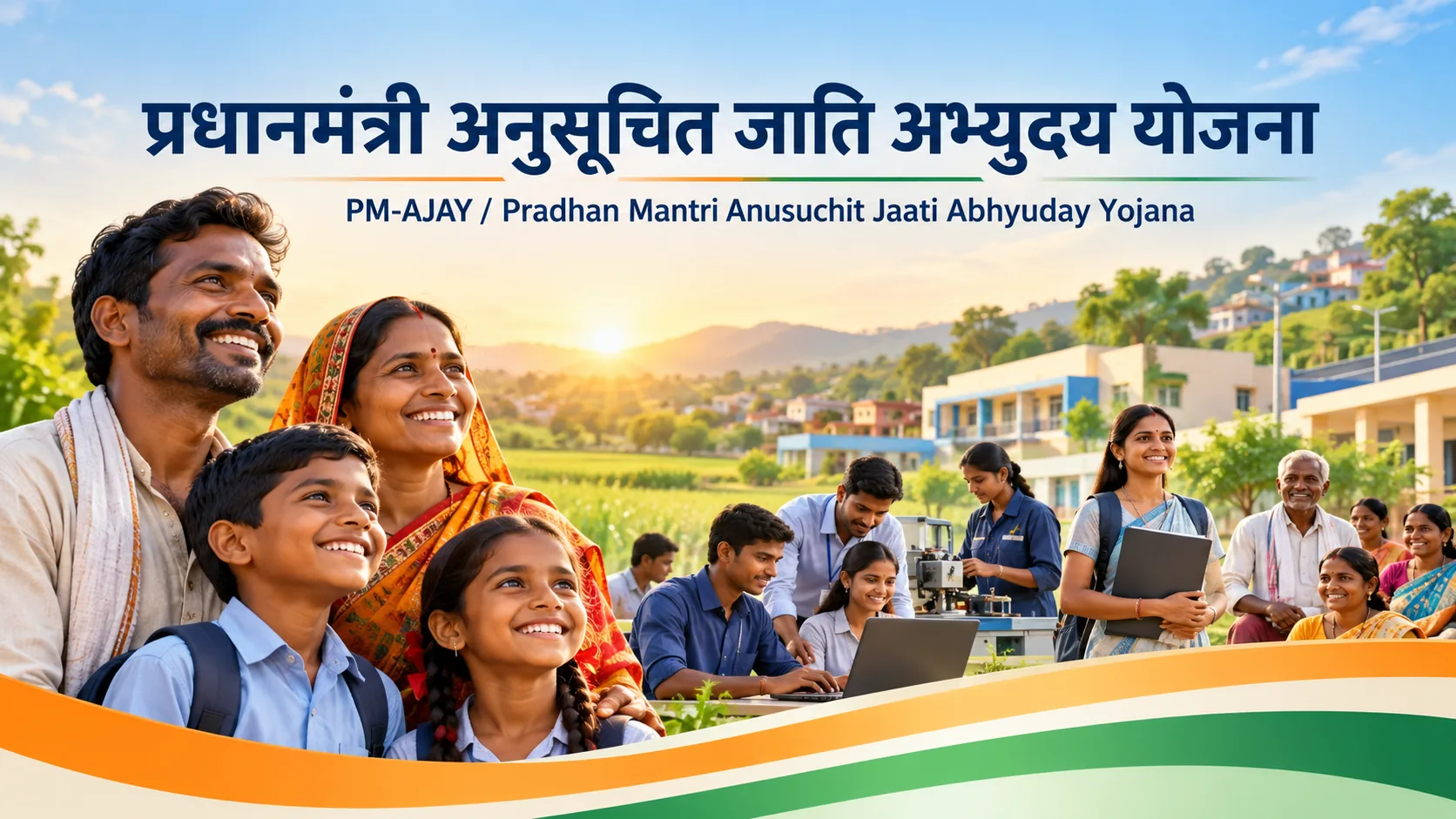
What Is Pradhan Mantri Anusuchit Jaati Abhyuday Yojana?
Pradhan Mantri Anusuchit Jaati Abhyuday Yojana (PM-AJAY) is a Government of India programme focused on improving the socioeconomic conditions of Scheduled Caste (SC) communities. Its main objectives are to create additional livelihood opportunities, improve essential infrastructure in SC-dominated villages and expand residential education facilities for SC students.
The scheme is administered by the Department of Social Justice and Empowerment under the Ministry of Social Justice and Empowerment. It operates through approved projects and development activities involving State Governments, Union Territory administrations, districts and eligible institutions.
PM-AJAY brings together three major areas of assistance. The first supports the integrated development of selected SC-dominated villages under the Adarsh Gram component. The second provides Grants-in-Aid for approved district- and State-level projects intended to improve economic opportunities and community infrastructure. The third supports the construction of hostels in eligible educational institutions.
This distinction matters because PM-AJAY is not a single application-based cash subsidy. A village development project may improve shared infrastructure, a livelihood project may support selected beneficiaries, and a hostel project may create residential accommodation for eligible students. These activities operate under different approval and eligibility arrangements.
Important: Being a member of a Scheduled Caste community does not automatically guarantee a particular cash payment, training place, employment opportunity or hostel seat under PM-AJAY. The applicable project and its eligibility rules must be checked separately.
PM-AJAY Scheme 2026: Key Details
| Particular | Information |
|---|---|
| Full scheme name | Pradhan Mantri Anusuchit Jaati Abhyuday Yojana |
| Abbreviation | PM-AJAY |
| Responsible ministry | Ministry of Social Justice and Empowerment |
| Administering department | Department of Social Justice and Empowerment |
| Primary focus | Socioeconomic development of Scheduled Caste communities |
| Component 1 | Development of selected SC-dominated villages as Adarsh Grams |
| Component 2 | Grants-in-Aid for approved district- and State-level development projects |
| Component 3 | Construction of hostels in eligible educational institutions |
| Types of support | Infrastructure, livelihood projects, skills and educational facilities |
| Universal individual cash benefit | No |
| Official portal | PM-AJAY Government Portal |
The scheme's benefits are delivered through approved activities rather than a single nationwide application process for every resident. Availability differs depending on village selection, State-level projects and participating educational institutions.
What Are the Objectives of PM-AJAY?
PM-AJAY addresses several factors that influence long-term socioeconomic development. Employment opportunities, village infrastructure and access to education can affect a person's ability to improve their living conditions.
The scheme therefore combines support for communities, livelihoods and educational infrastructure.
Creating Additional Livelihood Opportunities
One objective is to reduce poverty among SC communities by supporting activities that can improve earning capacity. These may include skills training, income-generating projects and other approved initiatives.
Individual participation depends on the relevant project. A livelihood activity may have its own selection criteria, training arrangements and funding conditions.
Improving Services in SC-Dominated Villages
The programme seeks to improve socioeconomic development indicators by addressing gaps in village infrastructure and essential services.
Rather than promising an identical package for every village, the Adarsh Gram component uses local planning and identified development needs.
Supporting Educational Access
Suitable residential facilities can make education more accessible for students who live far from quality schools and colleges.
PM-AJAY includes support for hostel construction in eligible institutions, particularly where accommodation can help SC students pursue education away from their home areas.
Strengthening Project Monitoring
The scheme also provides for implementation monitoring, digital information systems, evaluation and social audits.
These arrangements are intended to track project delivery and help authorities assess whether approved development work is being completed.
What Are the Three Main Components of PM-AJAY?
| Component | Main purpose | Level of assistance |
|---|---|---|
| Adarsh Gram | Integrated development of selected SC-dominated villages | Village-level projects |
| Grants-in-Aid | Socioeconomic development and livelihood improvement | Approved district- and State-level projects |
| Hostel construction | Improve access to residential educational facilities | Eligible schools and higher education institutions |
The same person may benefit indirectly from improved village infrastructure and separately participate in an eligible livelihood project, but those are different forms of assistance.
How Does the Adarsh Gram Component Work?
The Adarsh Gram component focuses on selected villages with a substantial Scheduled Caste population. Its purpose is to improve essential services and reduce development gaps through coordinated government action.
This component incorporates the earlier Pradhan Mantri Adarsh Gram Yojana framework within PM-AJAY.
Development needs can differ significantly between villages. One village may require improvements in sanitation or drinking water, while another may need better access to educational facilities or other public services.
Village selection and project planning are carried out under the applicable official guidelines. Individual residents do not independently approve a village for Adarsh Gram status simply by submitting a personal form.
What Is a Village Development Plan?
A Village Development Plan (VDP) identifies existing development gaps and proposed activities for a selected village.
The planning process considers the availability of essential services, opportunities for convergence with other government schemes and the infrastructure improvements needed to address identified gaps.
The official framework uses village-level development indicators to help determine priorities and track progress. This helps authorities focus on measurable improvements rather than treating the Adarsh Gram designation as a symbolic title.
What Does Adarsh Gram Status Mean?
A village declared an Adarsh Gram has reached the applicable development thresholds under the government framework. This does not mean that every resident has received an individual financial grant.
The distinction between a village being selected, development work being undertaken and the village being declared an Adarsh Gram is important when reading progress reports.
Selection indicates inclusion in the programme. Completion of development work reflects implementation progress. Declaration as an Adarsh Gram relates to the prescribed development indicators.
What Are Grants-in-Aid Projects Under PM-AJAY?
The Grants-in-Aid component provides support for approved projects at the district or State level that aim to improve the socioeconomic conditions of Scheduled Caste communities.
Official guidelines identify a range of possible activities, including infrastructure development, comprehensive livelihood projects, skills training and assistance linked to assets required for income generation.
Some projects may incorporate financial assistance towards loans taken by eligible beneficiaries for acquiring or creating livelihood-related assets.
However, this does not create a general right to receive a grant whenever an SC applicant takes a bank loan. Assistance must form part of an approved project and follow its eligibility, funding and implementation requirements.
Skills Development Activities
Skills development can help eligible participants acquire capabilities relevant to employment or self-employment.
A programme may be designed around local economic opportunities or the needs of a particular beneficiary group. Training availability, duration, location and selection criteria depend on the approved project.
Completion of training does not guarantee a government job. Applicants should ask the implementing agency about the actual outcomes and any follow-up assistance.
Support for Income-Generating Activities
Livelihood initiatives may involve support for activities intended to create additional income. These can require equipment, infrastructure, skills or other assets.
The approved project determines the nature of assistance. A beneficiary should confirm whether support is provided through training, an institutional project, eligible loan-linked assistance or another authorised arrangement.
Online claims promising a universal PM-AJAY cash grant or automatic business loan should be checked against the actual scheme guidelines.
Special Attention to SC Women
The government's original PM-AJAY guidelines contain provisions intended to encourage the participation of Scheduled Caste women in economic development activities.
These include earmarking a defined share of Grants-in-Aid resources for viable income-generating programmes for SC women and encouraging women's participation in skills initiatives.
The details applicable to a particular project should be checked in the current guidelines and the relevant State's approved proposal.
How Does the Hostel Construction Component Work?
The hostel component seeks to improve residential education facilities for Scheduled Caste students.
Students from rural or remote areas may need accommodation to attend educational institutions located outside their home district. Without suitable residential facilities, education-related expenses and travel can become major obstacles.
PM-AJAY addresses this issue by providing financial assistance for hostel construction through eligible institutions and implementing authorities.
According to the Ministry, the scheme can support hostels in higher educational institutions that meet the applicable National Institutional Ranking Framework (NIRF) and government-funding conditions.
It also includes provisions for school hostels that meet the relevant government-funding and Ministry of Education recommendation requirements.
Does Every SC Student Automatically Receive a Hostel Seat?
No. The approval of a hostel construction project and admission to a hostel are separate processes.
Government funding may enable an institution to build additional accommodation. Individual students must still follow the admission and eligibility rules established by the relevant institution.
Seat availability, academic enrolment and other applicable requirements may affect admission.
Hostel Facilities and Safety Standards
Government information issued in August 2026 describes provisions designed to improve quality, safety and accessibility in SC hostels.
These include arrangements for female wardens and security personnel in girls' hostels, along with appropriate educational, health and accessibility facilities.
The actual facilities at an institution should be confirmed directly with that institution rather than assumed from the national policy description.
Who Is Eligible Under PM-AJAY?
There is no single eligibility checklist that applies to every PM-AJAY component. Requirements differ depending on whether the subject is a village, an approved livelihood project, an educational institution or an individual beneficiary.
Eligibility Under Adarsh Gram
Selection concerns villages meeting the prescribed Scheduled Caste population and other applicable government criteria.
The selection process is carried out by the responsible government authorities. A personal caste certificate alone does not entitle an applicant's village to immediate selection.
Eligibility Under Grants-in-Aid Projects
Eligible SC individuals or groups may be covered through specific approved projects. Such projects can have their own income, training, occupation or other selection conditions.
Applicants should confirm the actual criteria for the project operating in their State or district.
Eligibility Under Hostel Projects
The government grant for hostel construction is provided through eligible institutions and authorities.
Students seeking accommodation must check the hostel's admission rules, available places and the institution's current procedures.
These differences make it misleading to present a single national personal application form as the route to every PM-AJAY benefit.
How to Apply for PM-AJAY Assistance
The first step is to identify which component is relevant to the enquiry.
For village development, information is generally connected with the responsible State or district authorities and the official programme's village-development records.
For individual livelihood participation, applicants should check whether an eligible project is currently operating in their district and whether applications or beneficiary selection are being undertaken.
For hostel accommodation, students should approach the institution concerned.
Practical Steps to Check Available Assistance
- Identify the component: Decide whether your enquiry concerns village development, livelihoods or student accommodation.
- Visit the official portal: Review information at pmajay.dosje.gov.in.
- Contact the relevant authority: For livelihood projects, consult the responsible State or district Scheduled Caste welfare department.
- Verify the project: Ask whether an approved project is operating in your area and whether beneficiary selection is open.
- Check the rules: Review the applicable eligibility and required documentation.
- Use the authorised process: Submit information only through the designated department or implementing agency.
- Keep a record: Retain any acknowledgement or reference number that is issued.
The availability of a government portal should not be interpreted as proof that a universal personal cash-benefit application is open.
What Documents May Be Required?
Document requirements depend on the assistance being sought.
A beneficiary applying for a livelihood project may be asked for a valid Scheduled Caste certificate and other information needed to establish eligibility under the approved project. Identity, residence, income or project-related records may also be relevant where the rules require them.
For loan-linked livelihood activities, the applicable project and financial institution may request additional information about the proposed activity and financing arrangement.
Students seeking hostel admission may need academic enrolment details, category documentation and records required by the institution.
By contrast, the Adarsh Gram component concerns village selection and development planning. It is not based on every resident submitting the same personal documents to receive a cash transfer.
Always obtain the exact checklist from the authorised agency instead of treating generic internet document lists as compulsory nationwide requirements.
What Is the PM-AJAY Portal and AJAY Mobile App?
On 26 May 2026, the Government launched the PM-AJAY Portal and AJAY Mobile App to strengthen the programme's digital implementation.
The official announcement described a transition from paper-based procedures towards end-to-end digital workflows and real-time monitoring.
The portal and mobile application were introduced to support the administration of the Adarsh Gram, Grants-in-Aid and hostel components, including project milestones and related financial processes.
This functionality is primarily connected with programme management and monitoring. It does not mean every visitor can install the application and receive an automatic personal subsidy.
PM-AJAY Scheme Progress in 2026
The Ministry of Social Justice and Empowerment has published several progress updates covering village development, livelihood projects and educational infrastructure.
According to the official release dated 16 October 2026:
- More than 47,200 villages had been covered under the Adarsh Gram component.
- 18,093 villages had been declared Adarsh Grams as of 8 September 2026.
- 46,944 development works had been completed.
- 27,032 Village Development Plans had been prepared.
- A total of 785 student hostels had been completed as of September 2026.
These are figures from a dated government report. They are not evidence that an individual project is available in every district or that a particular institution currently has vacant hostel places.
Educational Infrastructure Update
A separate government response dated 4 August 2026 reported that 90 hostels were sanctioned during FY 2021–22 to FY 2025–26, intended to benefit 10,649 SC students. The response stated that ₹198.50 crore had been released for hostel construction during that period.
That five-year sanction figure should not be added directly to the cumulative number of completed hostels from the October report. The reports measure different project stages and periods.
How Is Funding Distributed Under PM-AJAY?
The official scheme framework allocates resources among village development, district- and State-level projects, hostel construction and programme administration.
Under the published guidelines, up to 50% of the allocated funds may be used for gap-filling activities in selected Adarsh Gram villages, subject to actual requirements and programme provisions.
The administrative framework also includes funding for monitoring, evaluation, technical assistance and project implementation units.
Funds available for Grants-in-Aid projects are allocated through the applicable State and Union Territory framework, with criteria that consider Scheduled Caste population and relevant planning commitments.
These allocations represent government programme funding, not a personal amount divided equally between all SC residents.
What Is the Difference Between PM-AJAY and a Scholarship?
A student scholarship and PM-AJAY's hostel construction component both relate to education, but they provide different kinds of support.
A scholarship may provide financial assistance to an eligible student under a separate scheme. PM-AJAY hostel funding primarily supports the creation of residential facilities through approved educational institutions.
Building a hostel does not automatically establish a personal scholarship entitlement, and receiving a scholarship does not guarantee a hostel seat.
Similarly, a livelihood project under PM-AJAY should not be confused with a universal employment guarantee or an unrestricted business loan.
For related information, explore our Social Welfare Schemes and Employment and Livelihood Schemes categories.
Common Misunderstandings About PM-AJAY
Every SC household receives a fixed cash amount: PM-AJAY includes village development, approved projects and educational infrastructure. It does not create a universal household cash entitlement.
Adarsh Gram means every resident has been paid: The designation concerns development indicators and village-level improvements.
All SC students receive free hostel accommodation: Hostel admission depends on the relevant institution's eligibility and available capacity.
Every livelihood project guarantees employment: Skills and income-generating activities are intended to improve opportunities, not guarantee a particular job.
The government mobile app is an instant benefit-application tool: Its official purpose includes project administration and digital monitoring.
Frequently Asked Questions About PM-AJAY
1. What does PM-AJAY stand for?
PM-AJAY stands for Pradhan Mantri Anusuchit Jaati Abhyuday Yojana.
2. Which ministry administers PM-AJAY?
It is administered by the Department of Social Justice and Empowerment under the Ministry of Social Justice and Empowerment.
3. What are the three main components?
They are Adarsh Gram village development, Grants-in-Aid for approved district- and State-level projects, and hostel construction in eligible educational institutions.
4. Does PM-AJAY provide direct cash to every SC person?
No. Assistance depends on the relevant component and approved activity. It is not a universal personal cash-transfer scheme.
5. What is the Adarsh Gram component?
It supports the integrated development of selected SC-dominated villages by addressing gaps in infrastructure and essential services.
6. Can PM-AJAY support self-employment?
Approved livelihood projects may include income-generating activities, skills development and defined financial assistance. The exact conditions depend on the project.
7. Does PM-AJAY build hostels?
Yes. It includes assistance for constructing hostels in eligible schools and higher educational institutions for SC students.
8. Can a student apply directly for a PM-AJAY hostel construction grant?
The construction grant is an institutional project. Individual students should contact the relevant institution about hostel admission.
9. How can I check whether my village is included?
Review the official PM-AJAY portal and contact the responsible State or district department for selection and development information.
10. Is there a single online application for every component?
No. Village development, livelihoods and hostel projects have different implementation and eligibility processes.
11. What is the AJAY Mobile App used for?
Government information describes it as supporting digital implementation and monitoring of PM-AJAY activities.
12. Where can I find the official guidelines?
The Department of Social Justice and Empowerment publishes PM-AJAY guidelines on its official scheme page, with project information available through the PM-AJAY portal.
Official Government Sources
- Department of Social Justice and Empowerment — PM-AJAY Official Scheme Page
- PM-AJAY Government Portal
- Official PM-AJAY Guidelines, February 2022 (PDF)
- PIB — PM-AJAY Implementation Report, 16 October 2026
- PIB — SC Hostels and Educational Development, 4 August 2026
- PIB — Launch of the PM-AJAY Portal and Mobile App
Last reviewed: 19 October 2026. Eligibility requirements, approved projects, hostel admissions and funding conditions should be confirmed through the responsible government authorities. The progress figures quoted in this guide are dated official reports, not real-time availability information.
Disclaimer: eSarkariYojna is an independent informational website, not a Government of India department. This article explains publicly available scheme information and does not guarantee a cash benefit, loan, employment placement, hostel admission or project approval.
Always check the official website for final and accurate information.
Visit official website: socialjustice.gov.in ↗Last updated: 23 Oct 2026