SMILE Support for Marginalized Individuals
Institutional scheme supporting rehabilitation, healthcare, counselling, skills and livelihoods for identified marginalised groups, delivered through implementing agencies.
Eligibility: Access is often through district authorities and partner agencies; do not interpret the scheme as a universal cash allowance.
What Is the SMILE Scheme?
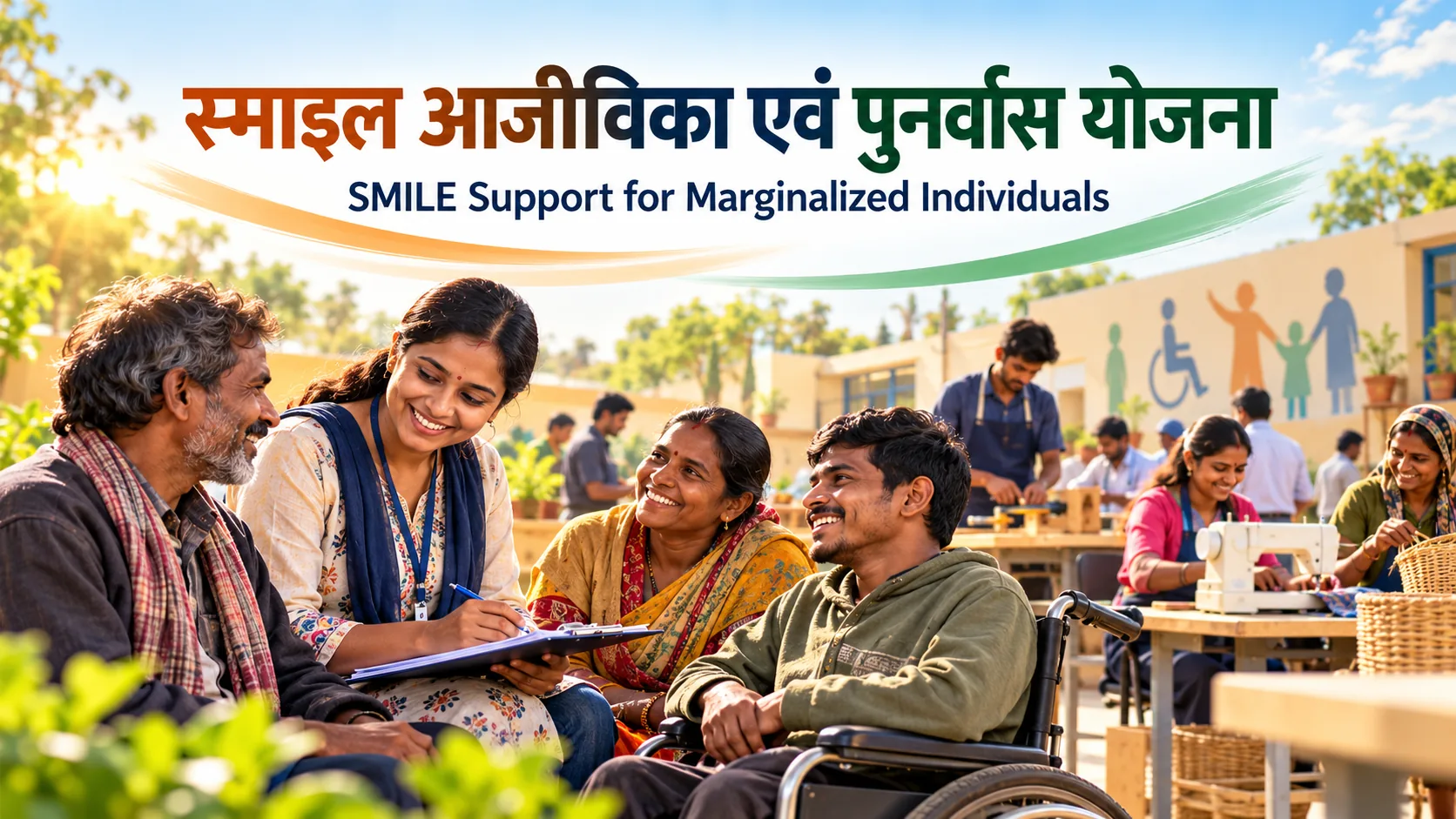
The SMILE Scheme is a Government of India programme designed to support the rehabilitation, welfare and socioeconomic inclusion of specific marginalised communities. SMILE stands for Support for Marginalized Individuals for Livelihood and Enterprise. It is an umbrella Central Sector Scheme administered by the Department of Social Justice and Empowerment under the Ministry of Social Justice and Empowerment.
The programme focuses on people who may need coordinated support to access healthcare, safe accommodation, counselling, education, skills training and sustainable livelihood opportunities. Rather than offering the same financial payment to everyone, SMILE works through separate rehabilitation programmes and designated implementing agencies.
There are two principal components. One supports the comprehensive rehabilitation and welfare of transgender persons. The other focuses on the rehabilitation of persons engaged in begging. Each component addresses different circumstances, so eligibility, available assistance and the process for accessing services are not identical.
The Ministry works with State and Union Territory administrations, district authorities, urban local bodies, community-based organisations and other authorised agencies to deliver relevant services.
Important: SMILE is not a universal monthly cash allowance, guaranteed employment programme or open loan subsidy for every Indian resident. An individual's access to services depends on the appropriate component, the applicable guidelines, assessment requirements and actual implementation in their area.
SMILE Scheme 2026: Key Information
| Particular | Details |
|---|---|
| Full name | Support for Marginalized Individuals for Livelihood and Enterprise |
| Abbreviation | SMILE |
| Responsible ministry | Ministry of Social Justice and Empowerment |
| Department | Department of Social Justice and Empowerment |
| Programme type | Umbrella Central Sector Scheme |
| Original guidelines | 12 February 2022 |
| Begging rehabilitation implementation | Commenced on 23 October 2023 |
| Main beneficiary groups | Eligible transgender persons and persons engaged in begging |
| Principal support | Rehabilitation, shelter, healthcare, counselling, education and livelihood-related services |
| Implementing partners | Government authorities, urban local bodies and authorised organisations |
| Universal individual cash payment | No |
| Official scheme website | Department of Social Justice and Empowerment |
The dates above relate to different stages of the programme. Revised guidelines and future administrative decisions can change how individual components operate. Always consult the current official documents for the particular service being considered.
What Are the Main Objectives of the SMILE Scheme?
Marginalisation can create several interconnected challenges. A person without secure accommodation may also struggle to access healthcare, identity documents, education or employment opportunities. A short-term payment alone may not resolve those difficulties.
SMILE takes a broader rehabilitation approach. Its purpose is to connect eligible people with services that address immediate needs while supporting longer-term independence and participation in society.
1. Promoting Social Inclusion
The programme aims to help people facing exclusion access welfare services and opportunities with dignity. This may involve cooperation between public authorities, local institutions and organisations that already work with the relevant communities.
2. Improving Access to Healthcare
Some beneficiaries may require medical attention, health assessments or support in accessing appropriate public healthcare services. The programme's rehabilitation approach includes healthcare-related interventions, depending on the component and individual circumstances.
3. Providing Counselling and Support
Counselling can be valuable when individuals face housing insecurity, family separation, discrimination or other difficult life situations. Support may involve understanding personal needs and identifying realistic options for rehabilitation.
4. Building Skills and Livelihood Opportunities
Training can help eligible individuals develop skills useful for employment or self-employment. However, completing a training activity does not guarantee that a person will receive a particular job, wage or business loan.
5. Supporting Sustainable Rehabilitation
The programme seeks to move beyond immediate assistance. Longer-term support may include links to appropriate welfare schemes, education, skills, livelihood opportunities and community-based services.
What Are the Two Components of SMILE?
Understanding the two components is essential because many online descriptions combine them into a single eligibility checklist. Their goals are related, but the services and procedures differ.
Component 1: Comprehensive Rehabilitation for the Welfare of Transgender Persons
This component supports the welfare and empowerment of eligible transgender persons through initiatives related to education, health, accommodation, skills, livelihoods and access to government services.
Government measures associated with this framework include Garima Greh shelters, the National Portal for Transgender Persons, skill development and employment-related initiatives, and mechanisms intended to protect rights and improve access to welfare.
Not every service requires the same procedure. Obtaining a transgender identity certificate, enquiring about accommodation and participating in a training programme are different activities, each governed by its applicable requirements.
Component 2: Comprehensive Rehabilitation of Persons Engaged in Begging
The second component focuses on identifying and supporting persons engaged in begging through a structured rehabilitation process.
Its objective is not simply to move people away from public spaces. Official guidelines identify welfare measures including medical assistance, counselling, education, skills development and support for sustainable rehabilitation.
Implementation involves district authorities, local governments and designated partner organisations. The services available to an individual depend on local implementation, assessment and the person's circumstances.
How Does Rehabilitation of Persons Engaged in Begging Work?
Government guidelines describe a coordinated rehabilitation approach rather than a general online application that automatically produces financial assistance.
The process can involve several stages, with the exact sequence and available services depending on the implementing authority.
Stage 1: Survey and Identification
Local authorities and implementing agencies may conduct surveys to identify persons engaged in begging in selected locations. This helps them understand the scale of the issue and identify people who may require support.
Information collected can assist with planning rehabilitation services. Identification during a survey does not itself establish that every type of benefit has been approved.
Stage 2: Outreach and Mobilisation
After identifying potential beneficiaries, authorised agencies may provide information about available rehabilitation arrangements and engage with individuals to understand their needs.
Effective outreach requires respectful communication and consideration of the person's circumstances. Medical, social and livelihood-related needs may differ significantly from one individual to another.
Stage 3: Shelter and Basic Support
Where appropriate and available, rehabilitation arrangements may include shelter and essential services. These can help address immediate concerns related to safety, hygiene, food and access to necessary assistance.
The type and availability of accommodation depend on the relevant programme facilities and local capacity.
Stage 4: Counselling, Education and Healthcare
Beneficiaries may be connected with appropriate counselling, educational support and medical services. These interventions can help address challenges that would otherwise make longer-term rehabilitation difficult.
The exact care provided depends on the person's requirements and the services available through authorised institutions.
Stage 5: Skills Development and Livelihood Linkages
Rehabilitation can also involve access to skills training or opportunities for livelihood development. Authorities may coordinate with other government programmes and relevant organisations to identify suitable options.
These arrangements are intended to support independence where possible, but they should not be presented as guaranteed placement in a job or automatic approval of a business grant.
Who Is Eligible for SMILE Scheme Benefits?
Eligibility depends on the sub-scheme. SMILE is not a general welfare programme that applies to every person simply because they are unemployed or have a low income.
| Component or service | Relevant beneficiary group |
|---|---|
| Transgender welfare and rehabilitation | Eligible transgender persons under the relevant programme rules |
| Rehabilitation of persons engaged in begging | Persons identified and assessed through the relevant rehabilitation process |
| Garima Greh shelter services | Eligible transgender persons requiring the applicable shelter and rehabilitation support |
| Skills and livelihood activities | Beneficiaries who meet the requirements of the relevant component and training arrangement |
For the begging-rehabilitation component, involvement in an authorised survey or outreach programme may be part of the process. For transgender welfare services, the applicable procedure may involve identity-related records or other service-specific requirements.
Neither component should be described using a generic checklist of income limits, bank balance or educational qualifications unless the official rules for that specific service require them.
What Is Garima Greh Under the SMILE Scheme?
Garima Greh refers to shelter and rehabilitation facilities established for eligible transgender persons under the government welfare framework.
These facilities are designed to provide a safer living environment and connect residents with relevant support. Depending on the authorised organisation and facility arrangements, services may include accommodation, meals, counselling, healthcare assistance and skills development.
A Garima Greh should not be treated as an unrestricted hotel or accommodation service open to anyone. Admission depends on the relevant eligibility and operational procedures, together with available capacity.
Government information published on 25 March 2026 reported 20 operational Garima Grehs across 16 States and Union Territories, with three additional shelters sanctioned during the 2025–26 financial year.
The numbers represent the position reported at that time. They should not be used as proof that accommodation is available today in a particular city.
How Do Transgender Identity Certificates Relate to SMILE?
The Government operates the National Portal for Transgender Persons to facilitate applications for identity certificates under the relevant legal framework.
Identity documentation can be important for accessing services, establishing records and participating in applicable welfare arrangements.
However, obtaining an identity certificate is not the same as receiving automatic approval for a Garima Greh place, livelihood training or another SMILE benefit.
Individuals should consult the appropriate official portal and service-specific guidelines before submitting an application or sharing identification information.
Further government information is available through the Department's transgender welfare information page.
What Healthcare and Counselling Services Are Available?
The SMILE framework recognises that rehabilitation may involve medical needs and psychosocial support alongside education and livelihoods.
For eligible persons engaged in begging, implementing agencies may help connect individuals with medical services as part of the rehabilitation process.
For eligible transgender persons, government welfare initiatives also address access to healthcare and related support systems.
Specific services should be confirmed with the authorised facility or relevant department. SMILE should not be advertised as guaranteeing every medical procedure, treatment or hospital payment to every applicant.
When someone requires urgent medical attention, appropriate emergency healthcare should be sought without waiting for a routine scheme assessment.
Does SMILE Provide Employment or Business Loans?
SMILE's full name refers to livelihood and enterprise, which can lead to confusion about direct loans and guaranteed jobs.
The programme includes skills development and livelihood-related interventions, but these are part of broader rehabilitation arrangements.
There is no basis for claiming that every eligible person automatically receives a fixed business loan, immediate employment or a monthly salary.
Some beneficiaries may be connected with appropriate training institutions, employers or other government programmes. Their actual opportunities depend on the relevant programme and their individual circumstances.
Readers interested in separate employment and skills programmes can explore our Employment and Skill Development Schemes category.
How to Apply for the SMILE Scheme
There is no single application procedure covering every SMILE service. The appropriate route depends on the component and the kind of assistance required.
For the rehabilitation of persons engaged in begging, implementation is often organised through district authorities, urban local bodies and designated partner agencies. Survey, outreach and assessment can form part of the process.
For transgender welfare programmes, some services are connected with dedicated portals and authorised institutions. The procedure for identity certification is different from the process for obtaining shelter or livelihood support.
General Steps to Seek Assistance
- Identify the relevant component: Determine whether the enquiry concerns transgender welfare or the rehabilitation of persons engaged in begging.
- Check the government guidelines: Review the applicable service details and eligibility rules.
- Find the implementing authority: Contact the relevant district administration, social welfare department or authorised agency.
- Ask about local availability: Confirm whether the particular service is operating in the area.
- Explain the assistance required: Provide accurate information needed for an appropriate assessment.
- Follow the prescribed procedure: Complete any authorised registration, identification or rehabilitation steps.
- Retain official records: Keep acknowledgements or contact details supplied by the responsible institution.
These steps describe how to make an enquiry and seek official guidance; they do not establish a uniform online application or guarantee approval.
What Documents Are Required for SMILE?
A single compulsory document checklist cannot accurately describe every service under the SMILE umbrella programme.
Depending on the service and individual circumstances, officials may request available information concerning identity, age, contact details, health needs or the relevant rehabilitation assessment.
Transgender welfare services may involve the applicable identity certification process, while the rehabilitation of persons engaged in begging may include helping people access identity records and other public services.
It would therefore be misleading to list Aadhaar, bank statements, income certificates and residence proofs as compulsory documents for every potential SMILE beneficiary.
Ask the authorised implementing authority for the precise requirements of the service being considered. Avoid uploading sensitive information to unofficial websites that claim to provide instant registration.
Does the SMILE Scheme Provide Direct Cash Assistance?
SMILE is primarily a comprehensive rehabilitation and welfare programme. Financial resources are used within the approved implementation framework to support authorised activities and service providers.
Some livelihood-related interventions may support economic empowerment, but they should not be described as a standard cash allowance for every person covered by the scheme.
Anyone advertising a fixed monthly benefit, guaranteed employment or an automatically approved business loan in the name of SMILE should be asked to provide the exact official notification supporting that claim.
Beneficiaries should rely on authorised government departments and implementing agencies for information about the actual assistance available.
SMILE Scheme Progress in 2026
Official government releases provide useful information about the programme's implementation. These figures should be presented with their reporting dates so that readers do not mistake them for real-time results.
On 17 August 2026, the Ministry of Social Justice and Empowerment reported the following progress under the rehabilitation component for persons engaged in begging:
- 42,589 persons identified or surveyed under the initiative.
- 12,710 persons rehabilitated according to the programme report.
- Rehabilitation interventions involving healthcare, counselling, education and skills development.
The same government release described transgender welfare measures, including three National Transgender Employment Melas benefiting 223 transgender persons.
It also reported that Transgender Protection Cells had been established in 27 States and Union Territories and that 30 Transgender Welfare Boards had been set up.
The Ministry stated that an independent third-party evaluation was conducted during September–October 2025 by the National Institute of Rural Development and Panchayati Raj, Hyderabad. Recommendations from that exercise were considered in the revised guidelines for the 2026–27 to 2030–31 Finance Commission cycle.
These are policy and implementation updates. They do not establish that any particular shelter currently has vacant places or that every person approaching an agency will receive the same service.
Is SMILE Available in Every City?
SMILE is a national government programme, but there is an important distinction between nationwide policy coverage and the operation of particular rehabilitation projects.
The begging-rehabilitation component has been implemented in phases through selected locations and designated authorities. Some cities may have operational shelters or active outreach programmes, while others may be at an earlier stage of implementation.
Government material published in 2026 described different levels of readiness across participating cities, including locations with fully operational facilities and locations conducting preliminary activities.
Before referring someone to a particular programme, contact the district administration or authorised social welfare office to confirm the current local arrangements.
How Is SMILE Different From Other Welfare Schemes?
Some government programmes provide pensions, scholarships, direct payments or specific employment-related incentives. SMILE has a different central purpose: coordinated rehabilitation and social inclusion for its defined beneficiary groups.
Another programme may support children in need of care and protection, while a skills programme may target eligible unemployed applicants. Those categories should not automatically be treated as interchangeable with SMILE's eligibility requirements.
Explore our Social Welfare Schemes section for related initiatives and their separate objectives.
Important Precautions Before Seeking SMILE Assistance
- Use official government websites and authorised implementing agencies.
- Do not assume transgender welfare and begging rehabilitation follow the same application procedure.
- Do not pay unauthorised intermediaries for promised approval, shelter access or employment.
- Confirm that a local rehabilitation centre is operating before travelling there.
- Protect sensitive personal and identity-related information.
- Check the latest guidelines instead of relying only on older programme announcements.
- Do not treat historical rehabilitation totals as evidence of current individual eligibility.
Frequently Asked Questions About the SMILE Scheme
1. What does SMILE stand for?
SMILE stands for Support for Marginalized Individuals for Livelihood and Enterprise. It is a Government of India umbrella programme for defined rehabilitation and welfare initiatives.
2. Which ministry administers SMILE?
The programme is administered by the Department of Social Justice and Empowerment under the Ministry of Social Justice and Empowerment.
3. Who are the main beneficiary groups?
The two principal components concern eligible transgender persons and persons engaged in begging who are covered by the respective rehabilitation arrangements.
4. Does SMILE provide a guaranteed monthly cash allowance?
No. The programme is primarily service-based and does not establish a universal fixed monthly payment for every individual.
5. What is Garima Greh?
Garima Greh refers to shelter and rehabilitation arrangements for eligible transgender persons under the applicable government programme.
6. Can beneficiaries receive skills training?
Skills development and livelihood linkages are among the programme's interventions. Availability and participation depend on the relevant component and implementing arrangements.
7. How can someone access begging-rehabilitation services?
The relevant district administration, urban local body or authorised implementing agency can explain local survey, outreach and rehabilitation processes.
8. Is SMILE available throughout India?
It is a national programme, but specific projects, shelters and services operate according to phased implementation and local availability.
9. Where can transgender identity certification information be found?
Consult the Government's National Portal for Transgender Persons and the Department of Social Justice and Empowerment for the applicable process.
10. Is there one online application form for all SMILE services?
No. Application or referral procedures depend on the relevant sub-scheme and type of assistance.
11. Does SMILE guarantee a government job?
No. Employment-related events and skills initiatives may support opportunities but do not guarantee placement or a particular salary.
12. Where can the latest government guidelines be checked?
The Department of Social Justice and Empowerment publishes the programme's official guidelines and revisions on its SMILE scheme page.
Official Government Sources
- Department of Social Justice and Empowerment — Official SMILE Scheme Page
- Revised Guidelines for Rehabilitation of Persons Engaged in Begging (PDF)
- Department of Social Justice and Empowerment — Transgender Welfare
- Press Information Bureau — SMILE Progress Report, 17 August 2026
- Press Information Bureau — Garima Greh Operational Status, March 2026
Last reviewed: 19 October 2026. Implementation status, individual eligibility, shelter availability and rehabilitation procedures should be checked with the responsible government department or authorised local agency.
Disclaimer: eSarkariYojna is an independent informational website, not a government department, authorised rehabilitation centre or scheme-approval agency. This guide explains publicly available programme information and does not guarantee financial assistance, accommodation, employment or approval.
Always check the official website for final and accurate information.
Visit official website: www.pib.gov.in ↗Last updated: 19 Oct 2026