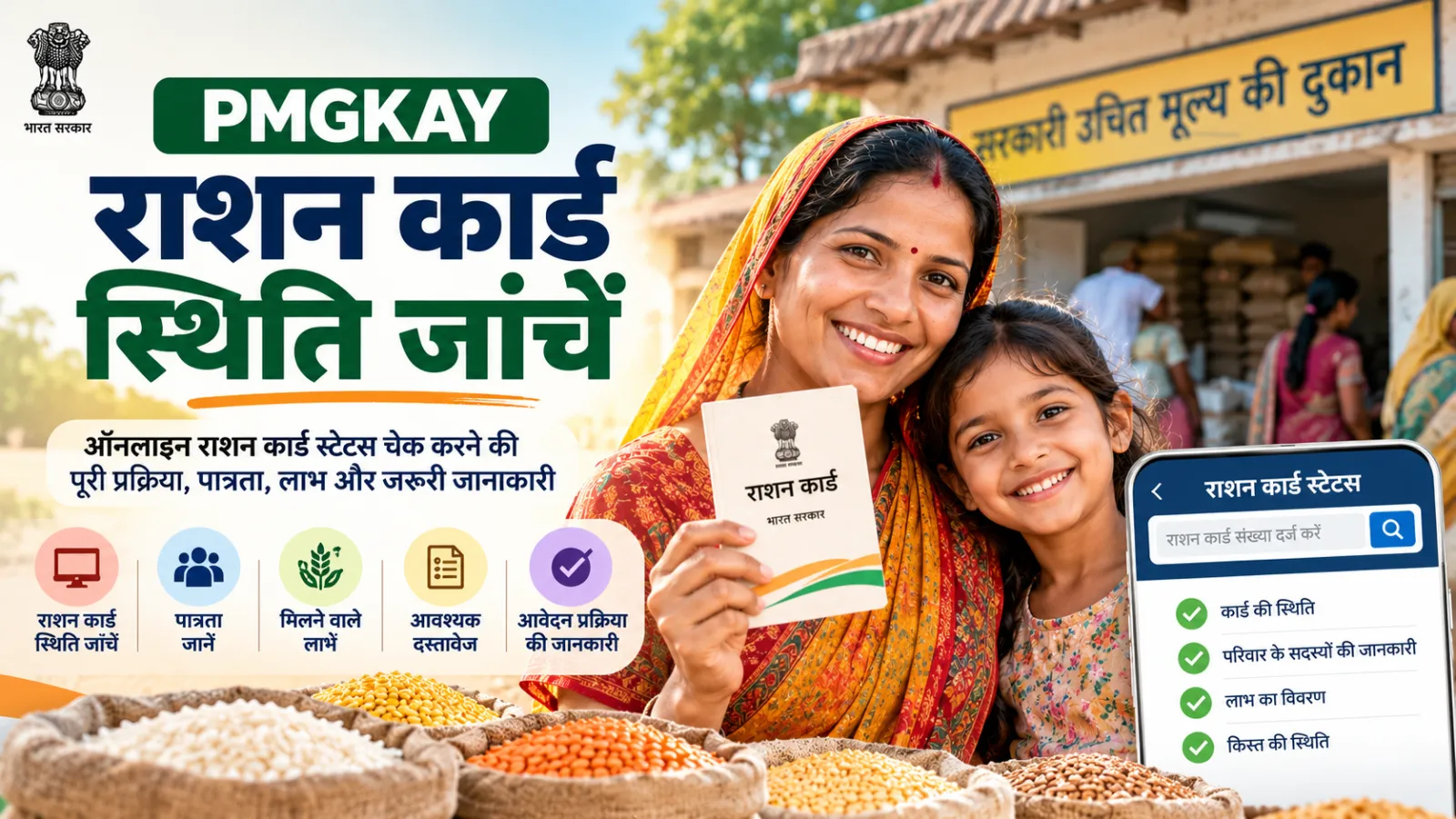
PMGKAY Ration Card Status 2026: NFSA Lists, Entitlement and Troubleshooting
Check PMGKAY 2026 ration eligibility, NFSA state lists, AAY and PHH monthly quantities, ePoS transactions and missing foodgrains.
PMGKAY Ration Card Status 2026: NFSA Lists, Entitlement and Troubleshooting is a decision guide written for readers who need more than the basic advertised promise. The practical questions are whether a person falls within the official rules, which institution administers the next step and what evidence confirms delivery of the relevant support. Insurance coverage, housing assistance, LPG services and foodgrain entitlements operate through different institutions and should never be treated as interchangeable cash grants.
Each section focuses on a particular eligibility or administration issue and suggests how to verify the underlying record without exposing confidential information to an intermediary. An online acknowledgement, a bank transaction and a competent authority’s approval can carry different meanings. Consult the linked official government sources for live procedures, local notices and case-specific decisions before making financial commitments.
PMGKAY works through NFSA beneficiaries
PMGKAY provides free grain to identified NFSA beneficiaries rather than an independent universal card for every resident. The household classification under the issuing state is the starting point. Do not pay anyone promising a newly invented central PMGKAY card.
For pmgkay works through nfsa beneficiaries, the state food department must supply the case-specific record. The first operational decision is which authority actually administers the rule. A national announcement and the instructions used by a bank, municipality or distributor may not be identical documents. Check their dates, scope and relationship to the applicant’s records. A procedure shown in a video from another state may not fit the current local process. Matching the relevant guidance to the correct authority reduces avoidable errors. For a first-time applicant, the strongest starting point is a correct scheme definition and the identity of the authorised office, not a viral promise of fast approval.
Five-year free-foodgrain decision
The central government committed to free NFSA foodgrains for five years beginning 1 January 2024. This does not turn the grain entitlement into a universal cash allowance. The scheme horizon should not be mistaken for the opening hours of a particular ration shop.
For five-year free-foodgrain decision, the state food department must supply the case-specific record. Consider a household that has an old acknowledgement but no current status record. Its strongest next move may be to recover the earlier reference and understand why the displayed information changed, rather than submit a new form immediately. Duplicate applications can create conflicting histories. The date of the original request, changes in household records and the responsible processing office form a more useful investigation than a broad claim that the portal has failed. A screenshot from a previous cycle might be genuine but outdated; the current government record should control the next step.
AAY household entitlement
An eligible AAY household receives a national entitlement of 35 kilograms per household per month, which differs from PHH’s person-based calculation. Confirm the category before comparing your grain quantity with another household.
For aay household entitlement, the state food department must supply the case-specific record. Eligibility and administrative completion are different questions. Someone can satisfy the basic published conditions yet still await a document review, an institutional decision or a service event. Conversely, a submitted application does not prove that every requirement was satisfied. Ask what stage is complete, what remains open and who must act next. This distinction prevents both false promises of approval and premature declarations of rejection. When one family member handles the phone for another, the intended beneficiary must still review and control the actual application.
PHH is counted per eligible person
The NFSA PHH entitlement is five kilograms per listed eligible person per month. Registered member counts, not informal estimates of household size, influence the expected allocation. Use the official member list to identify why the system shows a different quantity.
For phh is counted per eligible person, the state food department must supply the case-specific record. A neighbour’s result can reveal that a scheme is operating in the area, but it cannot establish another person’s right to the same outcome. Household composition, dates, past benefits and selected scheme pathways may differ. Compare only the facts relevant to the rule. If one detail appears inconsistent, prepare the supporting evidence and seek a case-specific explanation through an authorised channel rather than trying to copy someone else’s form. Two households with similar income can have different histories or family records, so their documentary questions may not be identical.
Card colours are state-specific
State colour codes and card names are not interchangeable nationwide. The verified AAY or PHH classification in the issuing state is more meaningful than a photograph of a particular card colour. Do not apply a ration classification from a different state to your family.
For card colours are state-specific, the state food department must supply the case-specific record. Headline benefits need to be interpreted in terms of amount, unit, period and mechanism. A foodgrain entitlement is not a cash transfer; a bank loan adjustment is not a free home; an insurance promise is not a deposit account. Ask what the scheme actually delivers and what event triggers that delivery. A small table separating eligibility, approval and benefit type can prevent expensive household decisions based on an impressive but misunderstood advertised number. A maximum advertised benefit should not be used as the basis for immediate spending without an actual sanction or eligibility confirmation.
Find the correct state ration portal
The official central directory links to state and UT beneficiary systems. A single national step-by-step screen will not match every state because the state governments maintain the underlying records. Use the official state link instead of searching for a commercial “PM राशन चेक” website.
For find the correct state ration portal, the state food department must supply the case-specific record. People who need assistance with online forms can prepare a short written checklist before visiting a recognised service point. Include the correct reference, verified identity details and the precise unresolved question. A legitimate helper does not need control of banking passwords or private account PINs. Keep the applicant involved in reviewing what is submitted. Understanding the boundary between assistance and credential sharing is a basic protection against avoidable fraud. Administrative offices can use different local names; identifying the legally responsible authority avoids repeated visits to unrelated counters.
District, village and FPS searches
State ration systems may support filters for district, village, fair-price shop and household identifiers. A failed search is not always a final finding of ineligibility. Check the selected geography and identifier before creating a complaint about a missing household.
For district, village and fps searches, the state food department must supply the case-specific record. A status screenshot is a dated record, not a permanent verdict. Save the exact message and its context, but redact complete identity and financial details before discussing an issue publicly. An official complaint generally needs a reference and concise statement of the problem, not a social-media post exposing every document. Keep sensitive scans within the authorised process. This approach preserves useful evidence while reducing the risk of identity theft or unsolicited contact. A changed phone number can make an online acknowledgement harder to retrieve, which is why a private reference record is useful.
Member omissions affect quantity
A household may have an active ration card but an incorrect number of eligible members. That is a member-record issue, not necessarily a dealer delivering less than the sanctioned amount. Ask the responsible food department how to amend the family roster with evidence.
For member omissions affect quantity, the state food department must supply the case-specific record. Administrative rules sometimes recognise special circumstances, but such exceptions require legitimate evidence and approval. A person should not force an inaccurate declaration into a form merely because one document is outdated. Explain the true facts, identify what official correction is allowed and ask which alternative proof, if any, is accepted. A cautious filing may appear slower, but it is safer than building a long-term claim on information that cannot be verified. A discrepancy in identity spelling should be corrected through the genuine issuer, not by privately altering a scan to resemble an official certificate.
Newborn or family addition
A household change may require a formal member-addition request and verification. Expecting an extra PHH allocation before the state record is updated can cause confusion. Keep the receipt for the change request and recheck the eligible list after approval.
For newborn or family addition, the state food department must supply the case-specific record. When household details or banking arrangements change, the related government records may not update at the same time. Identify the specific database that requires a correction and preserve evidence of the change. Altering a correct record to make it resemble a different outdated system can introduce a second problem. After an authorised update, keep the receipt and compare the new status with the earlier entry to establish whether the original issue has actually been resolved. After a move, the appropriate service-transfer route may preserve the existing record more effectively than creating a duplicate identity.
The ePoS transaction record
An electronic point-of-sale record improves transparency but the delivery of physical grain still needs to match the recorded amount. Compare the ePoS receipt with what was actually weighed and handed over.
For the epos transaction record, the state food department must supply the case-specific record. A simple three-column review often clarifies complicated cases: earlier recorded information, current official status and documentary evidence of the real facts. Focus the follow-up on the precise difference rather than requesting a general reset. The method also helps distinguish a substantive eligibility issue from a technical record error. Each requires a different decision-maker, and mixing them can lead to repeated visits without a usable answer. Two inconsistent fields can create one pending status; listing the differences before seeking help keeps the enquiry focused.
Biometric failure alternatives
A failed fingerprint match is a technical problem. Official food-department guidance recognises alternate authentication arrangements rather than assuming entitlement permanently disappears. Seek authorised iris, OTP or other accepted procedures where the local system permits them.
For biometric failure alternatives, the state food department must supply the case-specific record. Information from an intermediary should be checked against the current relevant official source before anyone pays a fee or shares personal data. Ask what service the payment would buy, who authorised it and whether a formal receipt exists. A promise of guaranteed priority in exchange for a transfer to a personal QR code is a warning sign. Preserve any suspicious messages and use the appropriate banking and official complaint systems if money has already been taken. A government-looking website may still be commercial or fraudulent; using the official department link is a stronger test than visual appearance.
Short delivery versus eligibility
A recorded allocation and physical delivery can differ. The right complaint should compare the category entitlement, ePoS entry and the weight provided at the shop. Document the amount recorded as issued and the amount actually received before escalation.
For short delivery versus eligibility, the state food department must supply the case-specific record. A short review before submission can prevent weeks of unnecessary correction. Read every field back against the documents: full name, category, location, contact details and selected scheme option. Some choices determine which institution will review the file and are not cosmetic. When a field is unclear, consult the official instructions instead of guessing. One accurately completed application is usually easier to investigate than several incomplete or conflicting copies. Choosing the wrong programme option can send a case down the wrong administrative pathway even when the entered identity details are correct.
Understanding suspension and cancellation
Administrative status codes may require verification or a formal decision. A biometric failure does not necessarily carry the same meaning as a cancelled household record. Request a dated official explanation rather than trying to bypass the record with a new identity.
For understanding suspension and cancellation, the state food department must supply the case-specific record. Pending cases are easier to solve when the responsible organisation is identified. Banks handle particular account and lending issues, government offices decide eligibility, and participating service providers confirm local delivery. Calling the wrong organisation repeatedly may produce only generic answers. Use the reference number to ask which party owns the next action and what evidence that party requires. Document the answer before moving to a different channel. A bank can answer some questions and a government department must decide others; the enquiry should go to the institution responsible for that stage.
ONORC portability
Portability supports eligible migrant beneficiaries accessing an existing NFSA entitlement away from home, without creating two separate complete quotas. Track how much of the household entitlement was already drawn at the home FPS.
For onorc portability, the state food department must supply the case-specific record. Rules and deadlines must be evaluated in their actual time frame. An old screenshot can accurately describe a previous policy and still be unsuitable for the current application. Separate the publication date of guidance, the scheme period and the individual transaction date. Do not invent a universal closing date where the government has not announced one. The safest practical plan is based on current, verifiable instructions issued for the relevant geographic and administrative context. A national announcement does not necessarily contain an individual household release date, so the case-specific official status remains important.
Split households and partial withdrawals
For split households, the permitted monthly grain entitlement remains finite. Transaction histories from different shops help establish the balance remaining. Check both source-state and destination transaction records when a balance looks wrong.
For split households and partial withdrawals, the state food department must supply the case-specific record. An unsolicited offer to bypass verification or guarantee approval deserves caution. Government benefit decisions generally depend on published rules and designated authorities, not a stranger’s claim to control a backend system. Never provide UPI PINs, net-banking credentials or remote phone access to “unlock” a scheme. If a suspicious financial transaction has occurred, retain the evidence and contact the bank and official reporting channel promptly rather than paying another alleged release fee. Scams often create artificial urgency; legitimate verification should not require giving confidential PINs to an unknown intermediary.
Issuing a new eligible ration card
State and UT authorities implement household identification and ration-card issuance within the NFSA framework. A central policy article cannot approve a new household. Ask the state food department how applications are accepted and what official acknowledgement is issued.
For issuing a new eligible ration card, the state food department must supply the case-specific record. Potential assistance should not be budgeted as money already received. An application can be accepted for review while a benefit remains conditional, delayed or unavailable. Understand whether the scheme supplies a service, an account adjustment, an insured risk payment or a direct transfer. Households should plan essential spending using confirmed resources, especially before taking a loan or making an irreversible purchase on the assumption that the government will reimburse it. Borrowing against an uncertain subsidy can make household cash flow fragile if the actual decision or timing differs from the advertisement.
Foodgrain entitlement is not a cash transfer
The central benefit concerns zero-cost eligible foodgrains. Other state food, cash or commodity measures should be identified separately rather than grouped under the PMGKAY label. Do not submit banking credentials to a site claiming it can release an invented cash benefit.
For foodgrain entitlement is not a cash transfer, the state food department must supply the case-specific record. Similarly named schemes sometimes serve entirely different needs. A pension, ration entitlement, housing grant and life-insurance product cannot be evaluated using interchangeable application or payout rules. Check the full official title and administering department before copying documents or values from another scheme. Historical and revised versions may also circulate together online. Maintaining a clear record of which scheme and option the applicant selected prevents serious misunderstandings. Eligibility for one programme should not be assumed merely from acceptance under another with a similar public welfare objective.
State top-ups require their own order
Supplementary state commodities and festival distributions do not automatically become part of the national NFSA grain entitlement. Keep national quantities distinct from state-specific additional programmes.
For state top-ups require their own order, the state food department must supply the case-specific record. A private document folder helps preserve continuity when phones, addresses or service providers change. Keep the acknowledgment, dates, authorised responses and necessary evidence with sensible access controls. Only share scans through recognised channels, and understand why each document is requested. Public comments and informal messaging groups are not secure repositories for a household’s identity or account information. Good documentation also reduces reliance on an agent who may disappear after collecting a fee. A newly added household member may require updates in more than one government system, each using its own lawful correction process.
Filing a useful ration complaint
A specific grievance can identify whether the problem was a member record, card status, authentication or physical delivery. The relevant evidence differs accordingly. Include essential facts but protect family identity data outside the official complaint portal.
For filing a useful ration complaint, the state food department must supply the case-specific record. A precise enquiry is more productive than asking only why a benefit has not appeared. State the exact pending milestone, reference, date and response sought. Ask which rule or document is relevant and which office has authority to correct it. Preserve the service-request number and the designation of the official who replied. This creates a coherent follow-up history that can be escalated if the issue remains unresolved without repeatedly restarting the explanation. A grievance reference is evidence of a formal follow-up route, while an undocumented verbal promise may be impossible to trace later.
Fraudulent ration activation links
Scammers often mimic ration-check websites and demand banking information for a service that should be verified through the issuing government. Avoid remote-access applications and never supply a UPI PIN to check ration status.
For fraudulent ration activation links, the state food department must supply the case-specific record. Before taking further action, confirm three independent facts: the identity and household record is correct, the current scheme procedure applies and the responsible authority has actually made the relevant decision. None of these alone guarantees delivery of the advertised benefit. This independent guide is intended to help readers prepare evidence and interpret official instructions. It does not approve eligibility, transfer money or override decisions by a competent government or financial institution. The final decision belongs to the administering authority, not a social-media status image or an independent information portal.
Detailed frequently asked questions
What should I verify about pmgkay works through nfsa beneficiaries?
PMGKAY provides free grain to identified NFSA beneficiaries rather than an independent universal card for every resident. The household classification under the issuing state is the starting point. Do not pay anyone promising a newly invented central PMGKAY card. Where the actual record differs from the normal description, the competent authority must explain the accepted documentation and the next action. A third-party article cannot promise an individual outcome.
What should I verify about five-year free-foodgrain decision?
The central government committed to free NFSA foodgrains for five years beginning 1 January 2024. This does not turn the grain entitlement into a universal cash allowance. The scheme horizon should not be mistaken for the opening hours of a particular ration shop. Where the actual record differs from the normal description, the competent authority must explain the accepted documentation and the next action. A third-party article cannot promise an individual outcome.
What should I verify about aay household entitlement?
An eligible AAY household receives a national entitlement of 35 kilograms per household per month, which differs from PHH’s person-based calculation. Confirm the category before comparing your grain quantity with another household. Where the actual record differs from the normal description, the competent authority must explain the accepted documentation and the next action. A third-party article cannot promise an individual outcome.
What should I verify about card colours are state-specific?
State colour codes and card names are not interchangeable nationwide. The verified AAY or PHH classification in the issuing state is more meaningful than a photograph of a particular card colour. Do not apply a ration classification from a different state to your family. Where the actual record differs from the normal description, the competent authority must explain the accepted documentation and the next action. A third-party article cannot promise an individual outcome.
What should I verify about district, village and fps searches?
State ration systems may support filters for district, village, fair-price shop and household identifiers. A failed search is not always a final finding of ineligibility. Check the selected geography and identifier before creating a complaint about a missing household. Where the actual record differs from the normal description, the competent authority must explain the accepted documentation and the next action. A third-party article cannot promise an individual outcome.
What should I verify about the epos transaction record?
An electronic point-of-sale record improves transparency but the delivery of physical grain still needs to match the recorded amount. Compare the ePoS receipt with what was actually weighed and handed over. Where the actual record differs from the normal description, the competent authority must explain the accepted documentation and the next action. A third-party article cannot promise an individual outcome.
What should I verify about onorc portability?
Portability supports eligible migrant beneficiaries accessing an existing NFSA entitlement away from home, without creating two separate complete quotas. Track how much of the household entitlement was already drawn at the home FPS. Where the actual record differs from the normal description, the competent authority must explain the accepted documentation and the next action. A third-party article cannot promise an individual outcome.
What should I verify about state top-ups require their own order?
Supplementary state commodities and festival distributions do not automatically become part of the national NFSA grain entitlement. Keep national quantities distinct from state-specific additional programmes. Where the actual record differs from the normal description, the competent authority must explain the accepted documentation and the next action. A third-party article cannot promise an individual outcome.
Related guides and schemes
Official sources
- https://dfpd.gov.in/pradhan-mantri-garib-kalyan-anna-yojana/en
- https://nfsa.gov.in/portal/Ration_Card_State_Portals
- https://dfpd.gov.in/faqs/en
This is an independent information portal, not a government website. Verify current official rules before applying.
Last updated: 24 Oct 2026