Pradhan Mantri Garib Kalyan Anna Yojana
Free entitled foodgrain allocation for eligible AAY and PHH beneficiaries under NFSA, with a five-year continuation effective January 2024.
Eligibility: AAY and PHH entitlement quantities differ; verify NFSA status and distribution at the authorised fair-price shop.
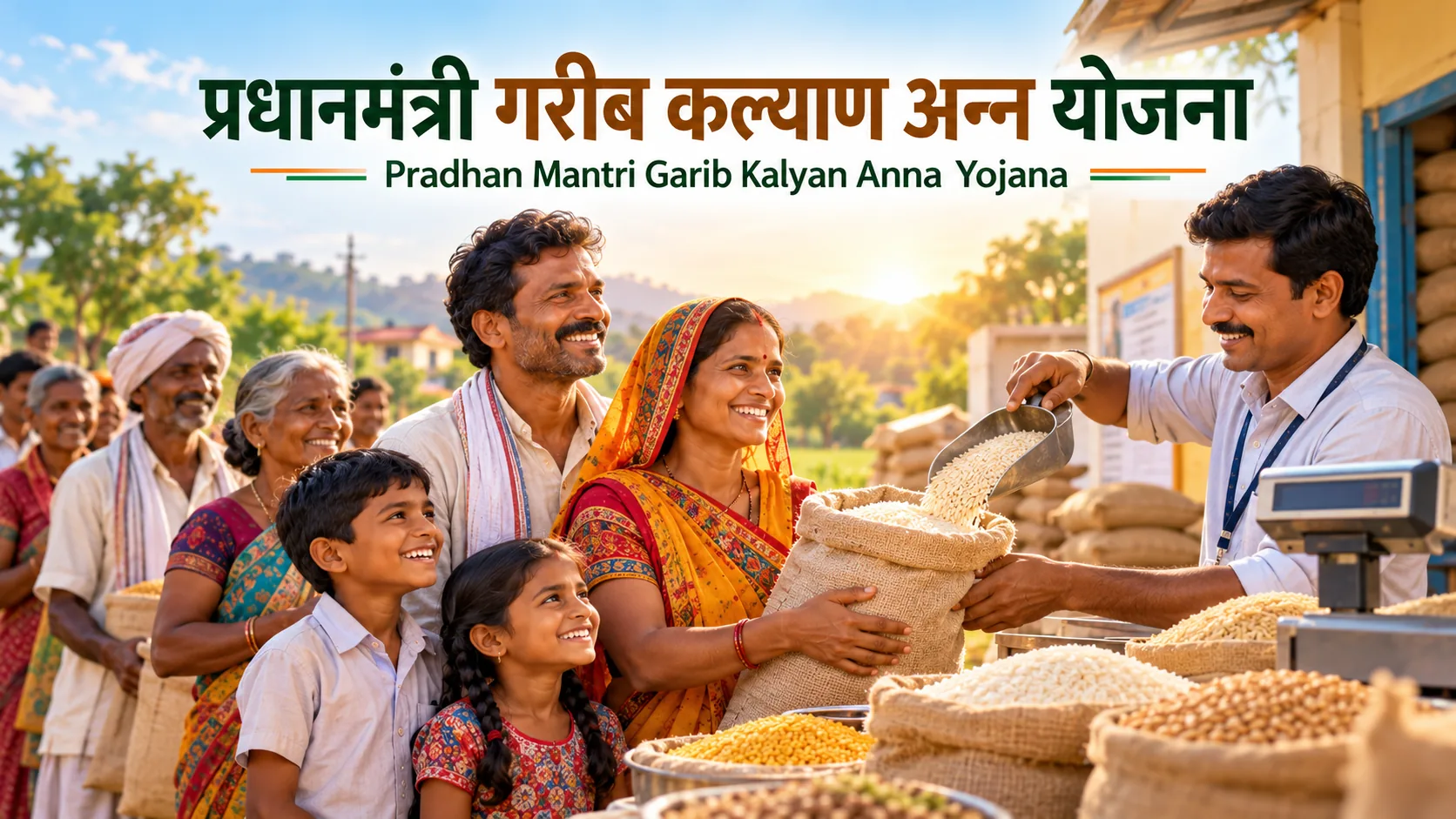
What Is Pradhan Mantri Garib Kalyan Anna Yojana?
Pradhan Mantri Garib Kalyan Anna Yojana (PMGKAY) is a Government of India food security programme that provides entitled foodgrains free of cost to eligible beneficiaries covered under the National Food Security Act, 2013 (NFSA). It is administered through the country's public distribution system, with the Department of Food and Public Distribution responsible for the central policy framework.
The programme is particularly relevant to lower-income households that rely on their ration card to meet part of their monthly food requirements. Rather than giving people money to purchase groceries, PMGKAY makes the prescribed NFSA allocation of foodgrains available without a charge for those foodgrains.
The Central Government decided to continue free foodgrain distribution for five years from 1 January 2024. The decision covers eligible Antyodaya Anna Yojana (AAY) households and Priority Household (PHH) beneficiaries, subject to their recognised NFSA entitlements.
There are important differences between a ration card, NFSA eligibility and PMGKAY benefits. Not every ration card issued by a State automatically qualifies for the same Central entitlement. The household must be identified under the relevant NFSA category, and its records must reflect the eligible members correctly.
This guide explains who can receive free ration, how quantities are calculated, what beneficiaries should verify at a Fair Price Shop, and where to seek help when the distribution record is incorrect.
PMGKAY 2026: Key Facts at a Glance
| Feature | Details |
|---|---|
| Full scheme name | Pradhan Mantri Garib Kalyan Anna Yojana |
| Abbreviation | PMGKAY |
| Responsible department | Department of Food and Public Distribution |
| Type of assistance | Free entitled NFSA foodgrains |
| Eligible categories | Antyodaya Anna Yojana and Priority Households |
| AAY monthly entitlement | 35 kg per eligible household |
| PHH monthly entitlement | 5 kg per eligible person |
| Five-year continuation | Effective 1 January 2024 |
| Announced intended coverage | Approximately 81.35 crore NFSA beneficiaries |
| Distribution channel | Authorised Fair Price Shops under the PDS |
| Official information | PMGKAY Government Page |
The intended coverage figure is a policy target. It should not be confused with the number of people who actually collected foodgrains in a particular month. Similarly, the entitlement figures are based on the applicable NFSA categories, not a universal amount for every resident.
Why Does PMGKAY Matter to Eligible Households?
For a household with limited income, food is one of the most important recurring expenses. Even a modest change in the cost of essential grains can affect how much money remains for other needs.
PMGKAY is designed to reduce that financial pressure by making eligible foodgrains available free of cost. It helps households access a basic portion of their food requirements through a publicly administered distribution system.
Reducing the Cost of Essential Foodgrains
When an eligible family receives its NFSA allocation without paying for the grain, it can reduce the amount the household would otherwise need to spend on those items. The actual savings depend on the type and quantity of grain received and local market prices.
However, this should not be described as eliminating every food expense. Families may still need to purchase pulses, vegetables, cooking oil and other essential food items separately.
Strengthening Food Security
A regular entitlement makes essential food support more predictable for households whose records remain valid. Beneficiaries should know their category, verify the number of eligible family members and check the quantity recorded for each distribution month.
Supporting Consistent Nationwide Provision
The Government's five-year continuation decision also sought to strengthen the availability and affordability of NFSA foodgrains across States and Union Territories. Central free-foodgrain provisions operate alongside State-level distribution arrangements, which may differ in administration and additional benefits.
Who Is Eligible for Free Ration Under PMGKAY?
PMGKAY is linked to NFSA eligibility, not an unrestricted application open to every individual. The State or Union Territory is responsible for identifying eligible households under the relevant NFSA provisions and its prescribed identification process.
Two categories are central to determining the amount of foodgrain assistance.
Antyodaya Anna Yojana (AAY) Households
AAY is intended for households identified under the relevant poorest-of-the-poor criteria. An eligible AAY household receives 35 kilograms of foodgrains per month under the NFSA entitlement framework.
The unit of calculation matters. The entitlement is 35 kilograms for the household, not 35 kilograms for each member. A household with four members does not automatically receive 140 kilograms merely because four individuals are listed on its AAY ration card.
Priority Households (PHH)
For PHH beneficiaries, the monthly entitlement is calculated using the number of eligible persons. Under NFSA, each eligible PHH member is entitled to 5 kilograms of foodgrains per month.
For example, an eligible PHH household with three recorded members would generally have a combined monthly entitlement of 15 kilograms. A five-member PHH household would have a combined entitlement of 25 kilograms.
These examples explain the calculation. The actual household record should always be checked with the responsible food department because the number of eligible members recorded in the system determines the relevant allocation.
How Much Free Ration Does PMGKAY Provide?
| NFSA category | Monthly foodgrain entitlement | How it is calculated |
|---|---|---|
| AAY | 35 kilograms | Per eligible household |
| PHH | 5 kilograms | Per eligible person |
One of the most common misunderstandings is that every ration cardholder receives 35 kilograms of free grain. That is incorrect. The 35-kilogram household allocation applies to AAY, while PHH quantities depend on the number of eligible members.
The foodgrains supplied may include rice, wheat or eligible coarse and nutritious grains according to the applicable allocation and distribution arrangements.
The precise combination of commodities can vary, so beneficiaries should check what has been allocated for their household and distribution period instead of assuming the same rice-to-wheat ratio in every State.
Is PMGKAY Free Ration Available in 2026?
The Central Government's decision provides for the continuation of free entitled NFSA foodgrains for five years beginning on 1 January 2024. This framework therefore covers 2026, subject to the applicable beneficiary and distribution requirements.
For context, the Government had previously decided to provide free foodgrains for one year beginning on 1 January 2023. The subsequent November 2023 Cabinet decision continued that arrangement for five more years from January 2024.
The continuation period should not be confused with an individual ration card's validity or beneficiary status. A household must remain correctly recorded under the applicable NFSA system to receive the relevant entitlement.
Readers should also distinguish the present free-NFSA-foodgrain arrangement from earlier pandemic-era arrangements that provided additional foodgrain support under the PMGKAY name. Different periods involved different provisions. It would be inaccurate to add an older emergency allocation to the current monthly entitlement without a valid government order.
Do Existing Ration Cardholders Need to Apply Again?
An existing eligible NFSA beneficiary generally does not need to submit a separate PMGKAY cash-benefit application simply to receive the regular free-foodgrain entitlement. The distribution relies on the recognised ration card and beneficiary records.
If a household is not covered under NFSA, the issue is different. Its members should check whether they can apply for a relevant ration card or request eligibility assessment under their State's rules.
Ration card issuance and beneficiary identification are administered through State and Union Territory systems. One State may offer an online application portal, while another may require a visit to a designated office or authorised service centre.
Applicants should use the official State food and civil supplies department rather than assuming an unofficial website can approve NFSA status.
How to Collect Free Foodgrains From a Ration Shop
Eligible households receive their monthly allocation through the authorised Public Distribution System. The exact operating procedure can vary, but the following steps explain the typical checks a beneficiary should make.
- Verify your category: Confirm whether your household is recorded as AAY or PHH under NFSA.
- Check eligible members: For PHH, the number of eligible people affects the monthly allocation.
- Locate the authorised Fair Price Shop: Use your State's distribution information to identify the relevant ration outlet.
- Ask about the distribution schedule: Collection dates and service hours may vary by location.
- Complete the required verification: Follow the applicable identification and ePoS procedure.
- Check the available allocation: Ask about the grain type and quantity shown against the household record.
- Collect the foodgrains: Verify the weight and review the transaction details where available.
- Report discrepancies: Use the authorised grievance channel if the quantity or beneficiary information appears incorrect.
Under the free-foodgrain provision, beneficiaries should not be charged for their prescribed eligible NFSA grains. Other commodities sold through a shop or separate State programmes may follow different rules.
How to Check Ration Card Eligibility and Beneficiary Status
A household's NFSA record is the most important starting point for understanding PMGKAY eligibility. If the card is inactive, a member is missing or the household category is incorrect, the appropriate solution is to investigate the official record.
Use the National Food Security Portal to find relevant government information and State-linked services. Depending on the State, beneficiaries may be able to view household details, ration card status or available public distribution records online.
If online records are unavailable or do not match the physical card, contact the relevant State food department or district supply office. Do not rely on a third-party website's unofficial eligibility prediction as confirmation of approval.
What Documents May Be Required?
For an existing eligible ration cardholder collecting foodgrains, the primary requirement is the recognised beneficiary record and the identification procedure applicable to the local distribution system.
Depending on the State and the type of request, relevant information may include:
- The existing ration card or its identification number.
- Beneficiary details recorded in the State ration system.
- Identity information required for authorised verification.
- Relevant household-member details if a record correction is needed.
- Supporting documents requested under State rules for a new card or an amendment.
A new ration card application is a separate administrative process. It may involve residence, household or identity evidence according to the relevant State's requirements.
School certificates, employment letters or bank account information should not be described as universal mandatory documents for collecting PMGKAY foodgrains. Requirements should be checked for the actual service being requested.
Can Beneficiaries Collect Free Ration in Another State?
Eligible NFSA beneficiaries may be able to use the One Nation One Ration Card (ONORC) portability framework to collect entitled foodgrains from an ePoS-enabled Fair Price Shop outside their home State.
This is especially useful for migrant workers. For example, someone whose eligible ration card is registered in Bihar but who works in Delhi can use the prescribed portability procedure to access their available entitlement at a participating shop.
ONORC does not provide an additional allocation. It allows the existing entitlement to be collected at another location, and the transaction is recorded so that the same quantity is not claimed repeatedly.
PMGKAY and ONORC therefore solve different problems. PMGKAY concerns the free provision of entitled NFSA grains, while ONORC concerns where eligible beneficiaries can collect those grains.
For related information, see our Ration & Food Security Schemes category. When the separate ONORC guide is published, a contextual link to its English article should also be added here.
What If Aadhaar or Biometric Verification Fails?
Electronic distribution systems commonly use beneficiary identification and ePoS equipment. In many locations, Aadhaar-based authentication forms part of the transaction process.
Technical difficulties may arise from device problems, connectivity, fingerprint recognition or a mismatch in beneficiary records.
A failed authentication attempt should not automatically be treated as proof that the household is no longer eligible. The beneficiary should ask the Fair Price Shop operator to identify the problem and seek guidance from the responsible food department regarding applicable alternative verification or grievance procedures.
Do not share one-time passwords or sensitive identity information with an unauthorised person claiming to fix a ration card or activate free-foodgrain benefits.
What If You Receive Less Ration Than Your Entitlement?
A difference between the expected allocation and the quantity actually received should be checked against the household record and transaction history.
For example, if a PHH household has five eligible members, the general calculation is 25 kilograms for the month. If the system shows a smaller available quantity, there may be a record issue or a prior transaction that needs to be understood.
Beneficiaries should not immediately assume that a missing allocation has been permanently cancelled. First confirm the relevant category, number of recorded members and distribution history.
If the discrepancy remains unexplained, approach the authorised grievance mechanism.
- Write down your ration card details and the month concerned.
- Check the allocation shown in the official record.
- Request the available transaction details or receipt.
- Record the quantity actually supplied.
- Submit a complaint to the responsible State food department or district supply office.
- Keep the complaint acknowledgement for follow-up.
Complaint channels and processing times vary, so use the authorised information for your State or Union Territory.
How PMGKAY Differs From One Nation One Ration Card
| Feature | PMGKAY | ONORC |
|---|---|---|
| Main purpose | Provide eligible NFSA foodgrains free of cost | Make existing ration entitlements portable nationwide |
| Type of benefit | Foodgrain assistance | Choice of eligible collection location |
| Eligibility basis | NFSA AAY and PHH coverage | Existing eligible NFSA records |
| Additional ration | No automatic extra allocation beyond applicable entitlement | No extra allocation from portability |
| Cash payment | Not a general cash-transfer programme | Not a cash-transfer programme |
Understanding the distinction is useful because online articles sometimes describe free ration, portable ration cards and additional food assistance as though they were interchangeable.
Common Misunderstandings About PMGKAY
Every Indian resident automatically receives five kilograms
This is incorrect. The five-kilogram per-person entitlement applies to eligible PHH beneficiaries identified under NFSA. AAY households have a separate household-based entitlement.
Every ration card provides 35 kilograms
The 35-kilogram entitlement applies to eligible AAY households. PHH allocations are calculated using the number of eligible members.
A new PMGKAY card must be purchased
The free-foodgrain provision operates through existing eligible NFSA records. There is no general requirement to purchase a separate PMGKAY card from a private agent.
Free ration means every food item is free
The Central provision concerns specified eligible foodgrains. It should not be interpreted as covering every grocery item sold at a shop.
PMGKAY provides a direct bank deposit
The programme provides foodgrains. It is not a general monthly cash benefit deposited into every eligible person's bank account.
Frequently Asked Questions About PMGKAY
1. What is PMGKAY?
It is the Government of India's programme for providing eligible NFSA foodgrains free of cost to recognised AAY households and PHH beneficiaries.
2. Is free ration available under PMGKAY in 2026?
The Government decided to continue the free-foodgrain arrangement for five years beginning on 1 January 2024. Individual beneficiary records and current distribution rules should still be verified.
3. How much foodgrain does an AAY household receive?
Under the general NFSA entitlement, an eligible AAY household receives 35 kilograms of foodgrains per month.
4. How much does a PHH beneficiary receive?
Each eligible PHH beneficiary is entitled to 5 kilograms per month under NFSA.
5. Can anyone apply for PMGKAY?
The free entitlement is linked to recognised NFSA beneficiary categories. People who are not currently covered should check their State's eligibility assessment and ration card procedures.
6. Is a separate PMGKAY application required?
Existing eligible NFSA beneficiaries generally receive the free-foodgrain provision through the regular distribution system, without a separate general cash-benefit application.
7. Can I collect ration while living outside my home State?
Eligible beneficiaries may use the ONORC portability framework at a suitable ePoS-enabled Fair Price Shop, subject to applicable verification.
8. Where can I check my ration card status?
Use the authorised State food department portal or relevant services linked through the National Food Security Portal.
9. What happens if the dealer provides less foodgrain?
Check your recorded monthly entitlement and transaction history, then raise the issue through the appropriate State food department or grievance mechanism.
10. Which government website provides official PMGKAY information?
The Department of Food and Public Distribution publishes programme details, NFSA allocation information and relevant government notices.
Official Government Sources
- Department of Food and Public Distribution — PMGKAY
- Government Foodgrain Allocation and NFSA Entitlements
- National Food Security Portal
- Press Information Bureau — Five-Year Free-Foodgrain Cabinet Decision
Last reviewed: 19 October 2026. Government notifications, beneficiary identification and distribution arrangements should be checked through current official sources.
Disclaimer: eSarkariYojna is an independent informational website, not a government department. We explain publicly available scheme information but cannot issue ration cards, approve NFSA eligibility or guarantee distribution benefits.
Always check the official website for final and accurate information.
Visit official website: dfpd.gov.in ↗Last updated: 19 Oct 2026