One Nation One Ration Card
Nationwide portability of existing NFSA ration entitlements using an eligible ration card at an ePoS-enabled fair-price shop; not an extra cash benefit.
Eligibility: A new ration card is generally not required; confirm biometric authentication and remaining entitlement.
What Is One Nation One Ration Card?
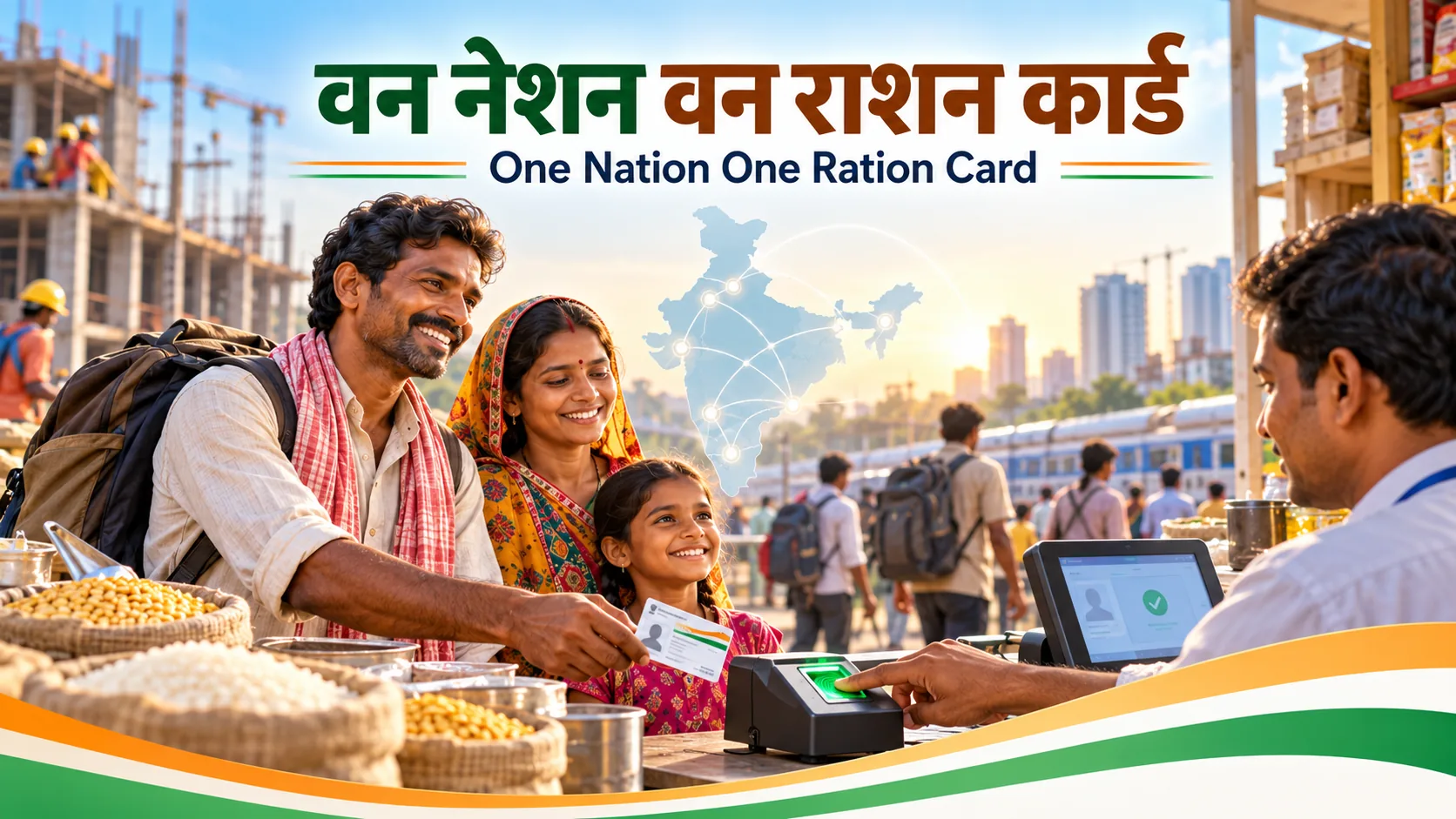
One Nation One Ration Card (ONORC) is a nationwide ration portability system introduced by the Government of India. It allows eligible beneficiaries covered under the National Food Security Act, 2013 (NFSA), to collect their entitled foodgrains from an eligible Fair Price Shop (FPS) in another part of the country while continuing to use their existing ration card.
The programme addresses a common problem faced by migrant workers and families who move between cities or States. A person's ration entitlement was traditionally linked to a particular location, making it difficult to access food support while living away from the home district. ONORC makes that entitlement portable through the digitised Public Distribution System.
For example, a person whose household ration card is registered in Uttar Pradesh may be able to collect their eligible share of foodgrains while working in Maharashtra. The transaction is authenticated through the prescribed electronic system, and the amount collected is recorded against the household's available entitlement.
ONORC does not create an additional monthly ration allowance. It does not provide a universal cash transfer or automatically issue new ration cards. The benefit is the flexibility to access an existing NFSA foodgrain entitlement at another participating location.
One Nation One Ration Card: Key Details
| Particular | Details |
|---|---|
| Programme name | One Nation One Ration Card |
| Abbreviation | ONORC |
| Responsible department | Department of Food and Public Distribution |
| Initial interstate pilot | August 2019 |
| National coverage | All 36 States and Union Territories |
| Eligible beneficiary groups | NFSA-covered AAY households and PHH beneficiaries |
| Primary benefit | Portability of existing foodgrain entitlements |
| Distribution channel | ePoS-enabled Fair Price Shops |
| Identity verification | Prescribed Aadhaar/biometric authentication |
| New ration card needed? | Generally, no |
| Official information | Department of Food and Public Distribution |
ONORC portability must be distinguished from the eligibility assessment used to issue a ration card. States and Union Territories identify eligible NFSA households under the applicable rules, while the portability framework enables those beneficiaries to use their entitlements elsewhere.
Why Was ONORC Introduced?
Millions of people in India move temporarily or seasonally for employment, education and family circumstances. Construction workers, factory employees, domestic workers and other mobile households may spend considerable time away from the State where their ration card was issued.
For a low-income household, travelling back to the original ration shop simply to collect foodgrains may be impractical. It can involve lost wages, travel expenses and disruption to everyday life.
ONORC seeks to reduce these barriers by connecting ration entitlement records through a technology-enabled national framework. Beneficiaries can access their existing food support without being restricted to a single Fair Price Shop in their home State.
Better Access for Migrant Workers
The most direct advantage is for eligible workers living outside their home State. Someone temporarily working in a different city can approach an appropriate ePoS-enabled ration shop and complete the required identity verification to collect their available entitlement.
Flexible Collection for Families Living Apart
Portability is also useful when household members live in different locations. An eligible family member may collect part of the entitlement while working away from home, and other members may collect the remaining balance in their home State.
The entitlement is not duplicated. Both transactions are recorded against the relevant household record, and the remaining quantity is determined accordingly.
Greater Transparency in Distribution
Electronic Point of Sale devices and digitised beneficiary records help document ration distribution. These systems support the verification of beneficiaries, quantity tracking and reconciliation of transactions between participating States and Union Territories.
Who Is Eligible for One Nation One Ration Card?
ONORC primarily applies to beneficiaries covered under the National Food Security Act. Being an Indian citizen or possessing an Aadhaar number by itself does not establish eligibility for NFSA ration benefits.
The relevant household must be identified under the applicable State or Union Territory process. Two principal beneficiary categories are Antyodaya Anna Yojana (AAY) and Priority Households (PHH).
Antyodaya Anna Yojana (AAY)
AAY covers identified households within the designated poorest-of-the-poor category. Under NFSA, an eligible AAY household is entitled to 35 kilograms of foodgrains per month.
This quantity applies to the household rather than being multiplied by the number of individuals on the card.
Priority Households (PHH)
PHH beneficiaries receive a foodgrain entitlement calculated on a per-person basis. The general NFSA entitlement is 5 kilograms per eligible person per month.
For instance, a PHH household containing four eligible members would ordinarily have a combined monthly entitlement of 20 kilograms. Actual records and applicable rules should be verified before collecting the allocation.
A beneficiary's ration card category should be checked through the appropriate State food department or official NFSA-linked service.
How Much Ration Is Available Under ONORC?
ONORC does not create its own separate foodgrain allowance. It allows beneficiaries to collect the quantity for which they are already eligible under NFSA and the relevant distribution arrangements.
| NFSA category | Monthly entitlement | Calculation |
|---|---|---|
| AAY | 35 kg | Per eligible household |
| PHH | 5 kg | Per eligible person |
Consider a PHH family with five eligible members. Its general monthly foodgrain entitlement would be 25 kilograms. If one member collects an eligible share elsewhere, the family should be able to access the remaining entitlement according to the recorded transaction and applicable portability arrangements.
Beneficiaries cannot use portability to claim the full household allocation repeatedly from multiple shops. The purpose is flexibility of collection, not an increase in the total entitlement.
Is Ration Free Under One Nation One Ration Card?
The availability of free NFSA foodgrains is related to the Pradhan Mantri Garib Kalyan Anna Yojana (PMGKAY) provisions, rather than being a separate cash benefit created by ONORC.
The Central Government decided to continue providing free entitled foodgrains to AAY and PHH beneficiaries for five years beginning on 1 January 2024.
Under those arrangements, eligible NFSA beneficiaries receive their prescribed foodgrain allocation without paying the Central issue price. ONORC allows eligible individuals to access the same entitlement through a suitable ration shop in another location.
Additional commodities, State-specific benefits and other welfare entitlements may follow separate rules. They should not automatically be assumed to be portable nationwide.
How to Collect Ration in Another State
The process is intended to allow an existing eligible ration cardholder to collect foodgrains without applying for a completely new NFSA card merely because they are temporarily living elsewhere.
- Confirm NFSA eligibility: Make sure your existing ration card is valid and the relevant household member is correctly recorded.
- Find a suitable Fair Price Shop: Locate a shop where the required ePoS-enabled portability facility is available.
- Provide ration identification details: Share the ration card number or the prescribed identification information with the authorised dealer.
- Complete authentication: Follow the applicable Aadhaar/biometric verification procedure on the ePoS device.
- Check the available balance: Confirm the quantity the system identifies as available for collection.
- Receive the entitled foodgrains: Collect the amount permitted under the applicable distribution record.
- Verify the transaction: Where available, retain a receipt or review the updated transaction history.
If authentication fails or the shop cannot process the record, ask for the specific reason rather than assuming your food entitlement has permanently ended.
Do You Need a New Ration Card After Moving?
Generally, an eligible NFSA beneficiary does not need to obtain a second ration card simply to use ONORC portability while living temporarily outside the home State.
However, portability should not be confused with permanently transferring household records. A family that has moved permanently, wishes to update an address or needs to add or remove household members may have to follow the administrative procedures of the relevant State or Union Territory.
Creating duplicate NFSA ration card records in different States can lead to verification problems. Check the correct procedure with the official food department before requesting a new card.
Can Family Members Collect Ration in Two Different States?
One of ONORC's practical advantages is its ability to support eligible households whose members are temporarily separated by employment or other circumstances.
Suppose a family has an NFSA ration card in Rajasthan, but one member works in Gujarat. Under the applicable portability framework, that worker can use the recorded entitlement at a suitable ration shop in Gujarat while the rest of the family accesses the remaining quantity in Rajasthan.
The digital system is intended to account for both transactions. The family does not receive additional grain merely because distribution takes place in separate locations.
This flexibility is especially valuable for seasonal migrant workers who may move several times within a year.
Why Is Aadhaar Authentication Used?
Aadhaar-based authentication helps the distribution system verify that the person collecting foodgrains is linked to the eligible ration record.
Official guidance describes the use of biometric authentication through electronic Point of Sale equipment. The system also relies on the relevant beneficiary records and established portability infrastructure.
A biometric mismatch does not necessarily mean the person's underlying eligibility has been cancelled. Authentication can fail because of equipment issues, connectivity problems or record-related errors.
Where authentication cannot be completed, ask the ration dealer or responsible food department about the applicable grievance and alternative verification procedure. Avoid sharing sensitive identity details with unauthorised intermediaries.
What Is the Mera Ration 2.0 App?
Mera Ration 2.0 is a government mobile application developed by the National Informatics Centre to help beneficiaries access ration-related information.
According to the official user FAQ, the app provides access to ration card details, monthly foodgrain entitlements, previous distribution transactions and information about nearby Fair Price Shops.
It also includes grievance-related facilities, enabling users to submit a complaint and review its status where supported.
Useful Features of Mera Ration 2.0
- View available ration card information.
- Check monthly NFSA foodgrain entitlements.
- Review previous ration distribution transactions.
- Find nearby Fair Price Shops.
- Submit eligible grievances and monitor their progress.
The app can be particularly useful for migrant beneficiaries who are unfamiliar with the ration distribution arrangements in a new city.
For accurate instructions, read the official Mera Ration 2.0 FAQ. Download the application only from a trusted official listing, and avoid unofficial APK files or websites requesting unnecessary personal information.
What If a Ration Dealer Refuses Portability?
A beneficiary may occasionally face problems such as an unavailable electronic record, failed fingerprint authentication, incorrect entitlement information or a dealer who cannot process an interstate transaction.
The appropriate response depends on the actual problem. Begin by checking that the ration card is active, that the member is recorded correctly and that the shop has the relevant electronic distribution facility.
If the problem persists, ask the dealer to identify the error shown by the system. Review transaction history and available entitlement information where possible.
You can then approach the State food and civil supplies department, district supply office or applicable official grievance mechanism. Retain any complaint acknowledgement for follow-up.
Do not automatically pay an unauthorised agent to reactivate portability or bypass authentication. Such payments may expose beneficiaries to unnecessary financial and identity-related risks.
What Are the Documents Needed for ONORC?
Because ONORC is a portability system, its requirements are different from those of an entirely new ration card application.
The essential starting point is an existing eligible NFSA ration record and the identification information needed for the prescribed authentication process.
Official public guidance indicates that a ration card or Aadhaar-related identification details can be used in the process, depending on the applicable procedure and system requirements.
A bank account, education certificate, employment letter or separate scheme application is not normally the central requirement simply for collecting portable ration. If a beneficiary instead needs to correct household records or apply for a new NFSA card, the relevant State may request additional documentation.
ONORC Versus PMGKAY: What Is the Difference?
| Feature | ONORC | PMGKAY |
|---|---|---|
| Primary purpose | Nationwide portability of eligible ration benefits | Provision of free entitled foodgrains |
| Key benefit | Collect existing entitlement from another eligible location | Receive applicable NFSA foodgrain entitlement free of cost |
| Eligibility basis | Existing eligible NFSA record | NFSA AAY and PHH coverage |
| Separate card needed | Generally no | Existing eligible NFSA card is used |
| Additional cash payment | No | No general cash payment under the foodgrain distribution arrangement |
Both programmes support food security, but they perform different functions. ONORC changes where an eligible beneficiary can access foodgrains; PMGKAY concerns the provision of those eligible foodgrains free of cost.
Readers can explore further government food assistance information in our Ration & Food Security Schemes category.
Common Misunderstandings About ONORC
Every ration card automatically works everywhere: Nationwide ONORC portability relates to eligible NFSA entitlements. Additional State-specific benefits may not be portable.
A new national ration card is required: Existing eligible NFSA ration cards are generally used. ONORC is not a compulsory replacement-card exercise.
People can collect a full ration allocation twice: Portability does not duplicate the monthly entitlement.
Moving temporarily cancels the original card: A portability transaction is different from permanently updating or cancelling the household's ration record.
ONORC gives a direct bank transfer: It provides ration entitlement portability, not a universal cash transfer.
Frequently Asked Questions
1. When was One Nation One Ration Card introduced?
Interstate portability began through a pilot involving four States in August 2019. The system was subsequently extended across all 36 States and Union Territories.
2. Can I use a Bihar ration card in Delhi?
An eligible NFSA beneficiary can generally use the ONORC system at a suitable ePoS-enabled Fair Price Shop in Delhi, subject to the prescribed identity and entitlement verification.
3. Is a new ration card necessary?
Not generally. Existing eligible NFSA ration card records are used to access portability.
4. How much foodgrain does a PHH beneficiary receive?
The general NFSA entitlement is 5 kilograms per eligible person per month.
5. What is the monthly AAY entitlement?
An eligible AAY household is entitled to 35 kilograms of foodgrains per month.
6. Can a migrant worker collect only part of the family's ration?
ONORC supports partial or full collection of an available entitlement, with the remaining balance recorded for eligible household members.
7. Is biometric authentication involved?
Yes. The official portability framework uses prescribed Aadhaar/biometric verification through ePoS equipment.
8. Does ONORC offer a cash subsidy?
No. It allows portability of existing eligible foodgrain entitlements rather than providing a separate cash benefit.
9. How can I check past ration transactions?
The Mera Ration 2.0 app and other authorised ration information services may provide access to transaction history.
10. Where can I report a ration portability problem?
Contact the relevant State food and civil supplies department, district supply office or the applicable official grievance service. Mera Ration 2.0 also describes a grievance facility.
Official Government Sources
- Department of Food and Public Distribution — ONORC
- Official PMGKAY Foodgrain Entitlement Information
- National Food Security Portal
- Mera Ration 2.0 Official FAQ
- Press Information Bureau — National ONORC Implementation
Content reviewed: October 2026. Local ration distribution arrangements, eligible household records and grievance procedures should always be confirmed with the responsible government authority.
Disclaimer: eSarkariYojna is an independent information website and is not operated by the Government of India. This guide explains publicly available information and does not guarantee ration card eligibility, distribution approval or access to a particular entitlement.
Always check the official website for final and accurate information.
Visit official website: dfpd.gov.in ↗Last updated: 19 Oct 2026