Sukanya Samriddhi Yojana (SSY)
Sukanya Samriddhi Yojana is a government-backed savings scheme for girls, currently offering 8.2% annual interest.
Eligibility: Parents or legal guardians can open an account for a girl below 10 years of age.
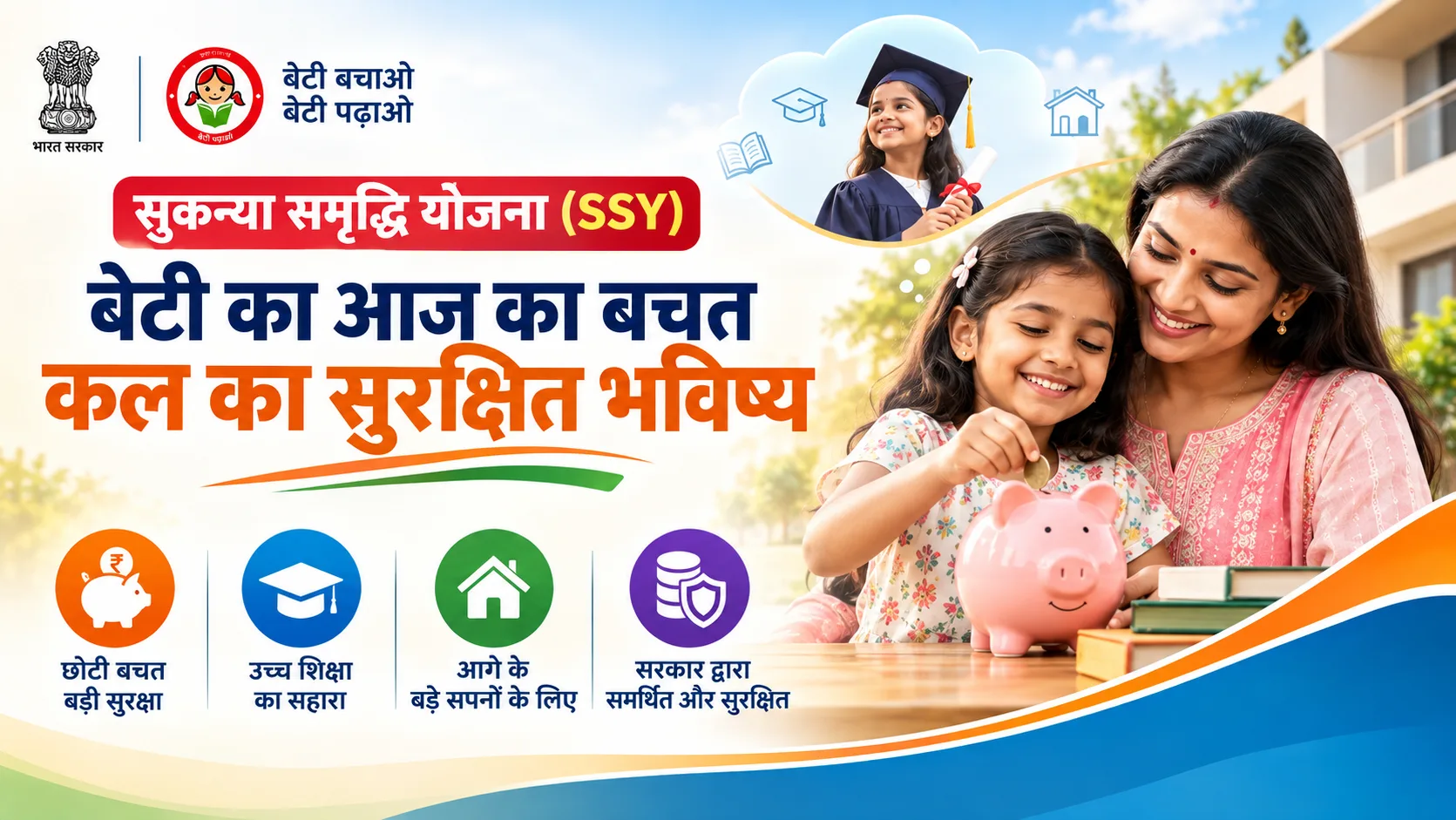
What Is Sukanya Samriddhi Yojana (SSY)?
Sukanya Samriddhi Yojana (SSY), also called the Sukanya Samriddhi Account Scheme (SSA), is a government-backed small savings scheme in India designed to help families build savings for a girl's education and future financial needs.
The scheme was launched on 22 January 2015 as part of the Beti Bachao, Beti Padhao initiative. A parent or legal guardian can open an account in the name of an eligible girl child at a participating post office or authorised bank.
For the October to December 2026 quarter, the Sukanya Samriddhi interest rate is 8.2% per annum, compounded annually. However, this rate is not fixed for the entire life of the account. The Government reviews small savings interest rates periodically.
This guide explains SSY eligibility, deposits, interest, account opening, withdrawals, maturity, tax benefits and important rules that parents should understand before opening an account.
Key Features of Sukanya Samriddhi Yojana
- The account is opened in the name of an eligible girl child by a parent or legal guardian.
- The girl must be below 10 years of age when the account is opened.
- The minimum annual deposit is ₹250.
- The maximum deposit is ₹1,50,000 per financial year.
- Deposits can be made for 15 years from the date of account opening.
- The account normally matures 21 years after it is opened.
- Partial withdrawal for education is permitted under specified conditions.
- The interest rate is notified by the Government and can change over time.
- Tax benefits may be available under applicable income-tax provisions.
Sukanya Samriddhi Yojana Interest Rate in 2026
The SSY interest rate for the quarter from 1 October to 31 December 2026 is 8.2% per annum. Interest is compounded annually according to the scheme rules.
This is the rate applicable to the current quarter, not a guaranteed return for all future years. The Government periodically reviews interest rates for small savings schemes.
The final amount in an SSY account depends on how much is deposited, when deposits are made, the applicable interest rates and the duration for which money remains in the account.
For official rates and updates, consult India Post or the National Savings Institute.
Who Is Eligible for Sukanya Samriddhi Yojana?
An SSY account can be opened for a girl child who is below 10 years old on the date of opening the account.
Important eligibility conditions include:
- A parent or legal guardian opens and operates the account on behalf of the eligible girl child.
- Generally, only one SSY account can be opened for each girl child.
- Normally, a family can open accounts for up to two girl children.
- Specified exceptions may apply in cases involving twins or multiple girls born together, subject to the required documentation.
- The age and identity details must satisfy the applicable account-opening requirements.
Families with special circumstances should confirm the rules with the participating post office or authorised bank before opening an additional account.
Sukanya Samriddhi Minimum and Maximum Deposits
SSY requires a minimum deposit of ₹250 in each financial year. The maximum amount that can be deposited is ₹1,50,000 per financial year.
- Minimum annual deposit: ₹250.
- Maximum annual deposit: ₹1,50,000.
- Monthly payments: Not compulsory.
- Deposit period: 15 years from account opening.
- Normal maturity: 21 years from account opening.
Deposits may be made in multiple instalments during the financial year, subject to the scheme's limits.
If the minimum annual deposit is not made, the account may be treated as an account in default. It may be possible to regularise the account by depositing the required shortfall and paying the prescribed fee under the applicable rules.
SSY Deposit Period vs Maturity Period: 15 Years or 21 Years?
One common source of confusion is the difference between the deposit period and the maturity period.
The deposit period is 15 years, while normal account maturity is 21 years from the date of opening.
For example, suppose a parent opens an SSY account in 2026. Deposits can be made during the prescribed 15-year period. The account would normally mature in 2047, which is 21 years after opening.
After the deposit period ends, the balance may continue to earn interest according to the applicable scheme rules until maturity.
The 21-year period is calculated from the account-opening date, not from the girl's date of birth.
How to Open a Sukanya Samriddhi Account
Parents or legal guardians can open an SSY account through participating post offices and authorised banks.
- Visit a participating post office or authorised bank branch.
- Request the Sukanya Samriddhi Account opening form.
- Enter the girl's details and the guardian's information.
- Submit the required identification and birth-related documents.
- Make an initial deposit of at least ₹250.
- Complete the bank or post office verification process.
- Receive the account details or passbook once the account is opened.
- Ask about supported deposit methods and account services.
Some financial institutions provide online deposit facilities for existing accounts. However, applicants should not assume that every authorised institution offers a fully online new-account-opening process.
Documents Required to Open an SSY Account
The following documents or details are commonly required:
- The girl child's birth certificate.
- Identity proof of the parent or legal guardian.
- Address proof and applicable KYC details of the guardian.
- A completed account-opening application form.
- Additional documents for special multiple-birth situations, where applicable.
- Any further documents requested by the authorised institution.
Check the exact document requirements with the post office or bank where you intend to open the account.
What Happens If You Deposit ₹1,000 per Month in Sukanya Samriddhi?
A monthly deposit of ₹1,000 means ₹12,000 is deposited in a year.
If the same amount is deposited throughout the 15-year deposit period, the total principal contribution will be ₹1,80,000.
The final maturity amount can be higher because interest is added to the account. However, the actual maturity value depends on the timing of deposits and the interest rates notified during the account's lifetime.
A calculation that assumes the current 8.2% rate remains unchanged for 21 years is only an illustration, not a guaranteed return.
What Happens If You Deposit ₹5,000 per Month?
Depositing ₹5,000 each month results in an annual contribution of ₹60,000.
Over 15 years, the total principal contribution would be ₹9,00,000, assuming regular deposits at that amount.
The maturity value may be greater after interest is added. The actual amount depends on deposit dates, future interest-rate changes and the scheme's calculation rules.
Can You Withdraw Money from Sukanya Samriddhi for Education?
SSY permits partial withdrawals for the education of the girl child under specified conditions.
An eligible withdrawal may be made after the girl turns 18 or passes the 10th standard, subject to the scheme rules.
The withdrawal is generally limited to up to 50% of the balance at the end of the preceding financial year. Supporting educational admission or fee-related documents may be required.
Permission to withdraw is not an unconditional right to take out half the account at any time. The authorised institution checks the request against the applicable conditions.
Can an SSY Account Be Closed Early for Marriage?
Special premature closure provisions are available in connection with the marriage of the account holder after she reaches the age of 18.
The application must satisfy the prescribed timing, age-verification and declaration requirements. The financial institution may request supporting documents before approving closure.
Other exceptional circumstances may also permit premature closure under the scheme rules. Applicants should check the current official provisions before making a request.
Sukanya Samriddhi Yojana Tax Benefits
SSY offers tax-related benefits under applicable Indian income-tax provisions. The treatment of deposits, interest and maturity proceeds depends on the relevant statutory rules.
Tax deductions on contributions may depend on the taxpayer's chosen tax regime and the rules applicable for the relevant financial year.
Parents should not assume that the same deduction is available under every tax regime. For an accurate estimate, review the current income-tax provisions or consult a qualified tax professional.
Common Sukanya Samriddhi Mistakes to Avoid
- Trying to open a standard new account after the girl has reached the age of 10.
- Opening multiple accounts for the same girl child.
- Missing the minimum annual deposit.
- Depositing more than the prescribed annual limit.
- Confusing the 15-year deposit period with the 21-year maturity period.
- Assuming the current interest rate is fixed for the entire account duration.
- Trusting unofficial websites that promise guaranteed maturity amounts.
- Sharing confidential banking information with unauthorised agents.
Frequently Asked Questions About Sukanya Samriddhi Yojana
1. What is the Sukanya Samriddhi interest rate in 2026?
For October to December 2026, the notified interest rate is 8.2% per annum. The rate can change in future quarters.
2. What is the minimum amount required for SSY?
The minimum deposit is ₹250 per financial year. The maximum annual deposit is ₹1,50,000.
3. Is a monthly deposit mandatory?
No. Monthly deposits are not mandatory. The annual minimum and maximum deposit rules still apply.
4. When does a Sukanya Samriddhi Account mature?
An SSY account normally matures 21 years after the date of opening. Deposits are permitted during the first 15 years.
5. Can an SSY account be opened after a girl turns 10?
Under the standard eligibility rule, the girl must be below 10 years of age when the account is opened.
6. Can parents open SSY accounts for two daughters?
Yes. Generally, separate accounts may be opened for up to two eligible daughters. Special rules apply to certain multiple-birth circumstances.
7. Can SSY funds be withdrawn for higher education?
Yes. Subject to the scheme rules, up to 50% of the balance at the end of the preceding financial year may be withdrawn after the girl reaches 18 or passes the 10th standard for educational purposes.
8. Is the maturity amount guaranteed?
The final value is not a fixed amount independent of deposit behaviour or future interest rates. It depends on contributions, deposit timing and rates applicable over time.
9. Can you open a Sukanya Samriddhi Account online?
Account opening depends on the services provided by the participating post office or authorised bank. Digital deposits may be supported for existing accounts, but a fully online opening process is not universally available.
10. Can an SSY account be closed for marriage?
Premature closure may be permitted for the account holder's marriage after she reaches 18 years of age, subject to prescribed conditions and documentation.
Official Sukanya Samriddhi Resources
- India Post Savings Schemes: indiapost.gov.in
- National Savings Institute: nsiindia.gov.in
- Department of Economic Affairs: dea.gov.in
Disclaimer: e-Sarkari Yojna is an independent informational website, not a government bank or post office. Sukanya Samriddhi interest rates, tax rules and account procedures can change. Confirm the latest information with official government sources and your chosen authorised financial institution before opening an account or making financial decisions.
Always check the official website for final and accurate information.
Visit official website: www.nsiindia.gov.in ↗Last updated: 17 Oct 2026