PM Surya Ghar: Muft Bijli Yojana
PM Surya Ghar offers eligible households up to ₹78,000 in central subsidy for residential rooftop solar.
Eligibility: Eligible Indian households with a suitable roof and valid residential electricity connection.
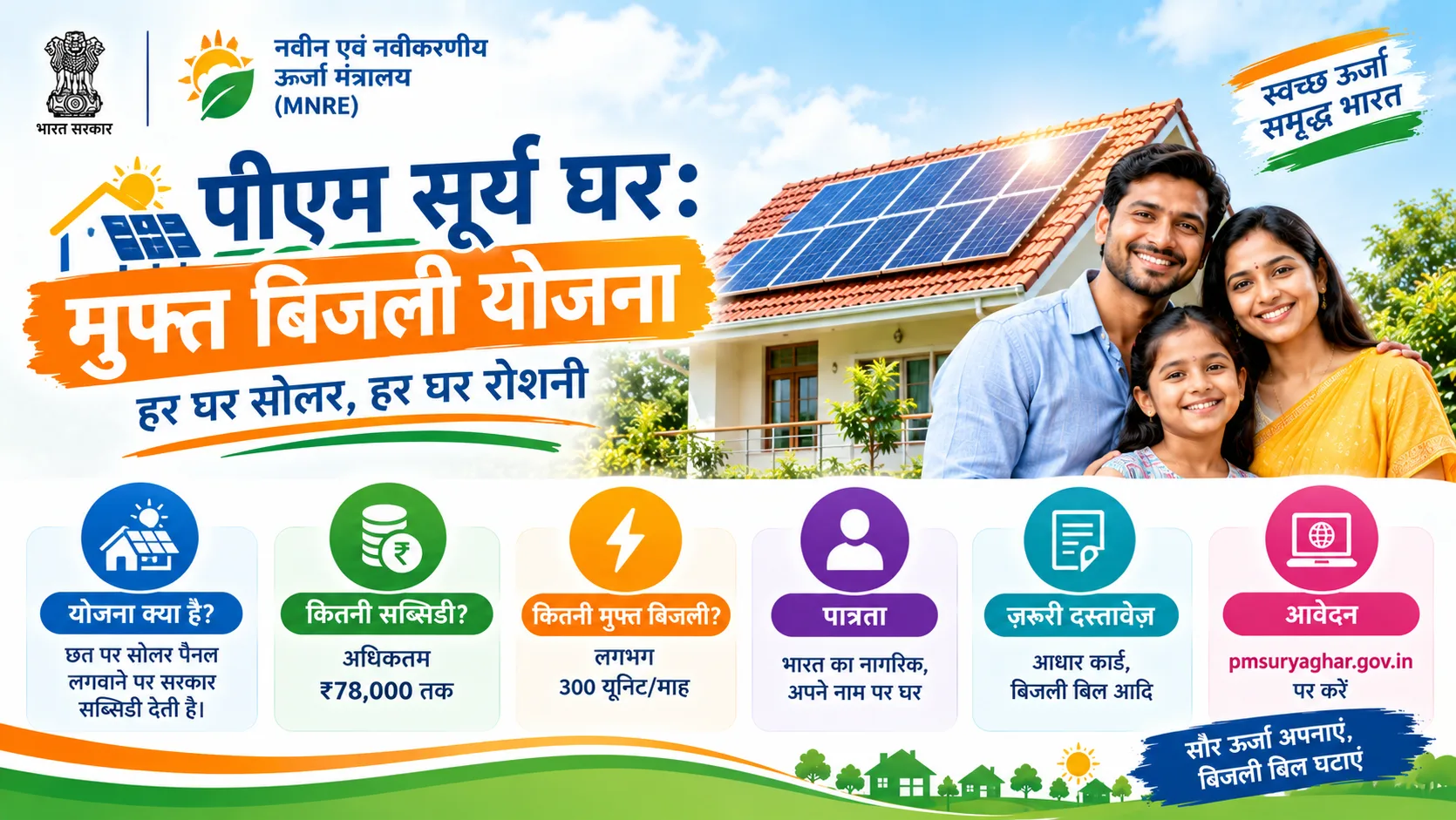
What Is PM Surya Ghar: Muft Bijli Yojana?
PM Surya Ghar: Muft Bijli Yojana is a Government of India scheme that helps eligible residential electricity consumers install rooftop solar power systems. The programme aims to make rooftop solar more affordable, reduce household electricity expenses and encourage the use of renewable energy.
Launched in February 2024, the scheme aims to support rooftop solar installations in one crore households across India. Its stated objective includes enabling households to benefit from solar electricity generation of up to around 300 units per month.
Eligible residential consumers can receive up to ₹78,000 in central financial assistance for qualifying rooftop solar installations. The subsidy depends on system capacity and the applicable technical and verification requirements.
The scheme should not be understood as a universal guarantee of 300 free units from the electricity distribution company every month. Actual solar generation and electricity-bill savings depend on system size, sunlight, roof conditions and household consumption.
PM Surya Ghar Solar Subsidy Amount
Under the standard Central Financial Assistance (CFA) structure for residential rooftop solar, the subsidy is linked to the installed system's eligible capacity.
| Rooftop solar capacityStandard central subsidy | |
| 1 kW | ₹30,000 |
| 2 kW | ₹60,000 |
| 3 kW | ₹78,000 |
| Above 3 kW | Maximum ₹78,000 |
The standard structure provides ₹30,000 per kW for the first 2 kW and ₹18,000 per kW for the additional capacity between 2 kW and 3 kW. For ordinary eligible residential systems, the central subsidy is capped at ₹78,000 even when the installed system exceeds 3 kW.
Different provisions may apply to certain special categories, locations or future changes to official guidelines. The actual approved assistance should always be checked through the national portal and the relevant electricity distribution company.
Key Benefits of PM Surya Ghar Yojana
- Central financial assistance for eligible residential rooftop solar installations.
- Standard subsidy of up to ₹78,000 for qualifying systems of 3 kW or higher.
- Opportunity to generate electricity on the household's own roof.
- Potential reduction in electricity purchases and monthly bills.
- Possible adjustment of surplus generation through approved net-metering or other applicable billing arrangements.
- Reduced dependence on conventional electricity generation.
- Access to financing options from participating lenders, subject to their terms.
The subsidy does not necessarily cover the entire system cost. Households may have to pay the remaining installation and other applicable expenses.
PM Surya Ghar Eligibility Criteria
To receive the residential rooftop solar subsidy, applicants must satisfy the applicable scheme, electricity connection and technical conditions.
General eligibility requirements include:
- The applicant must be an Indian citizen.
- The household must have suitable rooftop space for installing solar panels.
- A valid residential electricity connection must be available.
- The applicant's electricity consumer and identity details must satisfy the required verification.
- The installation must comply with the applicable rules on previous solar subsidies.
- The system must meet the relevant DISCOM's technical, safety and connection requirements.
Additional conditions may apply to rented properties, shared rooftops, apartment buildings and properties where the electricity connection holder is different from the rooftop owner.
Applicants should check the current requirements with their electricity distribution company, commonly called the DISCOM.
What Size Rooftop Solar System Should You Install?
The appropriate system capacity depends on monthly electricity use, available roof space, budget and the amount of sunlight reaching the solar panels.
As general guidance:
| Average monthly electricity consumptionIndicative solar system capacity | |
| 0–150 units | 1–2 kW |
| 150–300 units | 2–3 kW |
| Above 300 units | Consider a system above 3 kW |
These figures are broad planning guidance, not a site-specific installation recommendation. Actual output depends on local weather, shading, roof orientation, panel efficiency and other technical factors.
A qualified vendor should assess the installation site before confirming system capacity and cost.
Does PM Surya Ghar Guarantee 300 Units of Free Electricity?
The programme promotes rooftop solar installations that can help households generate electricity and potentially offset consumption of up to around 300 units per month.
However, 300 units of generation or a zero electricity bill are not guaranteed for every household.
Solar production changes with the season, sunlight, system capacity and maintenance conditions. Households may also continue to pay fixed electricity charges or other amounts under local billing rules.
Before installing a system, compare your electricity bills with a realistic generation estimate prepared for your property.
Documents Required for PM Surya Ghar Registration
The precise document requirements can vary by state, DISCOM and application stage. Applicants may need:
- Identity and applicant details.
- A valid residential electricity consumer number.
- A recent household electricity bill.
- A working mobile number for communication and verification.
- Details of the installation address and rooftop.
- Bank account information for the subsidy process, where required.
- Relevant technical approval and installation documents.
- Permission or ownership-related documents in special property situations.
Follow the current checklist displayed on the national portal and the instructions issued by your DISCOM.
How to Apply for PM Surya Ghar Online
The official application portal for PM Surya Ghar is pmsuryaghar.gov.in.
The general registration and installation process involves the following stages:
- Open the official PM Surya Ghar national portal.
- Select the available residential rooftop solar registration or application option.
- Choose your State or Union Territory and electricity DISCOM.
- Enter the electricity consumer number and requested details.
- Complete mobile or other required verification.
- Submit the rooftop solar application.
- Obtain technical feasibility approval or other DISCOM clearances where required.
- Review eligible vendor options available through the official process.
- Complete installation, applicable metering and inspection requirements.
- Submit the remaining subsidy information and track the application.
The exact portal screens and workflow may change. Applicants should follow the current instructions shown by the national portal and their DISCOM.
PM Surya Ghar Rooftop Solar Installation Process
Installing a residential solar system requires more than purchasing solar panels. A qualifying project must satisfy the relevant electrical safety, technical and government requirements.
Typical stages include:
- Assessing roof condition and electricity consumption.
- Selecting an appropriate system capacity.
- Obtaining applicable technical approvals.
- Selecting an eligible vendor through the authorised process.
- Installing the solar modules, inverter and associated electrical equipment.
- Completing net-metering or other applicable metering arrangements.
- Undergoing the required inspection and commissioning process.
- Completing the subsidy documentation through the national portal.
Installation without required approvals or compliance with scheme conditions can affect subsidy eligibility. Applicants should confirm the process before paying the installer.
What Is Net Metering in Rooftop Solar?
Net metering is a billing arrangement that accounts for electricity consumed from the grid and electricity exported by an eligible rooftop solar system, according to applicable regulations.
If the solar system generates more electricity than the household uses at a particular time, surplus electricity may be exported to the electricity network where the approved arrangement permits it.
The financial adjustment, credit or compensation depends on the State's electricity regulations and the DISCOM's billing rules.
Net-metering requirements are not identical across India. Confirm the arrangements available at your location before finalising a system.
When Will the PM Surya Ghar Subsidy Be Paid?
The central subsidy is not necessarily paid immediately after submitting the initial application.
The process generally involves eligibility checks, installation, technical verification, required metering, inspection and submission of subsidy details.
Applicants may be required to provide installation records, bank information and other details requested by the official portal.
Payment is processed according to the current government procedure after the relevant requirements are met. The time taken may vary, so applicants should not rely on an unofficial guarantee of payment within a particular number of days.
How to Check PM Surya Ghar Subsidy Status
- Visit the official PM Surya Ghar portal.
- Sign in using the registered account details.
- Open the available application or subsidy tracking service.
- Review the technical approval, installation, inspection and subsidy processing stages.
- Follow the instructions shown if additional information or correction is required.
Keep the application reference and registered mobile details safely. Contact the relevant DISCOM or official support service if the portal does not explain a pending issue.
Can You Get a Bank Loan for Rooftop Solar?
Some participating banks and financial institutions offer loans for eligible residential rooftop solar installations. The scheme also aims to make access to affordable financing easier.
However, loan eligibility, interest rates, repayment tenure, down payment and EMI amounts depend on the lender.
The central subsidy and a bank loan are different arrangements. Applicants should calculate the total system price, possible subsidy, interest costs and expected electricity savings before accepting financing.
Common PM Surya Ghar Application Mistakes
- Entering an incorrect electricity consumer number or DISCOM.
- Choosing solar capacity without assessing roof conditions.
- Using an unauthorised installation provider without verifying scheme requirements.
- Assuming every system receives the full ₹78,000 subsidy.
- Believing that 300 free grid-electricity units are guaranteed every month.
- Skipping mandatory technical approvals, metering or inspection.
- Failing to provide complete subsidy payment details.
- Sharing identity documents, bank information or OTPs on suspicious websites.
Frequently Asked Questions About PM Surya Ghar Yojana
1. What is the maximum central subsidy under PM Surya Ghar?
The standard central residential subsidy is ₹30,000 for 1 kW, ₹60,000 for 2 kW and a maximum of ₹78,000 for qualifying systems of 3 kW or more.
2. Does every household get 300 units of free electricity?
No. The programme is based on rooftop solar electricity generation. Actual production and bill savings depend on the installed system and household consumption.
3. Can a tenant apply for PM Surya Ghar?
Applications involving rented properties depend on rooftop permission, the residential electricity connection and applicable scheme and DISCOM conditions.
4. Is the subsidy higher for a 5 kW solar system?
Under the standard residential central subsidy structure, the maximum assistance remains capped at ₹78,000 for systems of 3 kW or greater.
5. Will rooftop solar completely eliminate my electricity bill?
Not necessarily. Electricity consumption, solar production, net-metering rules and fixed charges can all affect the final bill.
6. Is taking a bank loan compulsory?
No. A bank loan is not generally mandatory for the central subsidy. Eligible households may finance the installation using their own funds.
7. Is the subsidy paid immediately after installation?
No. Required commissioning, verification and application processes must be completed before subsidy processing.
8. Where can I apply online?
Applications and related services are available through the official portal at pmsuryaghar.gov.in.
9. Can State Governments offer additional solar incentives?
Some States may provide additional incentives under separate policies. Their availability and eligibility should be checked using current State Government notifications.
10. Can apartment residents benefit from the scheme?
Eligibility depends on the applicable residential arrangements, electricity connections and relevant rules. Separate provisions may apply to group housing societies or resident welfare associations for common facilities.
Official PM Surya Ghar Websites and Resources
- PM Surya Ghar National Portal: pmsuryaghar.gov.in
- Ministry of New and Renewable Energy: mnre.gov.in
- Government Scheme Information: myScheme — PM Surya Ghar
- Official Central Subsidy Guidelines: MNRE Operational Guidelines
Disclaimer: e-Sarkari Yojna is an independent informational website. It is not operated by the Government of India or an electricity distribution company. Subsidy eligibility, technical standards, payment processes and local regulations may change. Confirm the latest conditions through official government sources and your DISCOM before applying or paying an installation provider.
Always check the official website for final and accurate information.
Visit official website: pmsuryaghar.gov.in ↗Last updated: 18 Oct 2026