NPS Vatsalya 2026: Minor Pension Account and Contribution Rules
PFRDA-regulated long-term savings account for a minor, operated by a guardian with market-linked investments and age-based exit rules.
Eligibility: Indian minor below age 18, including eligible NRI/OCI cases, with guardian KYC and the minimum ₹250 opening contribution.
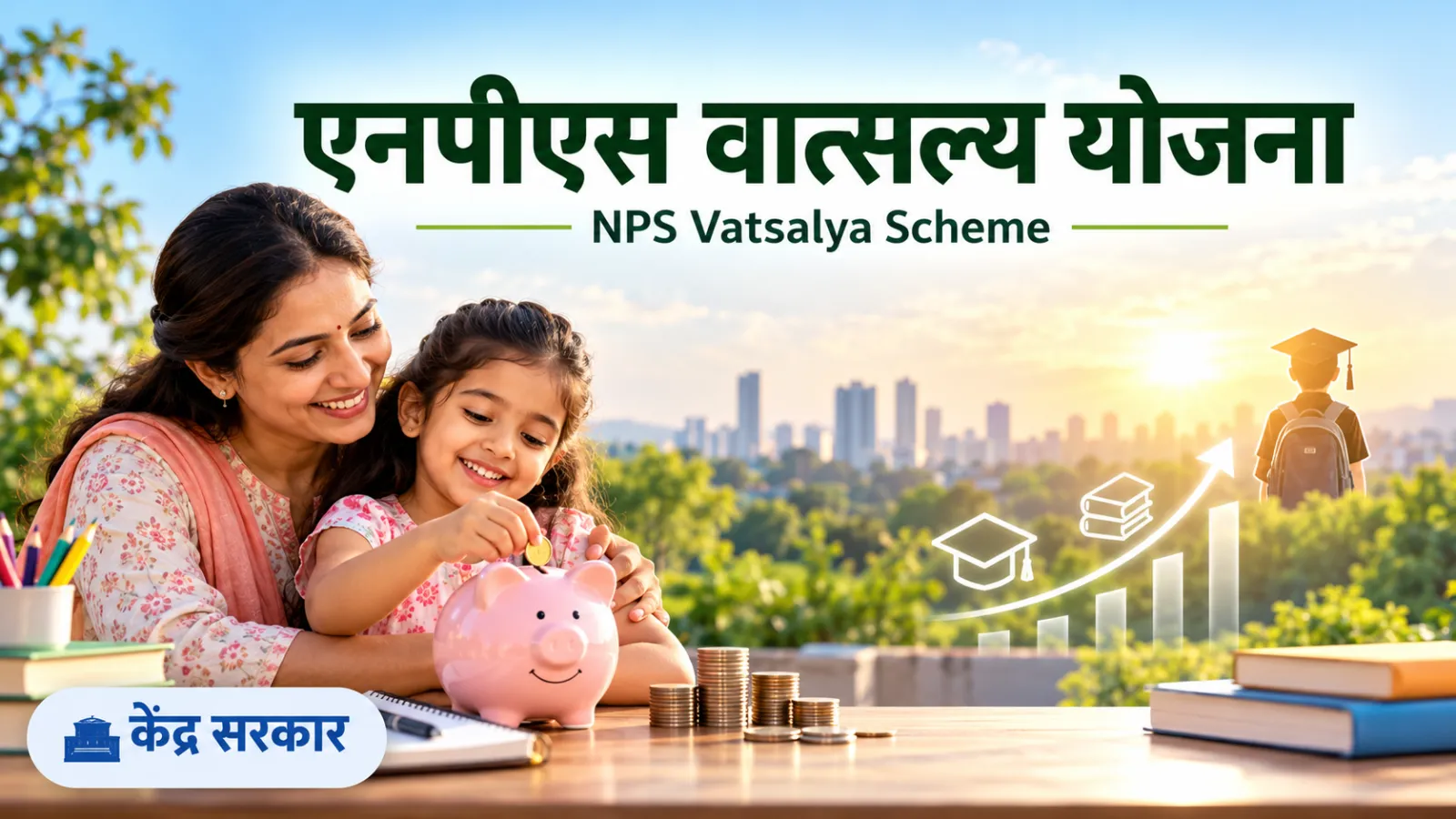
NPS Vatsalya in 2026: A Parent's Guide to the Child's Pension Account
Saving for a child usually begins with immediate goals: school expenses, occasional medical costs and perhaps a university education several years away. Retirement seems distant, especially when the child is still learning to read. NPS Vatsalya takes a different approach. It lets parents or legal guardians start a regulated, long-term investment account in a minor's name, with the possibility of moving that accumulated investment into the regular National Pension System when the child becomes an adult.
Launched on 18 September 2024, the arrangement is regulated by the Pension Fund Regulatory and Development Authority (PFRDA). Its revised NPS Vatsalya Scheme Guidelines 2025 were notified to take effect from 23 February 2026. Several popular explanations of the 2024 product therefore need updating, particularly the minimum contribution and the choices available when the subscriber turns 18.
Before opening an account: this is not a government cash payment for children, a guaranteed scholarship or a fixed-interest deposit. It is a voluntary contributory investment product. A child's account balance depends on actual contributions, market performance, charges and the applicable rules.
2026 NPS Vatsalya Rules at a Glance
Question | Current scheme position
Who can join? | Eligible Indian citizens below 18, including qualifying NRI and OCI minors
Whose account is it? | The minor is the subscriber and sole beneficiary
Who operates it? | A parent or legal guardian until the subscriber turns 18
Initial minimum | ₹250
Minimum subsequent transaction | ₹10
Annual minimum | ₹250 in each financial year
Maximum contribution | No prescribed maximum
Investment outcome | Market-linked, without a guaranteed interest rate
Partial withdrawals | Subject to a three-year minimum and specified purposes
At adulthood | Complete fresh KYC; select the applicable continuation, transfer or exit option
Why the 2026 Contribution Change Matters
Older online guides sometimes state that ₹1,000 is the compulsory minimum for opening a Vatsalya account. The current official PFRDA information gives a minimum of ₹250 at opening and ₹250 per financial year. After the opening contribution, individual transactions can start at ₹10. There is no fixed upper limit on contributions and no restriction on how many permitted contributions are made during a financial year.
This flexibility can be meaningful to a household with irregular income. A family might make occasional contributions after seasonal earnings rather than follow a rigid monthly deposit calendar. Another family may choose recurring transfers for the sake of financial discipline. Neither approach converts the investment into a guaranteed savings account, and any applicable intermediary fees should be considered.
PFRDA also explains that a missed financial-year contribution does not by itself automatically terminate the account. Nonetheless, guardians should not ignore the annual minimum or leave the account unmonitored. Check its status with the relevant Central Recordkeeping Agency and keep contact information current.
Who Owns the Money: The Child or the Guardian?
The minor is the NPS Vatsalya subscriber and sole beneficiary. A Permanent Retirement Account Number, known as PRAN, is issued in the child's name. The parent or lawful guardian operates the account during minority; this does not make it an ordinary investment account owned by the adult.
Relatives and friends may also contribute through authorised channels. For instance, a grandparent might prefer to contribute to the child's long-term investment rather than give a conventional present. But contributing money does not make the relative an additional beneficiary or confer control over the account. The arrangement is designed around the financial future of the minor subscriber.
Eligibility is gender-neutral. The programme is not confined to girls, children from a particular income bracket, or students scoring particular examination marks. Eligible NRI and OCI minors are also covered under the conditions prescribed for those categories.
How to Open an NPS Vatsalya Account
Parents can approach a PFRDA-registered Point of Presence (PoP), use the eNPS facility, or use an authorised digital channel offered by a registered intermediary. At registration, the guardian can select from available Central Recordkeeping Agencies and registered Pension Funds according to the applicable framework.
- Begin at the official PFRDA NPS Vatsalya information page.
- Choose an authorised eNPS route or a registered Point of Presence.
- Prepare the child's age evidence and the guardian's KYC documents.
- Provide accurate minor, guardian and contact particulars.
- Review the available pension fund and investment choices.
- Make the minimum opening contribution of ₹250 or more through the official channel.
- Retain the PRAN and acknowledgement, and check the account details for errors.
A private social-media link promising special returns or guaranteed approval is not a substitute for an authorised enrolment channel. Avoid sharing authentication OTPs, UPI PINs or banking passwords with unsolicited helpers.
Which Identity Documents Are Needed?
PFRDA lists several accepted forms of proof of the child's date of birth. Depending on the case, these may include a birth certificate, school-leaving certificate, matriculation certificate, PAN or passport. The guardian must meet applicable know-your-customer requirements using accepted identity documents such as Aadhaar, a driving licence, passport, voter ID, NREGA job card or National Population Register document, together with PAN or Form 60.
The account-opening bank account requirement differs by residency category. PFRDA identifies a bank account as optional at opening for resident Indians but mandatory for NRI and OCI cases. Bank details may still be needed later for withdrawals or exit processing. Always follow the current checklist of the registered PoP or CRA rather than treating every item in a general article as compulsory for every household.
Where Contributions Are Invested
NPS Vatsalya contributions are managed by a pension fund registered with PFRDA. They can be allocated across permitted asset categories such as equities, government securities, debt instruments and money market investments. The guardian's selected fund and scheme design can affect the risk and return profile. Current PFRDA guidance recognises investment arrangements under which a pension fund may allocate up to 100% to equity, subject to the regulatory framework.
That degree of equity exposure should make one point obvious: a regulated product is not the same as a principal-protected product. Returns will vary, and a period of market weakness can reduce the current value of the corpus. Do not treat advertisements showing annual returns of 10% or 12% as promises for future years. Understand the fund's investment approach before selecting it.
What Regular Contributions Could Look Like
Imagine a guardian decides to save ₹500 a month and periodically contributes those savings to the child's NPS Vatsalya account. That adds up to ₹6,000 of personal contributions during a year. Over ten years, the contributions alone would total ₹60,000, assuming the same amount each year. The eventual account value would not necessarily equal ₹60,000 because investment returns and charges change the result.
This is a contribution illustration, not an investment projection. The objective is to understand how habits accumulate, not to promise a large future pension from a small monthly sum. Families should maintain liquid reserves for emergencies and near-term education costs. Money committed to a long-term investment should not be the only resource available for next year's school fees.
When Can Money Be Withdrawn Before Adulthood?
NPS Vatsalya has specific limited partial-withdrawal provisions. Generally, at least three years must pass after the account is opened. Eligible purposes include the minor's education, treatment of specified illnesses and disability of more than 75% of the minor. This is not unrestricted access for holidays, shopping or household bills.
The permitted partial-withdrawal amount is up to 25% of the subscriber's own contributions, excluding investment returns. Suppose the amount contributed over time totals ₹40,000; 25% of those contributions is ₹10,000. It would be incorrect to calculate 25% of the full market value if the corpus has grown beyond contributions. Actual approval remains subject to the permitted reason and operating conditions.
The rules permit at most two such withdrawals before the subscriber turns 18. Between ages 18 and 21, two additional partial withdrawals may be allowed following the necessary KYC and other requirements. Plan for emergencies separately so that a restricted long-term account does not become the family's only source of accessible money.
What Changes When the Child Turns 18?
At 18, the subscriber becomes responsible for operating the account. Fresh KYC and the required nomination particulars must be provided. Rather than assuming that the entire savings balance is automatically paid out on the eighteenth birthday, the newly adult subscriber needs to consider several permitted options.
One option is to continue in NPS Vatsalya until age 21. Another is to shift the entire accumulated corpus to an eligible regular NPS model after the required verification. A third is to exit according to the special corpus thresholds. The availability of each route is governed by the published rules and completed documentation.
How the ₹8 Lakh Exit Threshold Works
If a qualifying subscriber elects to exit and the corpus is below ₹8 lakh, the current rules permit withdrawal of the entire amount in one lump sum. If the corpus is ₹8 lakh or higher, up to 80% may be withdrawn as a lump sum and at least 20% must be used to purchase an annuity.
For example, a hypothetical corpus of ₹10 lakh falls into the second category. The applicable exit arrangement can require at least ₹2 lakh to be applied towards an annuity purchase, with up to ₹8 lakh available as a lump sum. This should not be confused with a blanket statement that the entire lump sum is tax-free: taxation and withdrawal permission are separate questions.
An annuity is a financial product that provides payments under a defined contract. Its actual payout depends on the provider, options and rates available at purchase. No fixed lifelong monthly pension should be advertised for a child today.
What Happens if No Decision Is Made by 21?
PFRDA says that when the subscriber exercises none of the permitted options between 18 and 21, the account automatically shifts to a higher-equity scheme under the Multiple Schemes Framework of the same pension fund. Thereafter, the applicable NPS exit and withdrawal regulations govern the account. This may materially change the investment profile, so a family should not simply forget about the account once the child reaches adulthood.
Parents can use the years before 18 to explain investing, compounding, market losses and personal financial decisions. The adult subscriber should then be prepared to review the investment arrangement, update contact information and select the option consistent with future needs.
Tax Treatment Requires a Separate Check
PFRDA's current scheme page describes an eligible contribution deduction of up to ₹50,000 for a parent or guardian under the old income-tax regime, with no equivalent contribution deduction under the new regime. Different provisions apply to partial withdrawals, purchase of annuity and lump-sum exits. The site also distinguishes the percentage of the corpus that may be withdrawn from the percentage that can be exempt from tax.
Tax consequences depend on the law applicable at the time and individual circumstances. A family comparing old and new tax regimes should check current rules or seek professional tax advice. In particular, never assume that an 80% permitted lump-sum withdrawal means that 80% is necessarily exempt from income tax.
NPS Vatsalya Versus a Bank Fixed Deposit
A conventional bank fixed deposit generally offers a stated rate for an agreed term, while NPS Vatsalya invests through market-linked pension funds. The products also differ in how and when money can be accessed. NPS Vatsalya's restrictions may be suitable for long-term saving discipline but inconvenient for families expecting to pay tuition within the next year.
The right comparison is about purpose rather than slogans. For short-term bills, easy liquidity may matter more than the possibility of long-term growth. For a decades-long retirement objective, investment horizon and risk tolerance become more important. Families may use different tools for different goals instead of expecting one account to cover every need.
Errors to Avoid Before Enrolling
- Repeating the outdated ₹1,000 opening-minimum rule.
- Assuming ₹250 must be deposited every month.
- Describing market-linked returns as a guaranteed interest rate.
- Calculating the partial-withdrawal limit on the full market corpus.
- Believing the balance is always released in full at age 18.
- Assuming the parent, rather than the child, owns the PRAN.
- Confusing the permitted exit percentage with a tax-exemption percentage.
- Using an unregistered intermediary to handle identity or payment credentials.
Frequently Asked Questions
Can an account be opened for a newborn?
The product is designed for eligible minors below 18. A guardian should confirm the acceptable birth document and current registration process with the authorised provider.
Is a monthly contribution mandatory?
No fixed monthly payment schedule is prescribed. The minimum is ₹250 at opening and ₹250 per financial year; later contributions can start at ₹10.
Can grandparents contribute?
Yes. PFRDA permits contributions by relatives and friends through authorised routes, while the minor remains the account's beneficiary.
Are returns guaranteed by the Government?
No. NPS Vatsalya is invested through pension funds with market-linked outcomes and no guaranteed rate.
Can the full corpus be withdrawn at 18?
An exit with corpus below ₹8 lakh permits full lump-sum withdrawal, but a corpus of ₹8 lakh or more follows the separate lump-sum and annuity conditions.
What if the family misses a contribution year?
The scheme page says an account does not automatically cease solely because contributions were missed during one financial year. Continue to follow the applicable operational requirements.
Can a parent make a complaint online?
PFRDA provides its Pension Sahayak grievance routes, and the account's authorised CRA or PoP also offers assistance.
Does the scheme replace education savings?
Not necessarily. Partial withdrawals are restricted to specified purposes and amounts. Short-term education costs may call for separately accessible savings.
Conclusion
NPS Vatsalya offers a regulated way to begin investing for a minor, with a low ₹250 opening minimum and a structured pathway into adult NPS participation. Its greatest strengths are flexibility of contribution and a long investment horizon, but its limitations are equally important: market risk, restricted withdrawals and specific exit rules. The best first step is to read the latest PFRDA guidance, examine the authorised fund and provider choices, and decide whether the arrangement suits the family's actual time horizon and financial capacity.
Official Sources
- PFRDA — Official NPS Vatsalya Guide
- PFRDA — NPS Vatsalya Scheme Guidelines 2025
- PFRDA — Effective Date Notification
Last reviewed: 19 October 2026. Disclaimer: eSarkariYojna is an independent informational website, not PFRDA or a government investment platform. This article is general information, not personalised financial or tax advice. Confirm current rules and fees with PFRDA and the authorised intermediary before investing.
Always check the official website for final and accurate information.
Visit official website: www.pib.gov.in ↗Last updated: 20 Oct 2026