Mission Vatsalya
Child protection and rehabilitation services for children in need of care and protection or in conflict with law, implemented through States and districts.
Eligibility: This is not a universal personal cash scheme; approach the designated child protection institutions for assessment.
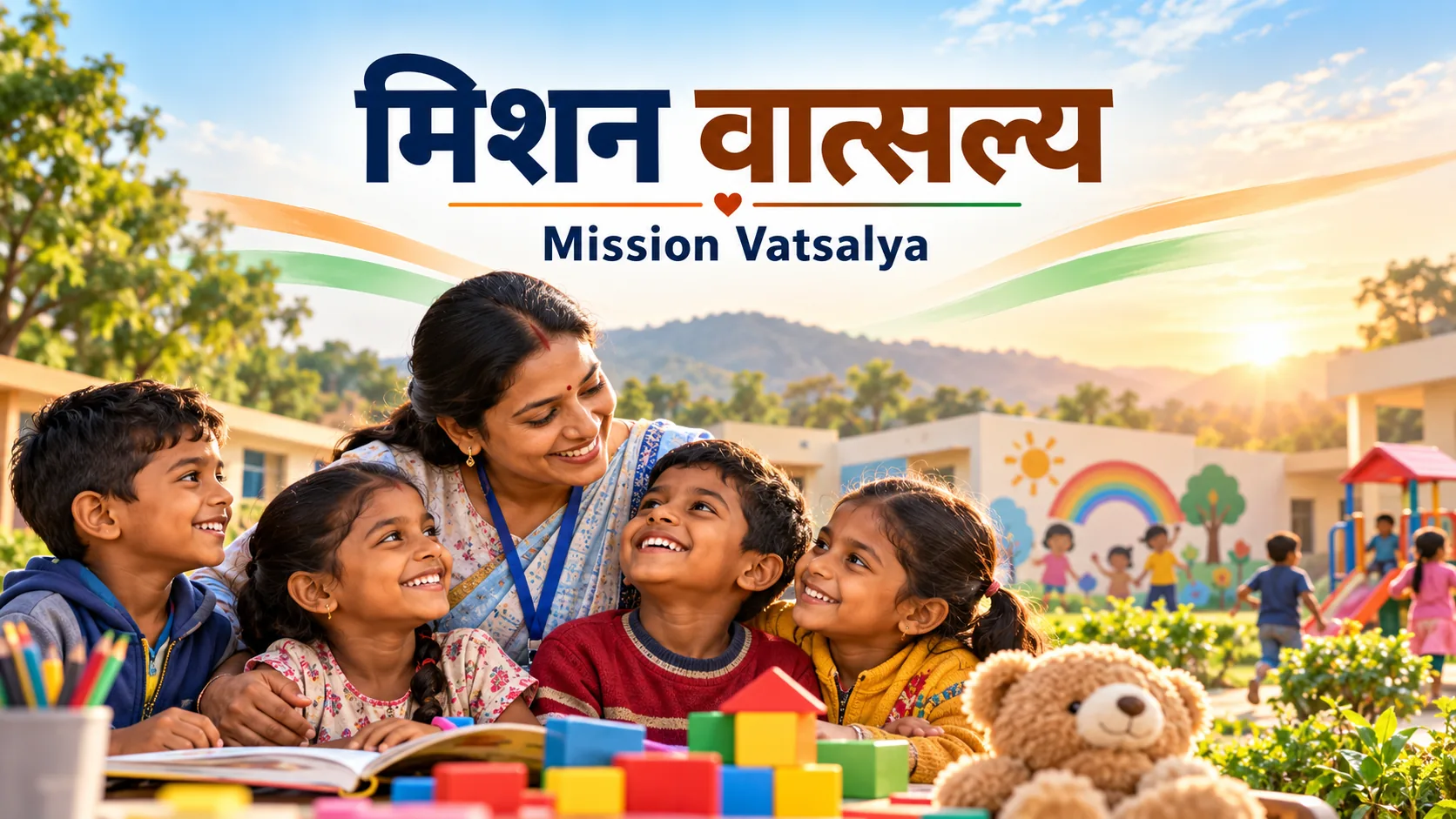
What Is the Mission Vatsalya Scheme?
Mission Vatsalya is a Government of India child protection programme designed to support children who are living in difficult circumstances, need care and protection, or require rehabilitation under the juvenile justice system. The programme is administered by the Ministry of Women and Child Development in partnership with State Governments, Union Territory administrations and district-level child protection authorities.
The scheme works within the framework of the Juvenile Justice (Care and Protection of Children) Act, 2015, as amended. Its purpose is not limited to operating children's homes or providing financial assistance. It also aims to strengthen the institutions responsible for protecting children, assessing their needs and helping them return to safe family or community environments wherever appropriate.
Mission Vatsalya covers institutional care and non-institutional care. Institutional care may involve authorised Child Care Institutions when a child requires a protected residential arrangement. Non-institutional care includes sponsorship, foster care and aftercare support, with an emphasis on keeping children in suitable family-based environments whenever possible.
The programme also supports Child Helpline 1098, coordination between child protection agencies, rehabilitation services and the statutory mechanisms that deal with children in different legal and social circumstances.
Important: Mission Vatsalya is not a universal cash-benefit programme in which every parent can submit an online form and receive a guaranteed monthly payment. Access to support depends on the child's circumstances, the applicable guidelines and decisions made through authorised child protection processes.
Mission Vatsalya Scheme 2026: Key Details
| Particular | Details |
|---|---|
| Scheme name | Mission Vatsalya |
| Responsible ministry | Ministry of Women and Child Development |
| Programme type | Centrally Sponsored Scheme |
| Legal framework | Juvenile Justice (Care and Protection of Children) Act, 2015, as amended |
| Primary groups | Children in Need of Care and Protection and Children in Conflict with Law |
| Main care arrangements | Institutional and family-based non-institutional care |
| Non-institutional grant provision | ₹4,000 per child per month under specified support categories |
| District coordination | District Child Protection Unit (DCPU) |
| Statutory child protection body | Child Welfare Committee (CWC) |
| Child Helpline | 1098 |
| Emergency assistance | 112 |
| Official portal | Ministry of Women and Child Development |
The financial grant listed above is part of a government-administered support framework. It should not be interpreted as an automatic payment available to every household with a child.
What Is the Main Objective of Mission Vatsalya?
The central objective of Mission Vatsalya is to create a coordinated child protection system that can respond to the needs of children facing unsafe or vulnerable circumstances.
Children may require protection for different reasons, including neglect, exploitation, abandonment, violence, family separation or other circumstances identified under the applicable law. A single form of assistance cannot address every situation.
Mission Vatsalya therefore supports a range of services and institutions intended to assess individual needs, provide appropriate care and encourage rehabilitation.
Protecting Children From Harm
The programme seeks to strengthen the identification and protection of children who may be exposed to unsafe environments. Relevant child protection authorities can intervene through the statutory framework when protection is required.
Prioritising Family-Based Care
Government guidelines emphasise the principle that institutionalisation should be a measure of last resort. Where safe and suitable, support that allows a child to remain with family or in an appropriate family-based setting is preferred.
Supporting Education, Health and Development
Children experiencing difficult circumstances may need help with schooling, healthcare, nutrition, counselling and other developmental requirements. Mission Vatsalya supports arrangements through which these needs can be addressed.
Encouraging Rehabilitation and Reintegration
For children who have experienced institutional care or disruption to family life, rehabilitation may involve education, skill development, emotional support and preparation for greater independence.
Who Is Eligible Under Mission Vatsalya?
Eligibility is linked to the child's circumstances and the relevant provisions of the Juvenile Justice Act. Under that legislation, a child is generally a person who has not completed 18 years of age.
Two legal categories are especially important for understanding the scheme.
Children in Need of Care and Protection (CNCP)
This category concerns children whose situations require protective intervention under the law. Depending on the facts and applicable legal definitions, it may include children experiencing abandonment, serious neglect, abuse, exploitation or other circumstances requiring care and protection.
The Child Welfare Committee has an important statutory role in considering the needs of such children and making appropriate decisions in their best interests.
Not every child experiencing economic hardship automatically qualifies for every component of Mission Vatsalya. Support depends on the relevant criteria, assessment and authorised process.
Children in Conflict with Law (CCL)
This category concerns children who are alleged or found to have committed an offence under the applicable juvenile justice framework.
The Juvenile Justice Board deals with relevant legal proceedings and related decisions. These cases follow different procedures from those involving children primarily identified as needing care and protection.
Mission Vatsalya supports the broader system of appropriate care, services and rehabilitation for children covered by these provisions.
What Benefits and Services Does Mission Vatsalya Provide?
The programme includes several forms of support. The most suitable arrangement depends on the child's needs, living circumstances and decisions of the responsible authorities.
| Service | Purpose |
|---|---|
| Sponsorship | Help an eligible child remain in an appropriate family setting with support for essential needs |
| Foster care | Provide authorised alternative care in a suitable family environment |
| Aftercare | Support eligible young people transitioning from institutional care |
| Child Care Institutions | Provide protected residential care and rehabilitation where necessary |
| Child Helpline | Connect children in difficult circumstances with emergency and protection services |
| Rehabilitation support | Facilitate education, health, counselling, skills and social reintegration |
These are different services rather than a single package automatically awarded to every applicant.
What Is the ₹4,000 Monthly Assistance Under Mission Vatsalya?
One of the most frequently searched aspects of Mission Vatsalya is its ₹4,000 monthly grant provision.
The Ministry of Women and Child Development describes a grant of ₹4,000 per child per month for specified non-institutional care components, including sponsorship, foster care and aftercare. This funding is provided within the scheme's government-administered arrangements.
It is important to distinguish this provision from a universal payment to parents. The grant is associated with approved care arrangements and the applicable assessment and sanction process.
At the district level, the Sponsorship and Foster Care Approval Committee (SFCAC) has responsibilities related to reviewing and sanctioning sponsorship support. The District Child Protection Unit may carry out relevant assessments and case-related work.
An applicant should not assume that submitting an identity document or online form creates an automatic entitlement to ₹4,000 each month.
The child's circumstances, eligibility requirements and responsible authorities' decisions determine whether support can be approved.
What Is Sponsorship Under Mission Vatsalya?
Sponsorship is intended to support eligible vulnerable children living with their families or suitable relatives where that arrangement is appropriate and safe.
A child may be at risk of separation from family because of circumstances affecting the household's ability to meet essential needs. In suitable cases, sponsorship can provide support for education, nutrition, health and development while helping maintain family care.
This approach reflects the principle that strengthening a safe family environment may be preferable to placing a child in institutional care.
However, sponsorship is not simply a general income-support payment for every low-income family. Authorities must evaluate the relevant circumstances and apply the prescribed guidelines.
How Does Foster Care Work?
Foster care provides an alternative family environment for a child who cannot remain safely or appropriately with their original family.
Under the relevant rules, a child may be placed with a suitable foster family through an authorised process. The objective is to provide nurturing, protection and appropriate support without treating institutional care as the default arrangement.
Foster care should not be confused with adoption. Adoption involves a separate legal process and consequences, while foster care is a care arrangement governed by its own statutory requirements.
A private agreement to transfer a child into another household is not a substitute for the official foster care process.
The appropriate authorities must consider the child's best interests and the suitability of the care arrangement.
What Is Aftercare Support?
Aftercare is designed to help eligible young people transition from Child Care Institutions towards independent life after they reach adulthood.
Leaving a residential care environment can be challenging, particularly when a young person lacks family support, accommodation or a clear employment pathway.
Aftercare services may support education, vocational development, independent living preparation and social reintegration.
The Ministry's Citizen's Charter describes aftercare assistance within the non-institutional care framework up to the age of 21, subject to the applicable rules.
Not every person turning 18 is automatically entitled to aftercare. Eligibility is connected to the relevant child protection history and the prescribed assessment.
What Are Child Care Institutions?
Child Care Institutions (CCIs) are facilities established or recognised under the juvenile justice framework to provide care for children whose circumstances require institutional services.
Different institutions serve different purposes. The system includes Children's Homes, Open Shelters, Observation Homes, Special Homes and other designated facilities.
Depending on the institution and a child's needs, services can include accommodation, meals, education, health support, counselling, recreation and vocational opportunities.
The Juvenile Justice Act provides a framework for rehabilitation and social reintegration. Relevant services may include mental health interventions, life-skills education, treatment support and referrals.
A decision to place a child in institutional care must follow the appropriate legal process. Mission Vatsalya does not authorise an unrelated person to place a child in a home solely through a private arrangement.
What Does the Child Welfare Committee Do?
The Child Welfare Committee (CWC) is a statutory body responsible for dealing with cases involving children in need of care and protection.
Its responsibilities include considering a child's circumstances and making legally authorised decisions about care, protection and rehabilitation.
The committee is expected to act in the child's best interests under the relevant legal framework.
Families or individuals seeking help for a vulnerable child may be referred to the appropriate CWC through the official child protection system.
What Is the Role of the Juvenile Justice Board?
The Juvenile Justice Board (JJB) deals with children in conflict with law under the relevant statutory process.
Its role is distinct from that of the Child Welfare Committee. A child requiring protection because of neglect or abandonment does not necessarily fall under the same procedure as a child facing proceedings under juvenile justice law.
The board's work must follow the applicable legal safeguards and provisions relevant to children.
Mission Vatsalya supports services and institutions that form part of this wider child protection and rehabilitation system.
What Is the District Child Protection Unit?
The District Child Protection Unit (DCPU) is an important part of the district-level implementation structure.
Its functions include coordination with child protection agencies, supporting implementation of relevant services and working with the institutions responsible for vulnerable children.
The DCPU can also have a role in examining sponsorship or foster care cases and presenting relevant information through the prescribed administrative process.
For people seeking information about family-based assistance, contacting the responsible DCPU or designated district department can be an appropriate starting point.
How to Apply for Mission Vatsalya Support
There is no single application route that applies identically to every Mission Vatsalya service. The procedure depends on whether the child needs immediate protection, sponsorship, foster care, institutional care or another form of assistance.
For sponsorship-related questions, a family or caregiver may contact the appropriate district child protection authority to understand the assessment process.
Where a child is in immediate danger, an ordinary benefit application is not the correct first step. Contact Child Helpline 1098 or emergency assistance at 112.
General Steps for Seeking Assistance
- Identify the concern: Determine whether the child needs emergency protection, ongoing family support or another service.
- Contact the appropriate authority: Approach the DCPU, Child Helpline or another authorised child protection institution.
- Explain the circumstances: Provide accurate information about the child's situation and immediate needs.
- Follow the assessment process: The responsible authorities may review the case according to the applicable guidelines.
- Provide relevant records: Submit available documentation requested for that particular service, where appropriate.
- Receive the authorised decision: The care arrangement or assistance must be determined through the proper process.
- Follow up safely: Retain any official reference information and contact the designated authority when necessary.
What Documents Are Required?
A universal mandatory document checklist is not appropriate for Mission Vatsalya because cases differ substantially.
Depending on the circumstances, officials may need available records concerning the child's age, identity, family circumstances, education or health. Sponsorship and foster care assessments may also involve information about the caregiving environment.
Requirements depend on the specific support being considered and the applicable legal or administrative procedure.
In an emergency involving a child's safety, do not delay seeking help merely because supporting documents are missing. Immediate protection and formal benefit assessment are different processes.
What Is Child Helpline 1098?
Child Helpline 1098 provides a point of contact for children in difficult circumstances and people seeking help for a child.
Under Mission Vatsalya, the service operates in coordination with State and district child protection authorities and is integrated with the Emergency Response Support System, ERSS-112.
The Government describes a round-the-clock arrangement involving State-level control rooms and district Child Helpline units.
The purpose is to connect children with appropriate emergency outreach, care and long-term protection services.
Concerns involving a child at risk of violence, exploitation, abuse or other serious danger can be reported through 1098. For an immediate emergency, 112 is also available.
When asking for help, share necessary information safely. Avoid posting identifying information about a vulnerable child on public social media platforms.
What Should You Do if a Child Needs Immediate Protection?
A child's immediate safety should take priority over routine application or scheme verification.
- Contact 112 if there is an immediate emergency.
- Use Child Helpline 1098 for child protection assistance.
- Provide the child's location and relevant facts as safely as possible.
- Follow the instructions of authorised emergency or child protection personnel.
- Avoid publicly sharing sensitive details about the child.
- Do not hand a child over to an unknown person claiming to provide informal protection.
If a child has a medical emergency, seek appropriate emergency medical assistance as well. A general online information website cannot replace the authorised response system.
Does Every Child Receive ₹4,000 Under Mission Vatsalya?
No. The ₹4,000 monthly grant is connected to specified non-institutional care arrangements and the government approval process.
Many children instead receive support through care institutions, counselling, education, rehabilitation or protection services.
The purpose of Mission Vatsalya is to provide appropriate care and protection based on the child's circumstances. It should not be promoted as a guaranteed monthly cash payment for every child.
Mission Vatsalya Versus Poshan 2.0
| Feature | Mission Vatsalya | Saksham Anganwadi and Poshan 2.0 |
|---|---|---|
| Main objective | Child protection, care and rehabilitation | Nutrition and early childhood development |
| Primary groups | Children in difficult circumstances under the juvenile justice framework | Eligible young children, pregnant women, lactating mothers and designated adolescent girls |
| Delivery institutions | DCPU, CWC, JJB and authorised child care services | Anganwadi Centres and linked health services |
| Typical support | Sponsorship, foster care, aftercare and protection services | Supplementary nutrition, early learning and health-linked services |
Both programmes contribute to child welfare, but they address different needs. Explore our Child Development and Protection Schemes category for related government information.
Common Misunderstandings About Mission Vatsalya
Every low-income family receives ₹4,000: The scheme's financial assistance follows specific care arrangements and approval rules.
Foster care is the same as adoption: These are different legal arrangements with separate procedures.
Every child requiring support must enter an institution: Mission Vatsalya promotes suitable family-based care and treats institutionalisation as a last resort.
Child Helpline 1098 is only for missing children: It supports children in various difficult or unsafe circumstances.
An online form is required before emergency help: Immediate protection concerns should be directed to the appropriate helpline or emergency authority without delay.
Frequently Asked Questions
1. Who is Mission Vatsalya intended to support?
It supports children in need of care and protection and children in conflict with law through services under the juvenile justice framework.
2. What is the ₹4,000 assistance provision?
It is a monthly per-child grant provision for specified sponsorship, foster care and aftercare arrangements, subject to the applicable approval process.
3. Is every child automatically eligible for this amount?
No. Eligibility depends on the child's circumstances, relevant programme criteria and authorised assessment.
4. Where can a family ask about sponsorship?
The appropriate District Child Protection Unit or designated district child protection authority can provide information about the applicable process.
5. What does the Child Welfare Committee do?
It makes legally authorised decisions concerning children in need of care and protection under the relevant law.
6. What is foster care?
It is an authorised arrangement for a child to receive care in a suitable alternative family environment.
7. Who can receive aftercare support?
Eligible young people transitioning from the child protection and institutional care system may receive aftercare under the applicable rules.
8. What is the child protection helpline number?
Child Helpline 1098 provides assistance for children in difficult circumstances. Immediate emergencies can also be reported through 112.
9. Is there one nationwide public application form?
There is no single route covering every type of Mission Vatsalya assistance. The relevant district or statutory authority should be consulted.
10. Where can official information be checked?
The Ministry of Women and Child Development publishes Mission Vatsalya guidelines, information about non-institutional care and Child Helpline services.
Official Government Sources
- Ministry of Women and Child Development — Mission Vatsalya
- Official Mission Vatsalya Guidelines (PDF)
- Government Guidance on Sponsorship, Foster Care and Aftercare
- Official Child Helpline 1098 Information
- Press Information Bureau — Child Protection and Rehabilitation Services
Last reviewed: 19 October 2026. Eligibility, assessment requirements and approved care arrangements should be confirmed with the responsible district child protection authority. In emergencies, do not wait to complete a routine application.
Disclaimer: eSarkariYojna is an independent informational website, not a government authority or child protection agency. This guide explains publicly available scheme information and cannot approve assistance, arrange private child placement or replace official emergency services.
Always check the official website for final and accurate information.
Visit official website: www.wcd.gov.in ↗Last updated: 19 Oct 2026