Mission Shakti: Sambal and Samarthya Services for Women
Mission Shakti is an umbrella of protection and empowerment services, not a universal cash payment to all women.
Eligibility: Women and girls meeting the specific criteria of each Mission Shakti service; eligibility differs across protection, shelter, accommodation and empowerment components.
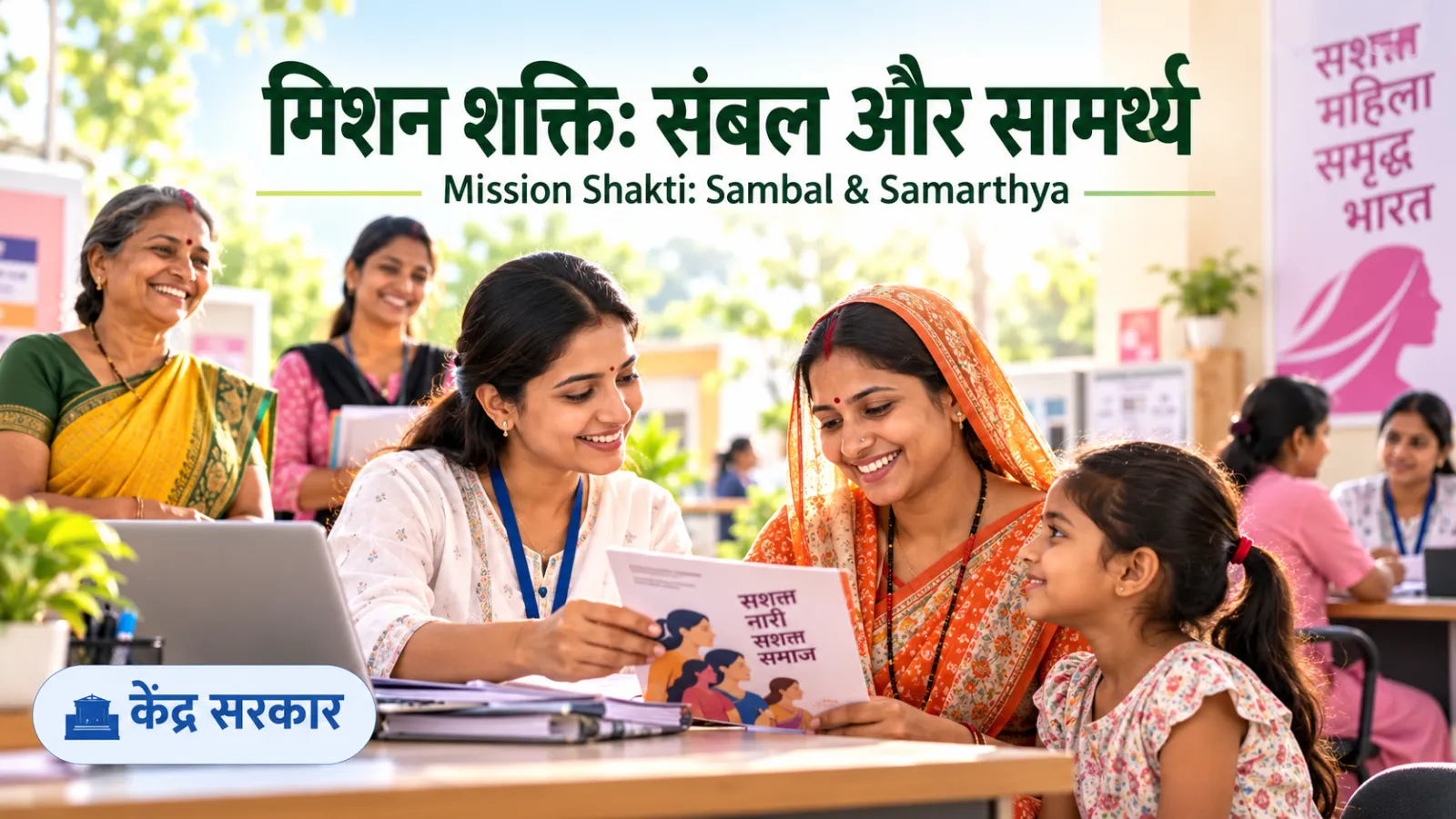
Mission Shakti: Sambal and Samarthya Services for Women: Practical 2026 Guide
Mission Shakti is an umbrella of protection and empowerment services, not a universal cash payment to all women. This guide distinguishes published programme design from an individual entitlement, approval or disbursement. It is written for readers who need to identify the actual authority handling their next step.
Key facts before proceeding
- Mission Shakti is an umbrella programme supporting safety, dignity and empowerment across women’s life stages.
- Sambal focuses on safety and protection; Samarthya supports empowerment and relevant services.
- The mission does not provide one uniform monthly cash benefit for every woman.
- PMMVY is one Samarthya component but has its own eligibility and distinct implementation; it should not be confused with access to a One Stop Centre.
A programme built around different kinds of support
Women may need crisis intervention, safe accommodation, childcare or information about rights at very different points in life. Mission Shakti brings multiple service channels under one policy framework rather than treating every problem as a cash-transfer application.
Always separate a programme announcement from the operative conditions under which benefits are delivered. An official page can explain the design without confirming that a particular application window is currently open. Check the department and local implementing institution before paying a fee or submitting sensitive documents.
Sambal and immediate safety needs
The Sambal side concentrates on protection, coordinated response and awareness. Its components are not interchangeable: an emergency referral, a counselling session and a community initiative are different forms of assistance.
For practical planning, create a short record of the problem, the organisation contacted and the evidence already supplied. This makes follow-up more efficient. Do not create a duplicate application simply because a portal has not immediately updated its status; ask the authorised office what the current record actually shows.
What a One Stop Centre actually provides
One Stop Centres are designed to reduce the burden of visiting several offices after abuse or violence. They coordinate medical, legal, police and counselling support; the precise response follows the survivor’s needs and safety assessment.
Headline benefit amounts should not be used as personal financial guarantees. Some programmes deliver services, some involve lending, and others transfer approved assistance. The beneficiary should understand the correct mechanism before committing household savings, signing a loan agreement or promising a payment to a third party.
When the 181 helpline is useful
The toll-free 181 service connects women seeking help with appropriate support systems, including emergency response and One Stop Centres. It is a referral channel, not proof that every call produces a particular financial benefit.
Take special care with identity information. A convincing social-media graphic and a government-style logo do not authenticate a payment or an application link. Use recognised public-service channels, keep credentials private and request a receipt when the relevant office formally accepts a document or correction.
Understanding Shakti Sadan support
Shakti Sadan is relevant when a woman needs more than a brief counselling interaction. Shelter, rehabilitation, support services and reintegration arrangements depend on individual circumstances and the responsible institutions.
Where implementation varies by district or institution, ask a precise question rather than assuming a nationwide procedure. The most useful answer identifies the responsible authority, the current stage and the next document or decision required. Keep a dated copy of that answer so later enquiries are grounded in evidence.
Sakhi Niwas for working women
A woman relocating for employment may need affordable and secure accommodation rather than crisis shelter. Sakhi Niwas serves that different policy purpose, subject to accommodation rules, local availability and the particular facility.
The useful next step is to identify exactly which part of the process applies to the household or applicant. Keep the relevant reference, date and written response together. A neighbour’s experience may be helpful context, but it is not evidence that the same eligibility decision or timetable applies in another case.
Childcare through Palna
Childcare is an economic participation issue as well as a family concern. The Palna component addresses access to crèche services; local service hours, places and eligibility are not uniform across all locations.
Always separate a programme announcement from the operative conditions under which benefits are delivered. An official page can explain the design without confirming that a particular application window is currently open. Check the department and local implementing institution before paying a fee or submitting sensitive documents.
BBBP is not a universal scholarship
Beti Bachao Beti Padhao works through communication and community-level change. It should not be described as a guaranteed deposit for every girl child; scholarship eligibility must be traced to the appropriate separate scheme.
For practical planning, create a short record of the problem, the organisation contacted and the evidence already supplied. This makes follow-up more efficient. Do not create a duplicate application simply because a portal has not immediately updated its status; ask the authorised office what the current record actually shows.
Keeping component programmes distinct
PMMVY is administered within the broader ecosystem but has separate rules for maternity benefits. A Mission Shakti overview should point readers toward the dedicated maternity guide instead of combining all components into an imagined single application.
Headline benefit amounts should not be used as personal financial guarantees. Some programmes deliver services, some involve lending, and others transfer approved assistance. The beneficiary should understand the correct mechanism before committing household savings, signing a loan agreement or promising a payment to a third party.
Finding the right local access point
A person searching for assistance should first identify whether the issue is safety, shelter, accommodation, childcare or scheme information. The relevant local contact will differ; official directories and authorised centres are safer than anonymous intermediaries.
Take special care with identity information. A convincing social-media graphic and a government-style logo do not authenticate a payment or an application link. Use recognised public-service channels, keep credentials private and request a receipt when the relevant office formally accepts a document or correction.
Safe records and confidential information
Safety-related cases often involve sensitive medical or personal information. Seek an authorised contact and explain the situation without publishing documents in open groups. Requirements vary, and crisis assistance should not depend on a social-media agent.
Where implementation varies by district or institution, ask a precise question rather than assuming a nationwide procedure. The most useful answer identifies the responsible authority, the current stage and the next document or decision required. Keep a dated copy of that answer so later enquiries are grounded in evidence.
Misleading cash-benefit claims
An umbrella programme can be misrepresented by advertisements that claim everyone receives a fixed allowance or instant placement. Ask which exact component is being discussed and which official authority administers it.
The useful next step is to identify exactly which part of the process applies to the household or applicant. Keep the relevant reference, date and written response together. A neighbour’s experience may be helpful context, but it is not evidence that the same eligibility decision or timetable applies in another case.
When a referral does not resolve the problem
Not every referral produces an immediate resolution. Keep the service reference when available and seek the designated supervisory support. For an immediate threat, emergency assistance takes priority over reading an online article.
Always separate a programme announcement from the operative conditions under which benefits are delivered. An official page can explain the design without confirming that a particular application window is currently open. Check the department and local implementing institution before paying a fee or submitting sensitive documents.
The practical takeaway
The mission is best understood as a network of distinct interventions. Accurate guidance identifies a woman’s actual need and directs her to the relevant authorised service, rather than promising a universal payment.
For practical planning, create a short record of the problem, the organisation contacted and the evidence already supplied. This makes follow-up more efficient. Do not create a duplicate application simply because a portal has not immediately updated its status; ask the authorised office what the current record actually shows.
Frequently asked questions
Does meeting a headline description guarantee approval?
No. The competent authority still checks the applicable scheme conditions, supporting records and implementation requirements.
Is there always an open online application form?
No. Some processes involve official service centres, district offices, bank appraisal or pre-existing beneficiary lists. Check the current route.
What if my identity or household records do not match?
Use the responsible agency’s correction procedure and retain an acknowledgement. Do not hand OTPs or account passwords to an unofficial intermediary.
How should a pending payment be investigated?
Identify whether the outstanding step is verification, sanction, transfer processing or actual bank credit. Different agencies handle these stages.
Can a social-media deadline be trusted?
Not without confirmation. Check the government notice and its date; an old application window may have already closed.
Where should an applicant verify the rules?
Use the official government resources below and contact the authorised implementing office for any case-specific decision.
Government references and editorial disclaimer
- https://wcd.gov.in/women/mission-shakti
- https://wcd.gov.in/women/one-stop-centre-header
- https://www.wcd.gov.in/offerings/women--helpline--scheme
Independent informational portal, not a government agency. Verify the latest scheme rules before applying.
Always check the official website for final and accurate information.
Visit official website: wcd.gov.in ↗Last updated: 20 Oct 2026