Samagra Shiksha Scheme (Former Sarva Shiksha Abhiyan)
Samagra Shiksha supports school education from pre-school to Class 12 through learning and infrastructure initiatives.
Eligibility: Eligible schoolchildren and institutions, subject to state and programme rules.
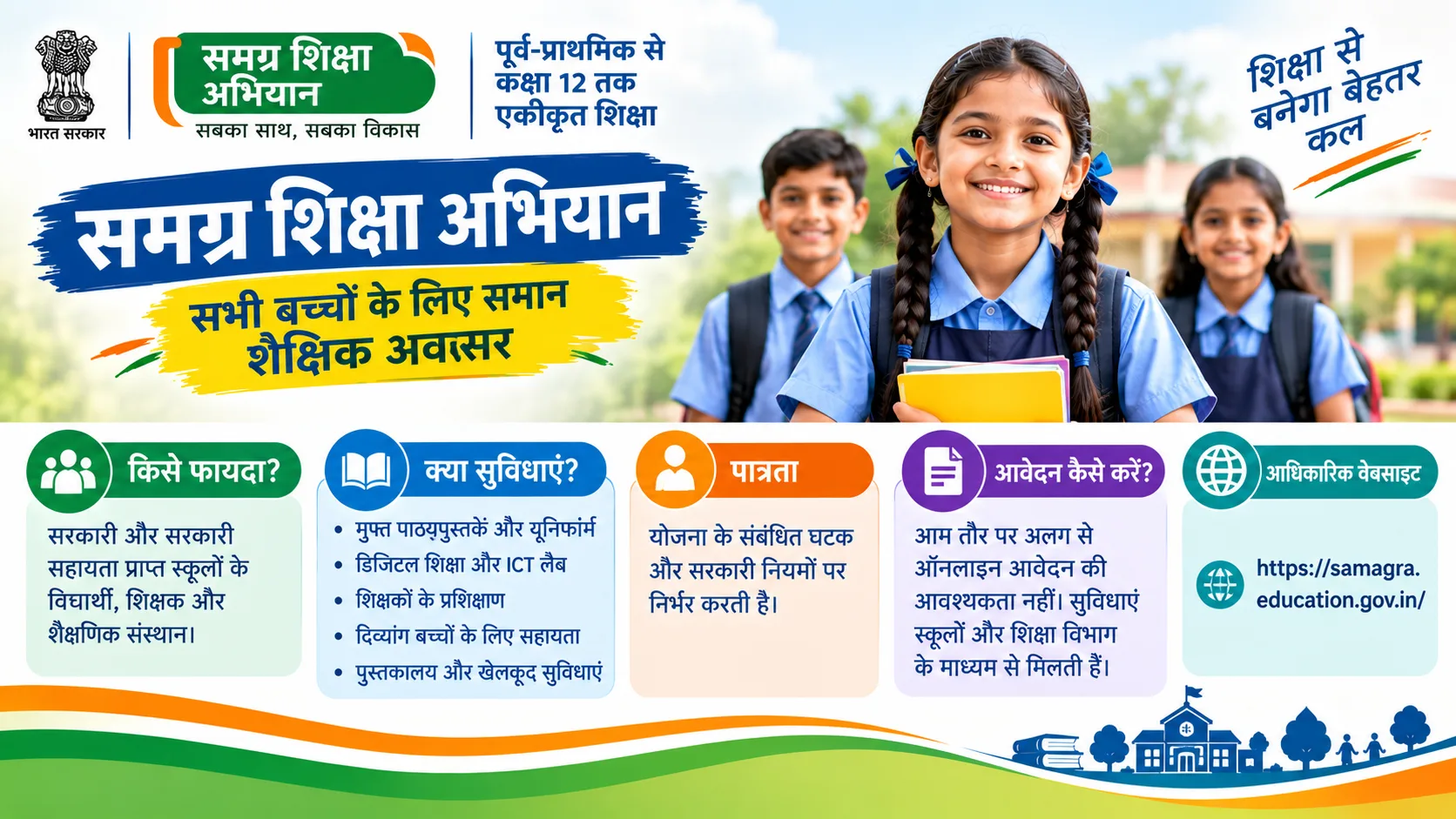
What Is Samagra Shiksha?
Samagra Shiksha is an integrated school education programme implemented by the Government of India in partnership with State and Union Territory governments. It aims to improve access to education, learning outcomes, school facilities, teacher training and educational opportunities for children from different backgrounds.
Introduced in 2018, Samagra Shiksha brought together three earlier programmes: Sarva Shiksha Abhiyan (SSA), Rashtriya Madhyamik Shiksha Abhiyan (RMSA) and Teacher Education.
Samagra Shiksha covers school education from pre-school to Class 12. It should not be confused with a programme restricted only to primary education or children aged 6 to 14.
The scheme primarily provides support through schools, education departments and implementing agencies. It is not a universal cash-transfer programme offering the same payment to every student.
Samagra Shiksha vs Sarva Shiksha Abhiyan
Sarva Shiksha Abhiyan mainly focused on universal access to elementary education. Samagra Shiksha takes a broader approach by integrating pre-primary, elementary, secondary and senior secondary education within a single programme.
- Sarva Shiksha Abhiyan (SSA): Primarily focused on elementary education.
- Rashtriya Madhyamik Shiksha Abhiyan (RMSA): Focused on access to and improvement of secondary education.
- Samagra Shiksha: Covers pre-school through Class 12, along with teacher education, inclusion and school development.
Samagra Shiksha is therefore more than a simple renaming of Sarva Shiksha Abhiyan.
Objectives of the Samagra Shiksha Scheme
- Improve access to quality school education.
- Increase school enrolment and reduce dropouts.
- Address social and gender gaps in education.
- Support children with disabilities and special educational needs.
- Improve school buildings and essential infrastructure.
- Strengthen teacher training and classroom learning.
- Support digital education, vocational learning, sports and library facilities.
- Improve coordination between different levels of school education.
What Are the Benefits of Samagra Shiksha?
Samagra Shiksha supports several types of educational services and interventions. Actual benefits vary according to the state, school, grade, student category and relevant programme rules.
1. Free Textbooks and Uniforms
The scheme provides financial support to States and Union Territories for supplying free textbooks and uniforms to eligible children at the elementary level.
Not every benefit applies automatically to every student or grade. Parents should check eligibility and distribution arrangements with their child's school.
2. School Infrastructure Development
Samagra Shiksha supports improvements to schools through approved infrastructure activities, including additional classrooms, school buildings and other essential facilities.
The availability of specific improvements depends on government approvals, funding and local needs.
3. ICT Labs and Smart Classrooms
The scheme supports digital learning initiatives, including ICT facilities, educational technology and smart classrooms in eligible schools.
Availability differs between schools and states. It should not be assumed that all government schools already have the same digital resources.
4. Inclusive Education for Children with Special Needs
Samagra Shiksha includes support for Children with Special Needs (CWSN) to improve participation and learning in school.
Depending on individual assessment and programme rules, support may include:
- Identification and assessment of educational needs.
- Assistive devices and accessible learning materials.
- Support from special educators and trained teachers.
- Accessibility improvements in school buildings.
- Transport or other support for eligible children.
- Specified assistance for girls with special needs.
The exact support available depends on the child's needs and the arrangements implemented by the relevant education department.
5. Girls' Education and Kasturba Gandhi Balika Vidyalayas
The scheme supports girls' education through initiatives such as Kasturba Gandhi Balika Vidyalayas (KGBVs), which provide residential educational opportunities for eligible girls from disadvantaged groups.
Facilities under KGBV can extend from Classes 6 to 12. Admission depends on the approved institution, student eligibility and state-specific procedures.
6. Vocational Education
Samagra Shiksha promotes vocational learning in eligible secondary and senior secondary schools. It aims to help students develop practical skills alongside general academic education.
7. Teacher Training and Educational Quality
The scheme supports professional development for teachers and institutional strengthening of bodies such as State Councils of Educational Research and Training (SCERTs) and District Institutes of Education and Training (DIETs).
These activities aim to improve teaching practices, school leadership and student learning outcomes.
Who Is Eligible for Samagra Shiksha Benefits?
Samagra Shiksha does not have one universal personal eligibility rule for every activity because it includes multiple school education components.
Depending on the programme, support may be available to:
- Eligible students from pre-school to Class 12.
- Government and other eligible schools covered by approved interventions.
- Children with disabilities or special educational needs.
- Eligible girls from disadvantaged groups under residential schooling initiatives.
- Teachers and teacher education institutions participating in training programmes.
Specific support depends on the student's circumstances, school type, state arrangements and the rules for the relevant intervention.
Important: The Right to Education Act establishes specific legal rights to free and compulsory elementary education for children aged 6 to 14. Samagra Shiksha is a broader education programme covering pre-school through Class 12, but that does not mean identical entitlements apply across every grade.
How Can Students Access Samagra Shiksha Benefits?
There is no single national online application form through which every student can register for all Samagra Shiksha benefits.
Many activities are delivered through participating schools, State Education Departments and local education authorities.
- Contact the child's school or a nearby government school.
- Ask which educational services and benefits are available for the relevant grade.
- Check the specific eligibility criteria for the requested support.
- Provide the enrolment or identity details requested by the school.
- For disability-related assistance, ask about the assessment and support process.
- For KGBV admission, contact the relevant school or local education authority.
- If the school cannot resolve the issue, approach the Block or District Education Office.
Be cautious of websites claiming that every student can register for a guaranteed fixed cash benefit under Samagra Shiksha. Verify such claims through official government sources.
Documents Required for Samagra Shiksha Support
Document requirements depend on the type of school service and the applicable State or Union Territory procedures.
Some programmes may require:
- Student name, age and school details.
- School enrolment or identification records.
- Parent or guardian information.
- Proof relating to an eligible social or educational category, where applicable.
- Disability or assessment documentation for specific support, where relevant.
- Other documents requested under a state programme.
Not every student needs every document on this list. Follow the specific requirements communicated by the school or education department.
Samagra Shiksha and the National Education Policy 2020
Samagra Shiksha has been aligned with several goals of the National Education Policy (NEP) 2020, including foundational literacy and numeracy, inclusive classrooms, improved learning outcomes, teacher development and digital education.
The Government formally approved a continuation period from 2021–22 through 2025–26. The Ministry of Education also described ongoing activities under Samagra Shiksha in July 2026.
Readers looking for the most recent funding period, approved allocations or revised implementation rules should consult the latest official government notifications rather than assuming earlier financial approvals remain unchanged.
Frequently Asked Questions About Samagra Shiksha
1. What is the Samagra Shiksha Scheme?
It is an integrated school education programme supporting educational quality, access, inclusion, infrastructure and teacher development.
2. Which classes are covered by Samagra Shiksha?
The programme covers school education from pre-school through Class 12.
3. Are Sarva Shiksha Abhiyan and Samagra Shiksha the same?
Not exactly. Sarva Shiksha Abhiyan was integrated with secondary education and teacher education programmes to form the broader Samagra Shiksha scheme in 2018.
4. Does Samagra Shiksha provide cash payments to all students?
No. It is not a universal direct cash-payment scheme. Benefits vary by educational component and eligibility.
5. Does the scheme provide free textbooks?
Support for free textbooks is available for eligible students at the elementary level through relevant government arrangements.
6. Are children with disabilities eligible for support?
Yes. Inclusive education is an important component, and eligible children may receive assistance suited to their educational needs.
7. How can parents apply for benefits?
Parents should contact the school or relevant State Education Department. There is no single national student application portal for every Samagra Shiksha service.
8. What is KGBV under Samagra Shiksha?
Kasturba Gandhi Balika Vidyalayas provide residential educational opportunities for eligible girls from disadvantaged groups, subject to programme rules.
9. Do all private-school students receive the same benefits?
No. Coverage varies by component, institution type and applicable government guidelines.
10. Where can I find official information about Samagra Shiksha?
Use the official Samagra Shiksha website, Ministry of Education resources and the relevant State Education Department.
Official Samagra Shiksha Websites and Resources
- Official Samagra Shiksha Portal: samagra.education.gov.in
- Scheme Features: Samagra Shiksha Features
- Inclusive Education: Inclusive Education Resources
- Ministry of Education: education.gov.in
Disclaimer: e-Sarkari Yojna is an independent informational website and is not operated by the Government of India or any State Education Department. Programme availability, eligibility and support may differ by state, school and educational component. Verify all final requirements through official government sources.
Always check the official website for final and accurate information.
Visit official website: samagra.education.gov.in ↗Last updated: 17 Oct 2026