Sukanya Samriddhi Yojana 2026: Interest Rate, Eligibility, Benefits, Deposit Rules and Maturity Explained
Understand Sukanya Samriddhi Yojana in 2026: 8.2% interest, who can open an SSY account, deposit limits, documents, withdrawal rules and maturity.
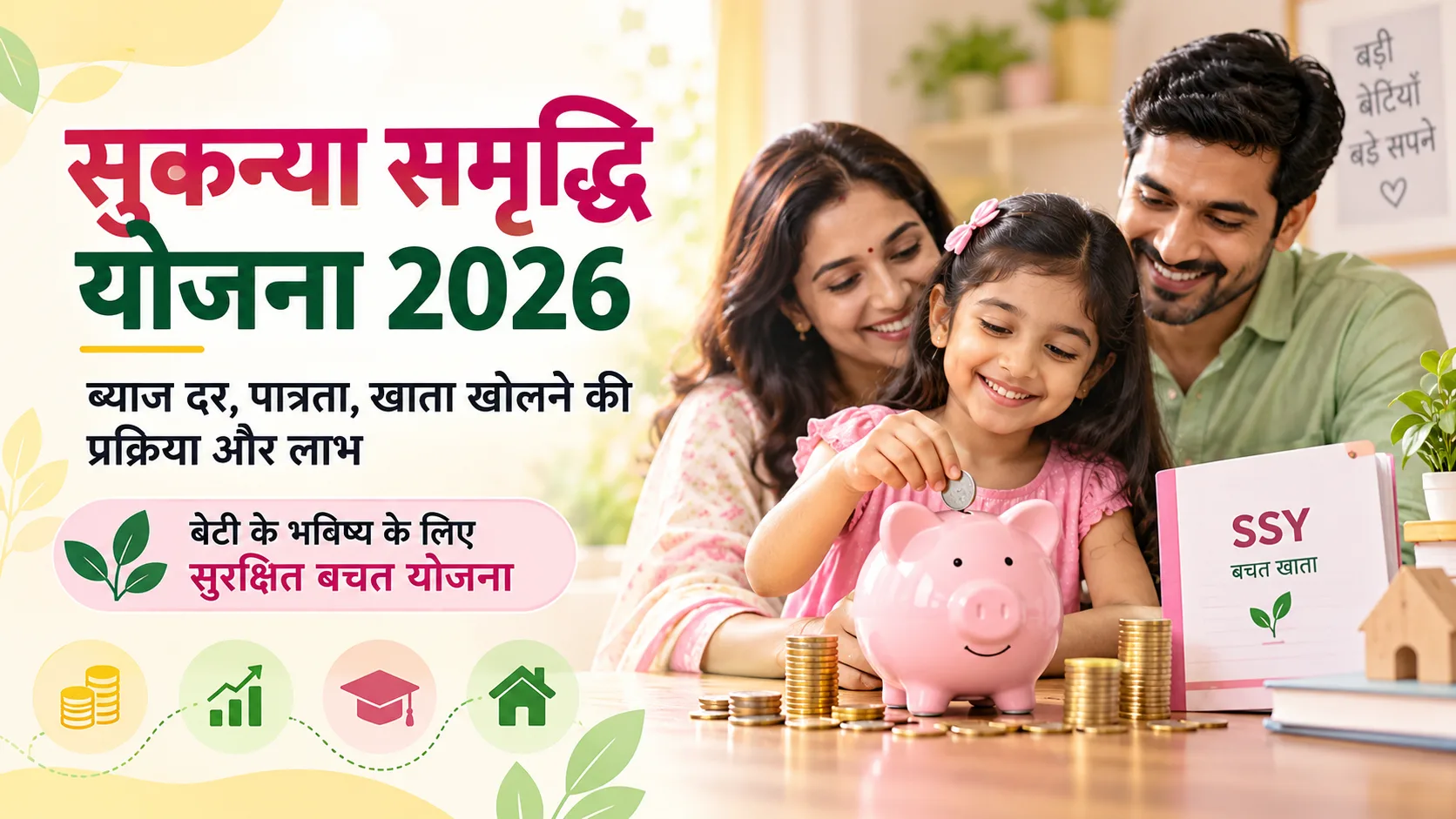
If you have a young daughter, you have probably heard someone recommend Sukanya Samriddhi Yojana. It might have been a relative, a bank employee, or a parent at school. The attraction is easy to understand: it is a government-backed savings account designed for a girl child's future, with tax advantages and a relatively attractive interest rate. But before opening one, it is worth understanding how the account actually works. In particular, the deposit period, maturity period and withdrawal rules are often confused with one another.
As of the October–December 2026 quarter, the Sukanya Samriddhi Account interest rate is 8.2% per annum, compounded annually. The government reviews small-savings rates every quarter, so 8.2% should not be treated as a fixed return for the entire life of an account. You can start with ₹250, contribute up to ₹1.5 lakh in a financial year, and generally make deposits during the first 15 years after opening. The account normally matures 21 years from its opening date—not automatically when the girl turns 21.
This guide answers the questions families actually ask: who is eligible, how many accounts are allowed, how much to save, where to open the account, whether it is available for boys, what happens if a deposit is missed, how higher-education withdrawals work, and what to check before using a maturity calculator.
What is Sukanya Samriddhi Yojana?
Sukanya Samriddhi Yojana, also called the Sukanya Samriddhi Account Scheme or SSY, is a small-savings scheme supported by the Government of India. It was introduced as part of the wider effort to encourage financial planning for girls. In practical terms, the parent or legal guardian opens an account in an eligible girl's name and puts money into it over several years. The account earns interest at the rate notified by the government for the relevant period. That interest is added to the balance and can itself earn interest, helping savings grow over the long term.
The scheme is not a scholarship, a direct cash grant or an insurance policy. Opening an account does not mean the government deposits an annual benefit into it. Families build the balance using their own contributions. SSY is therefore most suitable for households that want to earmark savings for a daughter's future and can leave most of that money invested for a long period.
People sometimes search for the “SSA account full form”. In post-office small-savings material, SSA can stand for Sukanya Samriddhi Account. SSY refers to the scheme, while SSA refers to the actual account. Do not confuse this abbreviation with Sarva Shiksha Abhiyan, which is an education programme and uses the same letters in a different context.
Sukanya Samriddhi Yojana at a glance
| Feature | Position in October 2026 |
| Who can open it? | A guardian on behalf of an eligible girl child |
| Girl child's age | Below 10 on the date the account is opened |
| Minimum opening deposit | ₹250 |
| Minimum annual deposit | ₹250 per financial year |
| Maximum annual deposit | ₹1,50,000 per financial year |
| Deposit period | First 15 years from account opening |
| Normal maturity | 21 years from account opening |
| Interest rate | 8.2% annually for October–December 2026 |
| Higher-education withdrawal | Up to 50% under prescribed conditions |
| Where available | Designated post offices and authorised banks |
| Tax treatment | Special tax benefits; deduction depends on applicable tax regime |
Keep in mind that interest rates can change. A table showing the current quarter is useful for planning today, but no current rate can guarantee the final value after two decades.
Who is eligible to open a Sukanya Samriddhi account?
An account is opened by a guardian in the name of a girl who has not yet reached her tenth birthday. The timing matters. If a daughter is nine years and eleven months old, the family should check the paperwork and approach an authorised office promptly rather than assume there is no deadline. Once the eligible age has passed, a new account generally cannot be opened under the scheme. The account is in the girl's name, not in the parent's personal name, even though the guardian operates it while she is a minor.
Ordinarily, only one Sukanya account is permitted for each girl. A family may generally open accounts for up to two girls. There are prescribed exceptions in certain multiple-birth situations, such as twins or triplets, which require supporting documents. Because these cases depend on the specific family circumstances, confirm the applicable exception and documentation with the account office instead of opening extra accounts and hoping they will be accepted.
A mother can open and operate an eligible account. A father can do so as well. A legal guardian can also act where the rules permit. The account should not be described as a benefit available only to mothers, single-parent households or families below a particular income threshold. It is a savings scheme with age and account-number conditions, not a general income-tested welfare payment.
Can Sukanya Samriddhi Yojana be opened for a boy?
No. One of the most common searches is “Sukanya Samriddhi Yojana for boy”. The scheme is specifically designed for a girl child, so a boy cannot have an SSY account opened in his name. That does not mean parents have no comparable savings choices for a son. Depending on their goals, they can look at a Public Provident Fund account, bank deposits, other post-office products or suitable investment arrangements. Each option has different risk, tax, access and maturity rules.
Parents with both a son and a daughter should not put all family savings into SSY simply because it offers an attractive rate. Education expenses for both children, emergency savings, life insurance needs and household cash flow should form part of the decision. SSY can be one dedicated component of the family's financial plan rather than the entire plan.
What is the Sukanya Samriddhi Yojana interest rate in 2026?
For 1 October to 31 December 2026, the notified interest rate for Sukanya Samriddhi accounts is 8.2% per annum, with annual compounding. The Ministry of Finance maintained small-savings rates for the quarter, and the schedule published by Indian Bank lists SSY at 8.2%. This is a current-quarter rate, not a contractual promise that the same number will remain in place for the next 15 or 21 years.
The government reviews rates quarterly. An account opened today can therefore earn different rates in different future periods. If rates rise, the growth trajectory can improve; if rates fall, future interest accrual will be lower than a projection based on today's rate. This is why articles promising a precise maturity amount are often misleading unless they clearly label it as an illustration.
Interest calculations also have timing rules. Under the scheme rules, interest for a calendar month is calculated using the lowest balance between the close of the fifth day of that month and month-end. Interest is credited at the end of the financial year. Depositing before that monthly cut-off can matter for how quickly new money starts earning interest. Check the actual credit date and transaction processing time at the bank or post office instead of treating an online transfer initiated at the last minute as necessarily completed that day.
How much can you deposit in an SSY account?
You need at least ₹250 to open the account, and the annual minimum is also ₹250. The maximum permitted deposit in a financial year is ₹1.5 lakh. The financial year runs from 1 April to 31 March, not from January to December. If you have contributed ₹80,000 since April, the remaining room for that financial year is ₹70,000. A fresh annual limit begins with the next financial year, subject to the rules then applicable.
Deposits after the initial amount are generally made in multiples of ₹50. You do not have to contribute the same amount each month. One family may add ₹500 whenever convenient, while another may deposit a larger amount once or twice a year. What matters is meeting the minimum and not exceeding the yearly ceiling. Families who earn seasonally or receive annual bonuses often prefer flexible deposits, but they should still plan ahead for the yearly minimum.
Think about affordability before choosing an ambitious figure. A commitment of ₹12,500 every month equals ₹1.5 lakh across twelve months; that is the current yearly maximum, not a compulsory payment. If ₹2,000 a month is more realistic, that is a legitimate contribution pattern too, provided the account rules are satisfied. An affordable plan that continues is more useful than a headline maturity projection based on contributions you may struggle to maintain.
Is there a monthly deposit requirement?
No fixed monthly deposit is mandatory. The scheme works around a financial-year minimum and maximum. You can save monthly if doing so helps you maintain discipline, but the account will not become irregular simply because one month has no deposit. Problems arise when the required minimum for an entire financial year is not paid. This distinction is particularly helpful for households with fluctuating income.
Some parents set up reminders to review deposits at the start of each financial year, while others contribute just before the close of the year. From an interest perspective, earlier contributions generally have more time to earn interest. From a household-budget perspective, it may be sensible to spread a large deposit over several months. Choose a schedule that balances both concerns and keep the transaction receipts.
How long do you deposit money: 15 years or 21 years?
This is the single most important rule to understand. Deposits are permitted for 15 years from the date the account is opened, subject to the scheme's conditions. Normal maturity happens 21 years from the opening date. These are different timelines. After the 15-year deposit period ends, the account does not need another six years of contributions to reach the normal maturity date. The existing amount can continue to earn interest under the applicable rules during the remaining period.
Imagine a girl is three years old when her guardian opens her account in October 2026. The deposit window would ordinarily run for 15 years from opening, while normal maturity would occur in October 2047. She would be about 24 years old then, not 21. Conversely, if the account opened shortly after birth, it would mature around the time she turns 21. Maturity depends on the date of opening, not simply the account holder's birthday.
This matters when planning college fees. Many families will need money before the account's normal maturity date. The scheme addresses that partly through a limited withdrawal facility for eligible higher-education expenses, but it is not designed to function as an unrestricted savings account. If university fees are likely to arise earlier, maintain some accessible savings outside SSY as well.
How to open Sukanya Samriddhi Yojana in a post office
Start by locating a post office that handles savings accounts or an authorised bank branch. Ask for the current Sukanya Samriddhi Account opening form and the latest checklist of required documents. Fill in the girl's details exactly as shown on her birth certificate, together with the guardian's information, address and identification details. Submit the form, provide the minimum opening deposit and complete any required identity verification. Obtain the account details or passbook and check the name, date of birth and opening date carefully before leaving.
The steps are straightforward, but small mistakes matter later. A misspelled name, inconsistent date of birth or incorrectly recorded guardian relationship can complicate transactions. Make sure the branch tells you how deposits can be made subsequently, whether digital options are available, and how to obtain statements. Keep copies of the documents and a note of where the account is serviced. Procedures can vary across institutions even though the scheme's core rules are common.
Do not pay a third-party website merely to obtain a government account-opening form. Use official bank or post-office channels. If an unfamiliar website promises instant approval, unusual bonuses or guaranteed government deposits, verify the claim directly with the institution before sharing identity documents or payment details.
Documents required for Sukanya Samriddhi Yojana
The girl's birth certificate is especially important because it establishes her name and age. The guardian should also be ready with proof of identity, address and any other information needed under the current customer-identification process. Depending on the account office and individual circumstances, photographs, PAN or other KYC details may be requested. For an exceptional multiple-birth situation, relevant birth records and supporting declarations may be necessary.
Avoid relying on generic lists that claim every person must submit exactly the same set of documents. Banks and post offices must follow current KYC requirements, and additional evidence may be requested to resolve an inconsistency. Before visiting, check the official branch checklist. Bring originals for verification when requested and preserve clear copies for your own records. The key is that the account holder's identity, eligibility and guardian relationship must be established correctly.
Can you open an SSY account online?
Digital services may support deposits and account management, depending on your bank or the post-office facilities available. That is not the same thing as saying every eligible family can open a new account fully online without visiting an office. The opening process involves identity checks and the child's birth documentation. Confirm the current opening facility with your chosen authorised institution instead of assuming an online form alone completes the process.
Once the account is active, ask whether transfers, standing instructions or other supported digital channels are available for deposits. Use the official website or app of the bank or postal service. Never enter one-time passwords or account credentials on a third-party “scheme registration” page. SSY is a savings account, so financial-information security is just as important as with an ordinary bank account.
What happens if you miss the minimum annual deposit?
An account can become irregular or be treated as in default if the minimum required deposit is not made during a financial year. Under the scheme rules, such an account may be regularised within the allowed deposit period by paying the shortfall and the prescribed penalty of ₹50 for each defaulted year. The applicable rules also describe how interest is treated if the account is not regularised.
If you discover a missed year, do not panic or assume the savings have disappeared. Ask the account office for a statement that identifies the years concerned and the amount required for regularisation. Pay through an official channel and retain proof. It is better to resolve an irregularity when noticed than to leave it until a planned withdrawal or maturity transaction. Making a small contribution early in each financial year can help prevent this administrative headache.
How much money will you receive at maturity?
The final figure depends on how much you contribute, when you contribute, how many years you deposit and the interest rates notified during the account's life. A calculator commonly assumes that today's 8.2% rate will continue unchanged for 21 years. That assumption makes a neat chart, but it cannot predict future government decisions. Even a shift of a fraction of a percentage point over many years can noticeably change the result.
For an illustration, ₹1.5 lakh contributed each financial year for 15 years means principal deposits of ₹22.5 lakh. The eventual maturity value would include that principal and interest earned over the full life of the account, subject to actual timing, rates and withdrawals. It would be inaccurate to promise every family a particular payout such as ₹70 lakh or ₹75 lakh. A person who starts late in the financial year, contributes at different dates or uses the education-withdrawal facility will get a different result from a simple example.
A trustworthy SSY calculator should show the opening date, deposit schedule, assumed interest rate, deposit years, maturity date and whether early withdrawals are included. Treat its output as a planning estimate. When deciding how much to save, compare several reasonable return assumptions rather than building your daughter's education plan around the most optimistic number.
Sukanya Samriddhi Yojana chart: understanding the savings timeline
| Time since account opening | What usually happens |
| Opening date | Guardian opens eligible girl's account and makes initial deposit |
| Years 1–15 | Deposits permitted, within yearly limits |
| After the deposit window | Normal deposits cease; balance continues under scheme rules |
| At eligible education stage | Qualified partial withdrawal may be available |
| 21 years after opening | Normal maturity and claim for balance |
This timeline is often more useful than a chart showing a single projected lump sum. It tells you when cash is available and when contributions stop. To make a personal plan, write your daughter's expected school and university milestones beside the account timeline. You may notice a funding gap that would otherwise be hidden by a large maturity figure.
Can money be withdrawn for the girl's education?
Yes, but only within the scheme's rules. Up to 50% of the balance at the end of the preceding financial year may be withdrawn for the account holder's education, once she has reached 18 or passed Class 10, whichever is earlier. This is not an unrestricted 50% withdrawal for any household expense. The amount must correspond to the education costs supported by appropriate evidence, such as an admission offer or fee slip.
The rules allow withdrawal as a lump sum or in instalments subject to conditions, including a maximum of one instalment per year over a specified period and the relevant withdrawal ceiling. Before budgeting for a course, ask the account office for the current process, proof requirements and account-specific eligible amount. Also remember that a withdrawal reduces the balance left to earn interest. Using SSY for tuition can be sensible, but it changes the expected final maturity amount.
Can Sukanya Samriddhi Yojana be closed early?
Early closure is possible in prescribed circumstances, but it is not a flexible “close whenever you like” account. The rules permit closure connected with the account holder's marriage after she reaches 18, subject to the time window and documentary conditions. They also provide for special cases such as death or qualifying hardship circumstances. Requirements and interest treatment depend on the reason for closure.
If an urgent situation arises, consult the account office before withdrawing or arranging any financial commitment on the assumption that the full amount is immediately available. Ask for the exact form, evidence and applicable rule. A long-term scheme is most useful when paired with a separate emergency fund so that a temporary household problem does not force a decision about money intended for a child's future.
How does the Sukanya Samriddhi tax benefit work?
SSY is known for favourable tax treatment. Contributions can qualify for deduction under the relevant Section 80C framework, subject to the applicable tax law, limits and the taxpayer's chosen tax regime. Interest and qualifying maturity proceeds receive favourable treatment under the scheme's tax provisions. For taxpayers choosing the new tax regime, do not assume that an 80C contribution deduction remains available simply because a promotional chart says “tax-free”.
The tax benefit belongs in a broader tax calculation. A parent might already be using the available deduction limit through other eligible payments and investments. In that case, adding an SSY deposit may not create an additional deduction even though the scheme can still be useful for long-term savings. Tax legislation and section numbering can change, so confirm the relevant assessment-year rules with the Income Tax Department or a qualified adviser rather than relying on an old blog post.
Is Sukanya Samriddhi Yojana better than PPF?
The answer depends on the saver and the purpose. SSY is restricted to eligible girls and has its own 15-year contribution window, 21-year maturity and education-withdrawal conditions. PPF has different eligibility, extension and withdrawal rules, and can be available to a wider group of savers. Comparing only the current interest rates ignores when money can be accessed and whose name the account will be in.
For parents saving specifically for a young daughter and comfortable with the lock-in, SSY may be attractive. For emergency cash, short-term school expenses or goals involving multiple family members, it cannot do everything. Many families benefit from keeping a mix of liquid savings and longer-term products rather than choosing a single scheme for every need. A separate education budget helps make the comparison realistic.
Common mistakes to avoid before opening an account
The first mistake is thinking that deposits must continue for 21 years. They generally run for 15 years, while normal maturity comes after 21 years. The second is believing the account matures when the daughter turns 21; it matures according to its opening date. The third is treating the current quarterly interest rate as guaranteed forever. The fourth is assuming that all savings can be withdrawn whenever higher education begins. Partial withdrawal has its own conditions.
Other errors are more practical: missing the minimum annual deposit, exceeding the annual cap, using an unofficial payment website, submitting inconsistent identity details or forgetting to update guardian and account-holder records as required. Once the girl turns 18, she can operate the account herself after the prescribed formalities. Families should explain the account to her and make sure she knows where the documents are kept.
A practical savings example for parents
Suppose a couple has a four-year-old daughter. They can afford ₹3,000 a month for long-term savings but also expect school expenses to increase in five years. Depositing ₹36,000 over a full year into SSY can create a disciplined savings habit, yet putting every available rupee there would leave little room for school fees or medical expenses. A better plan may be to maintain emergency savings and a separate near-term education fund while contributing an affordable amount to SSY.
Now suppose a grandparent wants to contribute as a gift. The family should confirm how deposits can be made into the existing account and keep total contributions across all sources within the ₹1.5 lakh annual limit. The child's account is not a way for different relatives to each claim their own separate account limit. Coordination prevents accidental excess deposits and makes recordkeeping much easier.
Where to check the official SSY rules
The National Savings Institute publishes the Sukanya Samriddhi Account Scheme and links to the relevant rules and forms. India Post provides scheme guidance and customer information, and the Department of Economic Affairs publishes small-savings interest-rate notifications. An authorised bank can explain transactions for an account held with that institution. For a reader researching today, official documents should take priority over articles that have not been updated since the scheme's earlier rules.
The rules themselves are not identical to a blog summary. If a family is dealing with a special situation—multiple births, a guardian change, premature closure or an unusual KYC issue—it should refer to the applicable legal provisions and get confirmation from the account office. This article is an explanatory guide, not a substitute for an institution's formal decision about a particular account.
Frequently asked questions about Sukanya Samriddhi Yojana
When was Sukanya Samriddhi Yojana started?
The scheme began in 2015 as part of the government's initiative for the girl child. Its rules have been updated since then. This is why an old leaflet may show a minimum contribution or withdrawal detail that differs from the current 2019 scheme framework. Always check which version of the rules an article is using.
What is the SSY account full form?
SSY means Sukanya Samriddhi Yojana, while SSA is commonly used for Sukanya Samriddhi Account in postal savings material. The account is opened in the girl's name, with a guardian managing it while she is a minor.
Can an account be opened when a daughter is exactly 10?
The rule is that the girl must not have attained 10 years of age on the opening date. That makes the opening date and documented date of birth essential. Ask an authorised office if there is any uncertainty about eligibility.
Is Sukanya Samriddhi Yojana only for poor families?
No. The scheme is based primarily on eligibility of the girl child and the rules for account opening, rather than a stated low-income threshold. The family must contribute its own money; it is not a direct subsidy payment.
Can both parents open separate accounts for the same girl?
No. Generally only one account is allowed for a girl child. A second account in her name is not justified merely because the parents use different banks or post offices.
How many Sukanya accounts can be opened for one family?
Ordinarily, accounts may be opened for up to two eligible girls, one per girl, with specified exceptions in some multiple-birth situations. Documentation is essential for any exception.
Is ₹1,500 per month compulsory?
No. There is no compulsory ₹1,500 monthly amount. The minimum is ₹250 in a financial year, and the maximum is ₹1.5 lakh per financial year, subject to current rules.
What happens after 15 years?
The normal deposit window ends. The account can remain invested and continue under the applicable interest rules until its normal maturity, 21 years from opening.
Is the SSY interest rate fixed at 8.2% for 21 years?
No. 8.2% is the notified rate for October–December 2026. The government reviews rates quarterly, so future rates may be different.
Can a student withdraw all the money for college?
Not as an ordinary education withdrawal. The relevant provision generally allows up to 50% of the preceding financial year's closing balance for eligible education expenses, supported by the prescribed documents.
Can a parent use the savings for a home purchase?
The education withdrawal facility is not designed for general household purchases. The purpose, amount and documents must meet the account rules. The parent should not treat the fund as freely available cash.
Does the account mature when the daughter turns 21?
Not necessarily. Normal maturity comes 21 years from opening. If opened when the girl is five, the account would ordinarily mature when she is around 26.
Can SSY deposits be transferred when the family moves?
The account can be transferred between eligible post offices and banks as provided by the rules. Ask the current and destination institution about the documentation and process.
Can grandparents open the account?
The opening rules concern the guardian. A grandparent should confirm whether they qualify as the legal guardian in the circumstances rather than assume any relative may independently open an account.
Can I check my account balance on a website?
Options depend on the institution that maintains the account. Ask the post office or bank for its supported passbook, statement or digital balance-inquiry methods. Avoid unrelated websites asking for confidential login details.
Does SSY guarantee a particular maturity amount?
No. The scheme has government backing and prescribed interest-crediting rules, but the final amount depends on deposits, withdrawal timing and interest rates across many years. Charts based on a constant rate are illustrations only.
Final thoughts
Sukanya Samriddhi Yojana can be a sensible long-term savings tool for eligible families, especially where parents want to keep a daughter's future fund separate from day-to-day spending. Its strengths are the government-backed structure, favourable tax treatment and a clear framework for long-term contributions. Its main limitation is that much of the money is locked away, so it should be used alongside an accessible financial cushion. Before opening the account, check the child's age, confirm the latest rate, choose a realistic annual contribution and understand exactly when and why funds can be withdrawn.
Editorial note: Scheme rules, tax provisions and interest rates can change. This article reflects the information reviewed on 17 October 2026 and should be checked against official notifications before publication or a financial decision.
Official references:
- National Savings Institute, Sukanya Samriddhi Account Scheme: https://www.nsiindia.gov.in/InternalPage.aspx?Id_Pk=171
- National Savings Institute, scheme overview: https://www.nsiindia.gov.in/InternalPage.aspx?Id_Pk=89
- Department of Economic Affairs, small-savings notifications: https://dea.gov.in/budget-division/475
- Indian Bank, current small-savings interest rates: https://indianbank.bank.in/en/interest-rates-for-small-savings-schemes
Last updated: 17 Oct 2026