PM Kisan Samman Nidhi 2026: Eligibility, Registration, eKYC and Payment Status
Learn PM Kisan eligibility, ₹6,000 yearly instalments, 2026 payment update, new registration, eKYC, beneficiary status and practical fixes.
What is PM Kisan Samman Nidhi?
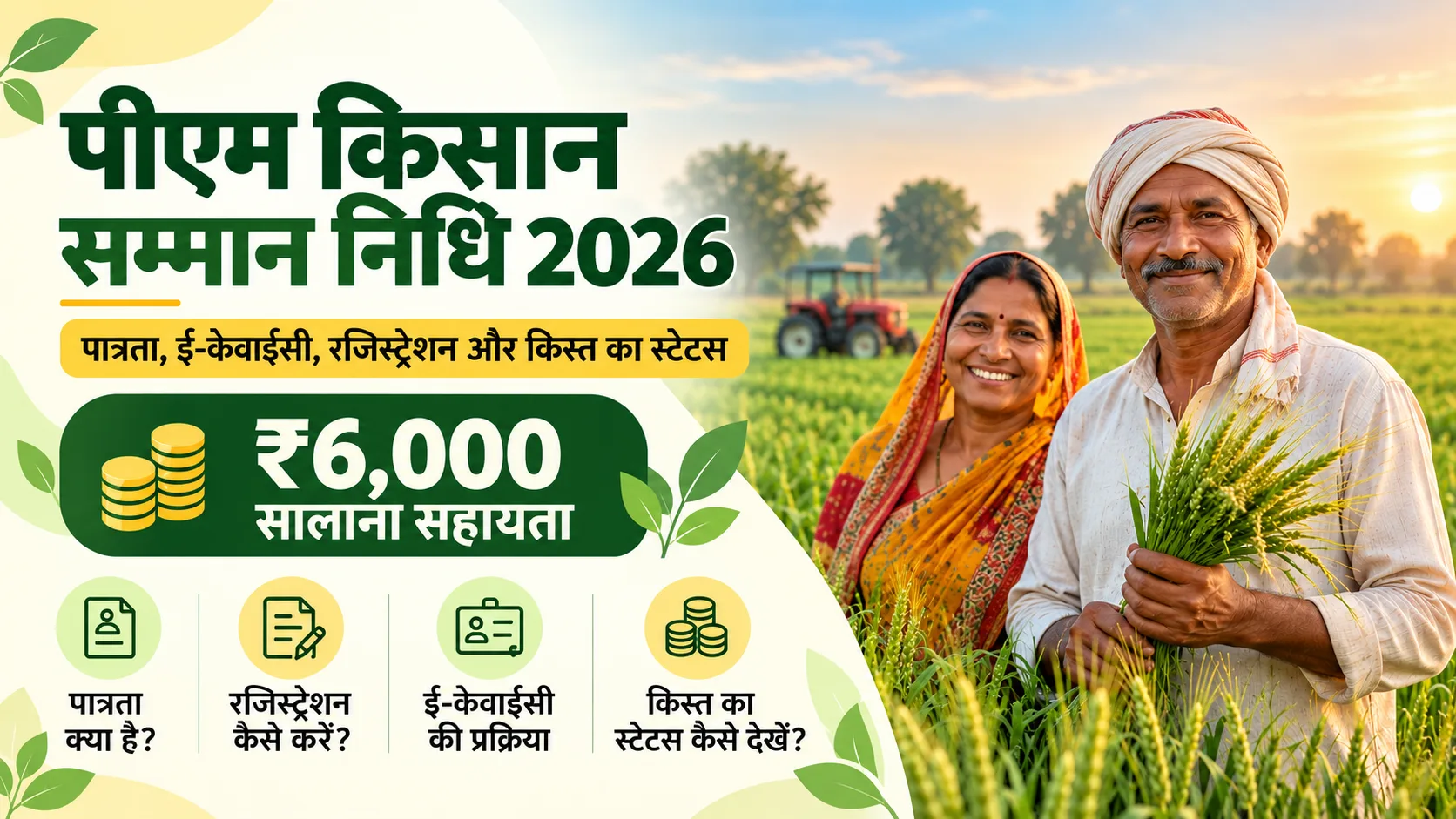
For a farming household, even a modest payment arriving at the right time can ease the pressure of buying seeds, arranging transport or meeting smaller household expenses. PM Kisan Samman Nidhi, usually written as PM-KISAN, is a Government of India income-support scheme for eligible landholding farmer families. It provides ₹6,000 in a financial year in three instalments of ₹2,000, normally sent directly into the beneficiary’s bank account. The scheme is not a crop loan, insurance policy or reimbursement for farm bills. Farmers do not have to repay the assistance. Its purpose is to offer predictable financial support rather than replace earnings from agriculture.
The most important point is that PM-KISAN is based on eligibility and verified records, not simply on whether somebody works in agriculture. The relevant land records, definition of a farmer family and exclusion criteria all matter. A person may cultivate fields yet need to clarify why their name is missing if the ownership record or verification details do not match. Likewise, a person who submitted a form does not automatically become an approved beneficiary. This guide explains those distinctions before walking through registration, eKYC and status checks.
PM Kisan benefit amount and payment pattern
The headline amount has not changed in the official scheme description: an eligible farmer family can receive ₹6,000 each financial year. It is divided into three transfers of ₹2,000 rather than deposited in one lump sum. In ordinary circumstances, instalments are associated with the April–July, August–November and December–March periods, but that schedule should not be read as a promise of one particular calendar date. A release takes place when the government announces it and processing is completed for eligible records.
For example, a family that receives every instalment in a full financial year would see three separate credits adding up to ₹6,000. A newly registered applicant should not assume all previous periods are automatically payable. Verification dates, eligibility records and the rules applicable to the beneficiary determine whether an instalment becomes due. Similarly, a beneficiary whose payment is held should first check why it was held instead of assuming the total annual amount has been cancelled. This distinction is especially important when newspapers report an instalment being released nationally, because a national release is not a guarantee that every individual account has been credited immediately.
Latest confirmed instalment in 2026
As checked on 17 October 2026, the official PM-KISAN portal and a Press Information Bureau release identify the 23rd instalment as released on 20 June 2026. The government stated that the release covered more than 9.44 crore farmers and transferred over ₹18,880 crore. That announcement confirms a national payment event; it does not establish the status of a particular applicant. If someone searches “PM Kisan next instalment date,” the responsible answer is to consult the current notices on the official portal rather than repeat an unverified social-media date.
A practical approach is to distinguish three questions. Has the government announced a release? Does the portal show the farmer as eligible for the relevant period? Has the bank received the transfer? These questions can have different answers on the same day. Website notices describe nationwide releases, the Know Your Status page contains beneficiary-specific information, and a bank statement shows what has actually arrived. Whenever an article discusses the latest payment, it should carry a review date and direct readers back to official notices.
Who is eligible for PM-KISAN?
Broadly, the scheme covers eligible landholding farmer families whose names and ownership details meet the rules and are reflected in relevant state or union-territory records. The programme originally focused on small and marginal landholders, but it was expanded to cover eligible landholding farmer families irrespective of the size of their landholding, subject to the exclusion criteria. The expansion does not mean that every Indian farmer qualifies automatically.
For the scheme, a farmer family generally means husband, wife and minor children. That definition matters because the benefit is for the family unit under the rules, not a ₹6,000 payment independently for every adult living in the house. State records and verification are central to determining eligibility. People who jointly own land, inherited land, recently purchased it or have inconsistent names across documents may require review. Before applying, check that the land ownership information is correct and that the bank and Aadhaar details can be used for verification. A self-declaration alone cannot override the formal eligibility conditions.
Who is excluded from the scheme?
The official portal lists institutional landholders and several categories of farmer families with higher economic status as exclusions. These include present or former holders of specified constitutional or political offices, many serving or retired government employees, certain pension recipients receiving ₹10,000 or more a month, people who paid income tax in the last assessment year, and practising registered professionals in identified categories. The government employee exclusion contains a specific exception for Multi Tasking Staff, Class IV and Group D personnel.
These are not interchangeable with a simple “income ceiling.” A farmer should not assume that annual household income below an invented figure automatically establishes eligibility. The exact category and family position matter. An applicant who suspects an exclusion should refer to the official text rather than rely on simplified posters. Where records incorrectly flag a beneficiary, the solution is to seek a factual review with the designated authorities, not to submit contradictory declarations or register multiple members of the same family.
Special cases: inherited land, women farmers and tenant cultivators
Women can receive PM-KISAN benefits when they meet the same landholding and scheme conditions as other applicants. There is no separate rule that limits the scheme to men. A woman whose name appears in qualifying ownership records should check whether she is already part of a beneficiary family and whether the land data are correctly recorded. The payment is linked to an eligible farmer family, so the rule against duplicate family benefits remains relevant.
Inheritance and ownership transfers need more care. Official clarifications recognise certain inheritance cases, but the date and nature of land transfer can affect review. The portal also warns that some cases involving land acquired after 1 February 2019 have been held for physical verification. This does not justify a blanket statement that every post-2019 owner is permanently ineligible. Tenant cultivators and agricultural labourers without qualifying ownership records should not assume that farming activity alone fulfils this landholding scheme’s requirements. When the case is unusual, ask the local agriculture or revenue office for guidance based on the actual land record.
Documents and details to prepare before registration
The smoothest application starts with matching records. Keep your Aadhaar information, a mobile number you can access, your bank details and the relevant land record available. Depending on the registration route and local verification requirements, the portal or official may request information such as state, district, village, landholding particulars and proof of ownership. A bank account should be active and suitable for receiving direct benefit transfers. In some cases, additional correction or verification may be needed before approval.
Write your name and identifying information exactly as supported by official records; inconsistent spellings can create avoidable delays. Use a phone number that you control, because OTP-based steps may require access later. Do not share OTPs, bank passwords or full Aadhaar information with an unknown agent who promises faster payment. Anyone assisting with a registration should explain what is being entered and which official portal is used. Keep a safe record of the registration number once the application is submitted; it is useful when checking subsequent status.
How to register as a new farmer
Start at the official website, pmkisan.gov.in, and look for the New Farmer Registration service. Enter the requested identity details and complete the verification shown by the live form. Continue with the information requested about the applicant and the agricultural land. Review spellings, account details and land particulars before submitting. The available form fields may change, so instructions copied from an old screenshot are not always reliable.
After submission, note the registration reference and keep any acknowledgement. Submission does not equal final approval: the appropriate state or district authorities may verify the identity, land information and exclusion criteria. If you are unable to use the website, seek help through an authorised Common Service Centre or the competent local government office. Do not pay someone simply to “unlock” an instalment without an official receipt and an explanation of the service. Where the registration is pending, check the self-registered farmer status rather than filing repeated applications in the hope of moving ahead in the queue.
How to check a newly submitted application
The public portal has a separate status facility for self-registered farmers and farmers registered through a Common Service Centre. This matters because application processing status and payment status are different. An application may be submitted yet still await verification; it would be premature to look for a ₹2,000 bank transfer at that stage. The self-registration status service currently accepts an Aadhaar number and captcha, while other portal tools may ask for a registration number. Always follow the fields displayed on the official page.
If status information indicates verification is pending, allow the designated officials to process it and follow up through the appropriate state channel if it remains unresolved. If the record has incorrect names, land particulars or bank details, find out which authority can correct the underlying data. Avoid recreating a profile under a slightly different name: that can lead to duplicates and more complications. Save your acknowledgement, and record when you checked so you can distinguish an unchanged status from a new update.
PM Kisan eKYC: why it matters
The PM-KISAN portal explicitly states that eKYC is mandatory for registered farmers. This verification helps connect the registered farmer’s identity with Aadhaar-based authentication. Even an older beneficiary who previously received funds should check the current eKYC status if an instalment does not arrive. A status marked incomplete is a practical problem to resolve before looking for more speculative explanations.
The available methods described in official guidance include OTP-based eKYC through the portal for suitable Aadhaar-linked mobile arrangements, biometric authentication at authorised centres, and face authentication through the prescribed official mobile applications. These options serve different circumstances. A farmer with no usable Aadhaar-linked phone number may need a biometric or supported face-authentication route rather than retrying an unavailable OTP. Complete the process only through legitimate services and check status afterward; the official guidance notes that updates may take time to reflect.
Step-by-step: checking and completing eKYC safely
First, open pmkisan.gov.in directly by typing the address into the browser. Find the eKYC service and follow the current instructions. If the site offers an OTP route, have the Aadhaar-linked mobile available and enter the OTP only on the official page. If the OTP does not arrive, check mobile connectivity and whether the correct number is linked before retrying. Do not ask another person to read out a confidential OTP from an unfamiliar message.
For biometric authentication, visit an authorised service centre and take the identification material requested by that centre. Government guidance has described a convenience fee for some assisted services; check the displayed fee and ask for a receipt instead of accepting an arbitrary charge. If choosing face authentication, confirm that you are using the genuine PM-KISAN app and required Aadhaar app, not a similarly named download advertised through a message. Finally, return to beneficiary status to confirm the updated eKYC indicator. An eKYC success message is not, by itself, proof that every other eligibility check has been cleared.
How to check PM Kisan beneficiary status
For an existing beneficiary, the Know Your Status service is the starting point. Visit the official site and select Know Your Status. The current page asks for a registration number, captcha and an OTP sent to the registered mobile number. Once the details are verified, the page can show payment-related information such as payment status, bank, transaction reference and credit information. The precise fields visible can change as the department updates the service.
Do not confuse a registration reference with Aadhaar or a mobile number if the page asks for a specific identifier. The official site offers help to locate the registration number when needed. Record the instalment and financial year you are examining. If the portal says a transaction was processed but the bank statement does not show a corresponding credit, use the transaction reference when raising the issue through proper channels. This is more useful than repeatedly searching for the scheme name on unrelated websites.
How to find your name in the beneficiary list
The PM-KISAN portal also publishes a beneficiary list interface organised by geography. The current form allows users to select state, district, sub-district, block and village. It is designed for looking up beneficiaries associated with a chosen location; it is not a substitute for the personal Know Your Status page. A village-level listing can help someone see whether their entry appears under the expected location, while individual payment details require the proper beneficiary-status process.
Village names, jurisdiction and land records may not always be intuitive, particularly after administrative changes. Select the correct geographic hierarchy, and avoid drawing a firm conclusion from a misspelled name or an incorrectly chosen block. If an eligible person appears to be missing, check the personal application and verification status first. A current-looking website elsewhere may reproduce outdated list data; the government portal remains the reference point.
What to do if the ₹2,000 instalment has not arrived
A missing instalment can have several explanations: a release may not yet cover the relevant payment period, the beneficiary may have an incomplete eKYC, land verification could be pending, bank information may be inconsistent, or the account may be flagged for a specific eligibility review. The quickest troubleshooting method is to identify the stage where the process stopped. Start with the government announcement, then check personal beneficiary status and finally compare the bank statement.
If eKYC shows pending, complete it through an official method. If a land-seeding or physical-verification issue appears, take the relevant record to the appropriate local office. For a bank-credit issue, ask the bank to check the transaction and Aadhaar/DBT arrangements using the actual status details. When information appears wrong, pursue correction rather than opening fresh registrations. Keep dated screenshots or acknowledgements but protect personal identifiers before sending them to anyone. Do not believe messages that guarantee the money if you pay a “release fee.”
Bank account, Aadhaar and DBT checks
PM-KISAN uses direct benefit transfer, which makes accurate identity and bank records important. A beneficiary might have a valid bank account yet still face a transfer issue if the relevant mapping or records are not ready. This is why a generic assurance that “the account is active” may not solve every missed payment. Ask the bank or responsible office what specific mismatch or transfer status needs attention.
If the farmer changes bank accounts, mobile numbers or other key details, it is sensible to verify that the official beneficiary information is updated through the allowed process. Do not assume that a new account will automatically inherit every arrangement from the old one. The bank statement is the practical evidence of credit; a portal message is evidence of processing at the level described by that message. Keep these roles separate to avoid confusion and to make a complaint easier to investigate.
If your PM Kisan eKYC is complete but your instalment has still not arrived, check whether your Aadhaar is correctly seeded with your bank account for Direct Benefit Transfer (DBT). eKYC verifies the beneficiary's identity, while Aadhaar bank seeding and NPCI mapping help determine the bank account used for Aadhaar-based DBT payments. These are separate processes, so completing eKYC does not automatically confirm that your bank account is ready to receive the payment.
You can check your beneficiary details through the official PM Kisan portal and contact your bank to verify the Aadhaar seeding and DBT mapping status. For a detailed explanation, read our guide on PM Kisan eKYC Done but Payment Pending? Check Aadhaar Bank Seeding and DBT Status.
PM Kisan complaints and corrections
An effective grievance states exactly what went wrong. Instead of writing only “PM Kisan money not received,” identify the registration number, the instalment or period, what the status page displays and whether the bank confirms a credit. The government portal provides complaint and help-related routes; state agriculture offices and authorised service centres may also guide applicants on issues within their authority. Use the available official channels, as the correct correction path varies with the type of error.
Land record mistakes generally need attention from the offices that maintain or certify those records. Aadhaar or mobile authentication problems belong to the relevant verification process. Payment tracking requires beneficiary and transaction details. Avoid sending an unredacted Aadhaar card or financial information to random social-media accounts offering assistance. After a correction, allow for the corresponding data to be checked and reflected in the portal rather than interpreting a temporary lack of change as proof that the complaint failed.
Common myths that confuse applicants
Myth one: every person who farms is eligible. The scheme has landholding and exclusion requirements, so farming work alone does not prove eligibility. Myth two: every adult family member can independently claim ₹6,000. The official family definition makes duplicate family claims a serious issue. Myth three: once a national instalment is released, every account must receive money that day. Individual checks and transfer processes can differ. Myth four: submitting a form is the same as approval. Registration begins a process of verification.
A fifth myth is that an intermediary can guarantee approval or speed up an instalment in exchange for payment. No unofficial operator can waive the scheme rules. A sixth is that every land record acquired after 2019 is automatically and permanently rejected. The current portal speaks about identified categories and verification holds; unusual cases require review against applicable guidance. When in doubt, prefer the exact current portal message and official operational guidelines over screenshots stripped of context.
PM Kisan and other farmer support programmes
PM-KISAN is best understood as direct income support. It does not replace crop insurance, subsidised institutional credit, irrigation support or agricultural extension services. Those programmes have separate applications, objectives and conditions. Farmers may be eligible for more than one programme, but they should not assume that receiving PM-KISAN automatically enrols them in another scheme or guarantees an agricultural loan.
This matters when a search result advertises a “PM Kisan loan” as if the ₹6,000 benefit were a loan application. The cash assistance is non-repayable and is not itself a credit product. Farmers seeking crop loans should compare authorised banking products and their separate requirements. A useful scheme information website should link readers to the right kind of support rather than combining unrelated programme conditions on one page. That clarity improves trust and reduces the chance that a user acts on the wrong instructions.
Practical checklist before you apply or troubleshoot
Start by asking whether the farm land is recorded in the correct ownership name, whether the family meets the rules, and whether anyone falls within an exclusion category. Next, check Aadhaar particulars, an accessible mobile number and bank readiness for direct benefit transfers. If not yet registered, use the New Farmer Registration service and preserve the reference. If registered, verify eKYC and inspect the beneficiary status. If there is a payment problem, identify the precise missing condition before approaching the relevant office.
Build a simple folder of records rather than sharing scattered pictures in messaging groups. It might contain an acknowledgement, relevant land-record extract, dated status notes and any bank confirmation. Keep private information secure. Revisit the official portal whenever a new instalment is announced because rules, field labels and processing notices can change. Most importantly, use the scheme to understand entitlements without treating a published article as an eligibility certificate: the final decision rests with the government’s authorised verification process.
Frequently asked questions
Q: Is PM Kisan ₹6,000 per month?
No. It is ₹6,000 per financial year in three instalments of ₹2,000.
Q: Is there a standard annual income limit for everybody?
Eligibility is not determined by one simple income figure; the official exclusion categories apply, including income-tax-payment rules.
Q: Can women farmers apply?
Yes, subject to qualifying landownership, family and other scheme rules.
Q: Do tenant farmers automatically qualify?
Cultivation alone does not establish eligibility for this landholding scheme. Check recorded ownership and rules.
Q: Is eKYC optional?
No. The official portal describes it as mandatory for registered farmers.
Q: How do I check whether money was credited?
Look at Know Your Status and verify the credit in your bank statement.
Q: Can husband and wife each receive the amount independently?
PM-KISAN works with a defined farmer-family unit; duplicate family payments may be flagged.
Q: Where should I apply?
Begin at pmkisan.gov.in or use an authorised assistance centre.
Q: When was the latest confirmed instalment issued?
As of the review date of 17 October 2026, the official portal identifies the 23rd instalment released on 20 June 2026.
Q: What should I do if the portal shows pending verification?
Follow the responsible verification channel and correct the underlying record if needed rather than creating multiple applications.
Final takeaway
PM Kisan Samman Nidhi is straightforward in its financial promise, but understanding who qualifies and why individual payments may be held takes more attention. The strongest starting point is always the official record: the registered family, the land details, the eKYC indicator, the beneficiary status and the actual bank credit. Avoid shortcuts, unofficial guarantees and rumours about release dates. When a problem appears, identify whether it is related to eligibility, verification or payment before trying to correct it.
For readers checking the scheme for the first time, the most useful next action is to open the official website and compare its current requirements with their own documents. For existing beneficiaries, checking Know Your Status and eKYC is often more useful than filling in another registration form. This guide is independent informational content, not an official government page, and cannot approve applications or release payments.
Official sources and editorial notes
- PM-KISAN official portal — https://pmkisan.gov.in/
- Know Your Status — https://www.pmkisan.gov.in/BeneficiaryStatus_New.aspx
- Self-registration status — https://pmkisan.gov.in/farmerstatus.aspx
- Beneficiary list — https://pmkisan.gov.in/Rpt_BeneficiaryStatus_pub.aspx
- PIB, 23rd instalment released 20 June 2026 — https://www.pib.gov.in/PressReleasePage.aspx?PRID=2275744&lang=2®=48
- Official FAQ — https://pmkisan.gov.in/Documents/FAQPMKISAN.PDF
- Official eKYC guidance — https://pmkisan.gov.in/Documents/Note-on-Modes-and-processes-of-ekyc-13th-Nov-English.pdf
Editorial note: Verify changes to application fields, eligibility notices and instalment announcements on official sites before publishing updates.
Last updated: 17 Oct 2026