Ayushman Bharat PM-JAY Eligibility 2026: Who Can Get an Ayushman Card?
Who is eligible for PM-JAY in 2026? Check women’s eligibility, rural and urban criteria, income questions, the 70+ rule and official verification steps.
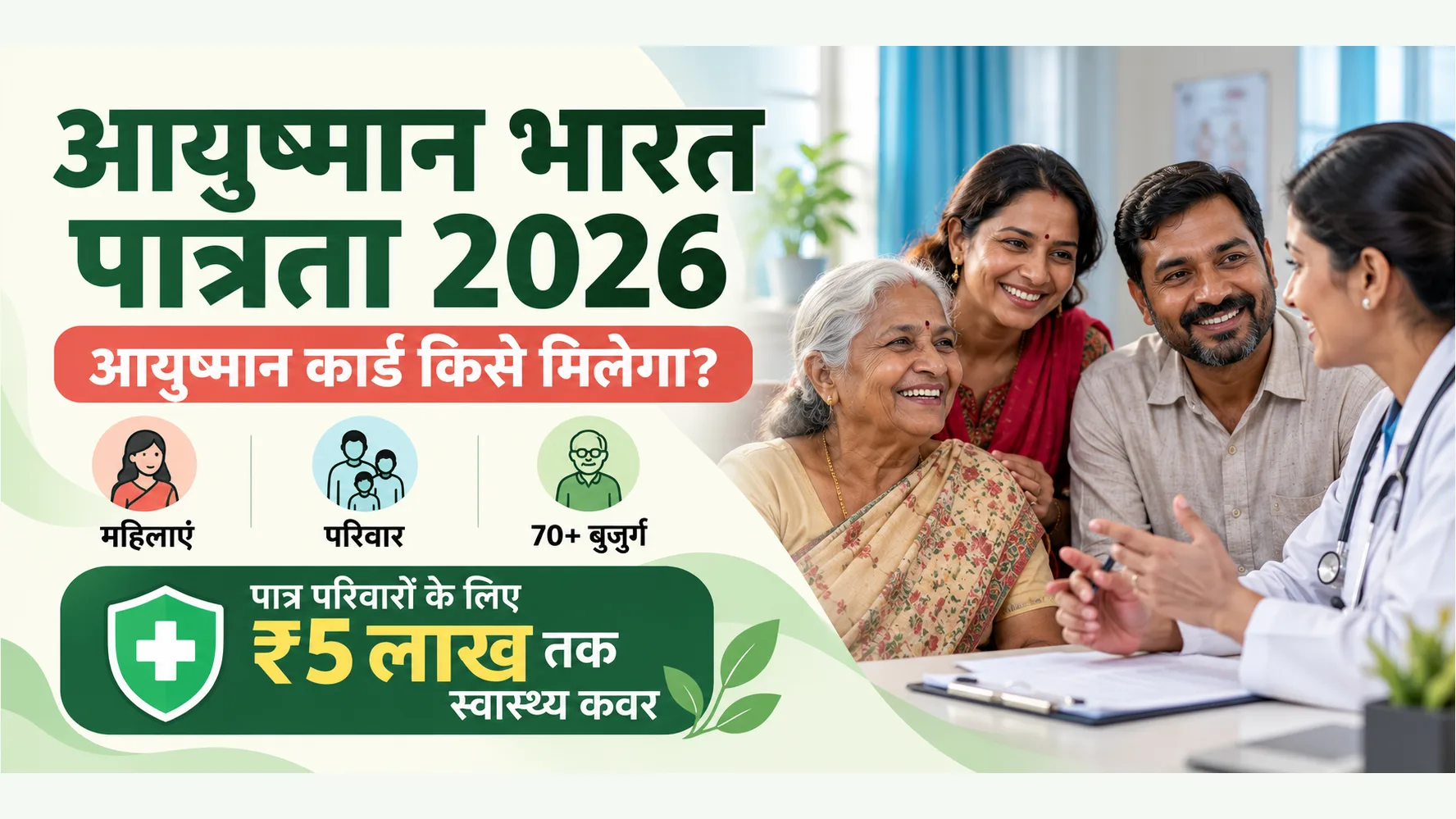
Ordinary PM-JAY eligibility is based on recognised household lists and applicable state rules. All citizens aged 70 and above have a separate income-independent eligibility route. Check your exact status on the official beneficiary portal.
Eligibility at a glance
| Category | How eligibility works |
| Listed vulnerable household | Check recognised PM-JAY or applicable state records |
| Woman below 70 | Eligible family or state inclusion; no blanket women-only entitlement |
| Child | Covered if included in eligible family |
| Senior aged 70+ | Income-independent expansion with verification |
| ABHA account holder | ABHA alone does not establish PM-JAY entitlement |
Complete eligibility guide
What is Ayushman Bharat PM-JAY, and why does eligibility matter?
Ayushman Bharat Pradhan Mantri Jan Arogya Yojana (AB PM-JAY) is a publicly funded health assurance programme intended to reduce the financial burden of qualifying hospital treatment. For covered families, its standard benefit is up to ₹5 lakh per family per year for listed secondary and tertiary hospitalisation packages. It is not a cash grant and the ₹5 lakh is not deposited into a bank account. The entitlement works through eligible treatment at empanelled hospitals.
A search for “who is eligible for PMJAY” is really a request for a yes-or-no answer. Unfortunately, a simple nationwide income number cannot reliably answer that question. Eligibility depends on recognised beneficiary lists, selected rural deprivation or urban occupational categories, applicable state extensions and specific inclusion decisions. There is also an important nationwide expansion for residents aged 70 years or above. The sensible starting point is to check the official beneficiary system rather than assume that an Aadhaar card, ration card or low salary independently guarantees coverage.
Is Ayushman Card available to everyone?
No. The usual PM-JAY entitlement is directed toward identified vulnerable households, not automatically every Indian citizen. The original framework used Socio Economic and Caste Census (SECC) 2011 data and identified rural deprivation and urban occupational categories. Some states use additional verified databases or broaden coverage with state resources. As a result, two people with similar earnings may have different results when their household details are checked.
The major exception to the common “not for everyone” answer concerns older citizens. People aged 70 or above have been brought under the Ayushman Vay Vandana expansion regardless of socio-economic status. That does not mean everybody below 70 is automatically covered. It is also important not to confuse “Ayushman Bharat” as an umbrella initiative with the specific hospitalisation entitlement called PM-JAY.
PM-JAY eligibility criteria for rural households
Under the original SECC-based approach, rural household identification considers specified deprivation categories rather than just a single annual income ceiling. Examples include households with only one room with kucha walls and roof, families with no adult member aged 16–59, households headed by women with no adult male aged 16–59, disabled members with no able-bodied adult, Scheduled Caste or Scheduled Tribe households and landless households deriving a major part of income from manual casual labour. Certain automatically included groups also form part of the original framework.
These descriptions are meant to help you understand how the original lists were built; they are not an invitation to self-certify into the programme. Being landless today does not by itself establish that a household appears in the current beneficiary database. Likewise, owning a small plot does not prove exclusion in every state extension. Check the record tied to your family and consult your state health agency if the listing appears incomplete or incorrect.
Practical tip: If your situation is unclear, keep your family details consistent and seek an official record check. A general article cannot confirm a named individual’s eligibility.
Urban PM-JAY eligibility and occupations
For urban families, the original targeting approach considers designated occupational groups. Common examples include rag pickers, beggars, domestic workers, street vendors, construction workers, sanitation workers, transport workers, shop helpers and certain home-based workers. The exact classification and beneficiary matching matter. An occupation name on its own is not a substitute for verification through the official system.
Suppose two people drive commercial vehicles in different cities. One household may be in an eligible source database while the other is not. It would be misleading to tell both that their job automatically secures the card. People with uncertain status should look up their household, confirm spelling or identity details and request guidance from the relevant implementation authority rather than paying someone who promises guaranteed enrolment.
Is there an income limit for Ayushman Card?
There is no single universal PM-JAY income limit that accurately decides eligibility for all applicants nationwide. Online posts often claim that everyone earning below a particular rupee figure can apply. Such short-cut claims overlook the beneficiary lists and state-level implementation differences. For the original target population, deprivation and occupational criteria played a central role, rather than a stand-alone income declaration.
For the 70-plus expansion, income is explicitly not a barrier. A senior citizen who meets the age requirement can seek coverage regardless of whether the household is poor, middle-income or wealthy, subject to verification and scheme procedures. Readers should avoid uploading income certificates or identity documents to unofficial websites that promise instant approval simply because they have seen an advertised income threshold.
Ayushman Card eligibility for women
Women are covered as members of eligible PM-JAY families, and the programme does not set a general rule that only male heads of household receive benefits. Women within covered households can access eligible cashless packages according to medical need and scheme rules. The original rural targeting framework also includes a category involving women-headed households with no adult male between 16 and 59. This is one criterion among several, not a women-only universal enrolment route.
A woman who is not shown on a family record should first investigate whether her name or identity details need updating. Marriage, changes in household records and differences in spelling may create practical verification difficulties. A female senior citizen aged 70 or above can independently use the age-based pathway, irrespective of income. Be particularly wary of agents who advertise “free Ayushman card for every woman” or ask for unnecessary payments.
Practical tip: If your situation is unclear, keep your family details consistent and seek an official record check. A general article cannot confirm a named individual’s eligibility.
Are children, young adults and pregnant women eligible?
There is no general age limit within the standard eligible household benefit: children and adults of different ages can be covered when the family is eligible. However, this should not be interpreted as automatic PM-JAY eligibility for every child, student or pregnant woman in India. The household’s entitlement must be established.
Pregnancy-related care may be supported under relevant approved hospital packages and implementation rules, but ordinary outpatient checkups or every health expense should not be assumed covered. Different maternal and child health programmes may offer other services. For treatment questions, the most useful action is to ask an empanelled hospital whether the specific care is included under the current package rules.
Eligibility for senior citizens aged 70 years and above
From 29 October 2024, the national PM-JAY expansion includes all senior citizens aged 70 years and above irrespective of socio-economic status. The associated Ayushman Vay Vandana card is distinct from the ordinary household eligibility check. The programme provides qualifying health cover up to ₹5 lakh per year on a family basis for newly included older citizens.
Where an older person belongs to a family already covered under PM-JAY, the qualifying 70-plus members have a separate additional cover of up to ₹5 lakh a year that does not reduce the standard family entitlement for members below 70. The rules for people already receiving government health benefits require attention: those in specified public schemes may need to select which scheme to continue under. The age-based category is based on actually reaching 70; being 60 or 65 does not confer this particular entitlement.
Practical tip: If your situation is unclear, keep your family details consistent and seek an official record check. A general article cannot confirm a named individual’s eligibility.
What if a 70-plus senior already has health insurance?
An older citizen with private health insurance or Employees’ State Insurance may still be eligible for the 70-plus PM-JAY extension. Having a private policy is not, by itself, a reason to reject the age-based benefit. However, existing members of schemes such as CGHS, ECHS or CAPF health arrangements have a choice between those arrangements and PM-JAY under the government’s published rules.
Before switching from an existing public scheme, compare the provider network, outpatient provisions, medicines, referral rules and any dependent-family benefits. Those features may differ substantially. The government announcement is not a reason to cancel private insurance without understanding the policy’s separate protections. A public hospital scheme and a retail insurance contract are not interchangeable simply because both mention ₹5 lakh.
How to check PM-JAY eligibility online
Start with the official beneficiary portal at beneficiary.nha.gov.in or the government-supported Ayushman App. Follow the current sign-in and identity-verification prompts, which may change as the service is updated. Use the available search method to find the intended household or eligible senior citizen. Review the displayed eligibility or enrolment status carefully, including the person’s name, age and family information.
If the portal shows no record, do not treat a third-party website’s “eligible” badge as official evidence. Try the available verified search options, check whether there is a spelling mismatch and contact the state health authority, an empanelled hospital help desk or a Common Service Centre for permitted assistance. Keep personal identifiers confidential and share OTPs only in the official authentication workflow.
Practical tip: If your situation is unclear, keep your family details consistent and seek an official record check. A general article cannot confirm a named individual’s eligibility.
Documents commonly needed for verification
Identity and age verification are especially important. Aadhaar-based identification may be used in the official process, and eligible families may be asked for accepted supporting documents according to applicable procedures. For a senior citizen applying through the 70-plus route, age must be verifiable. The exact evidence and authentication flow should be checked on the government portal or with an authorised centre.
Do not publish Aadhaar numbers, upload document scans in public comments or send one-time passwords to a person claiming to be an agent. A genuine eligibility result is linked to records and official verification, not to payment for a private “approval letter”. Readers should keep copies of official acknowledgements and record the support channel used if a correction is pending.
Ayushman Card, PM-JAY and ABHA: what is the difference?
PM-JAY is the hospital-cover scheme. An Ayushman card is the beneficiary identification used in the scheme’s operation for eligible individuals. The name Ayushman Bharat also appears in other health initiatives, including Ayushman Arogya Mandirs. ABHA, the Ayushman Bharat Health Account, is a digital health identity intended to support health-record sharing; creating an ABHA number does not automatically make someone eligible for ₹5 lakh PM-JAY cover.
This distinction matters for searchers who see several government healthcare portals. A digital health ID can be useful without serving as proof of PM-JAY financial cover. When visiting a hospital, ask staff to check actual PM-JAY beneficiary and package eligibility. Do not rely on a screenshot of an ABHA number as evidence that a particular treatment will be paid for.
What does eligible PM-JAY coverage pay for?
The standard PM-JAY protection is up to ₹5 lakh per family per year for covered secondary and tertiary hospitalisation, through listed cashless treatment packages at empanelled facilities. The benefit is not an unrestricted cash payment. Hospital eligibility, medical indication, authorisation and package rules matter. Pre-existing conditions are covered from the start under the programme’s published framework.
A common misunderstanding is to assume that every consultation, pharmacy purchase, cosmetic procedure, routine dental visit or non-hospital expense can be charged to the card. Coverage should be confirmed for the actual package and hospital before a planned admission. In urgent care, seek prompt medical attention first and ask hospital personnel to explain applicable scheme formalities.
Practical tip: If your situation is unclear, keep your family details consistent and seek an official record check. A general article cannot confirm a named individual’s eligibility.
How to find a participating hospital
Hospital participation is different from general eligibility. A person may be eligible for PM-JAY but still need to select an empanelled hospital that provides the required speciality and package. Start with government or state-approved hospital search facilities and verify the facility directly. The portability design permits covered beneficiaries to seek eligible cashless treatment at empanelled facilities beyond their home state, subject to scheme rules.
Before a non-emergency procedure, confirm the hospital remains empanelled, that the proposed medical service is in its permitted package list and that pre-authorisation is handled appropriately. Keep admission documents and request a clear explanation if any amount is demanded for a service represented as cashless. If a hospital refuses service, ask for a written reason and use official grievance channels.
Why eligibility searches or card requests fail
Frequent practical problems include name or date-of-birth differences, an outdated family record, duplicate entries, a change of mobile number or confusion between an ABHA identity and a PM-JAY record. A “not found” message is not always a definitive statement about a person’s medical or social circumstances; it may reflect the limitations of the search or the source database.
Try again through approved channels with consistent personal details. Do not repeatedly enter data into unknown sites, and never pay a middleman promising to add a household to the government list. Document the precise error, when it appeared and which official support channel was used so an authorised operator can investigate.
How states affect eligibility
PM-JAY operates alongside state-level health assurance arrangements. States and union territories may follow different implementation models, beneficiary databases or wider coverage policies. This is why a statement that a specific occupation or income level qualifies in one state may be misleading elsewhere. A general national article can explain core rules but cannot replace a live state beneficiary check.
For readers close to a state border or moving for work, it is useful to separate two issues: whether the person is enrolled and whether a chosen hospital is empanelled for the treatment. Portability can support eligible treatment away from home, but administrative steps and package availability can still require verification. Use official state health agency pages for exceptions.
Practical eligibility checklist before you apply
First, identify the likely pathway: an already-listed eligible family, a state-supported extension or the age-70-plus route. Second, check the official beneficiary system rather than trusting generic online calculators. Third, compare your personal details with official records. Fourth, use only recognised verification points for corrections. Finally, verify the desired hospital and treatment package before assuming the card pays a particular bill.
Families should also consider who is actually included in their beneficiary record. A card for one person does not automatically prove that an unrelated household member has a valid entitlement. Store official confirmation and support records safely. If an elderly parent has recently turned 70, their age-based entitlement deserves a fresh check even if the household was not eligible under the original categories.
Practical tip: If your situation is unclear, keep your family details consistent and seek an official record check. A general article cannot confirm a named individual’s eligibility.
Common scams and misleading promises
Beware of messages saying that every woman gets an Ayushman card, that approval is guaranteed after paying an “application fee”, or that a PM-JAY card can be exchanged for ₹5 lakh cash. These are not accurate descriptions of the national programme. Fraudsters may use lookalike government logos or ask for Aadhaar images and OTPs through messaging applications.
Use official government addresses and verified service points. Read the domain carefully before entering personal information; advertisements and search results are not proof that a site is authorised. A helpful independent information article should clearly state that it is not a government registration service, explain its sources and send visitors to the official beneficiary portal for a real eligibility decision.
Final answer: who can apply for PM-JAY in 2026?
A person may qualify through a family recorded under applicable beneficiary criteria, an approved state or special-group inclusion, or—if aged 70 or above—the nationwide senior-citizen expansion independent of income. Women, men and children within eligible families are not excluded solely because of gender or age. But below age 70, an Aadhaar card, ration card or low income alone should not be presented as a universal guarantee.
For the individual answer, check the official beneficiary record and complete the prescribed verification. If you need medical care soon, also confirm the hospital’s empanelment and package coverage. Treat online summaries, including this one, as guidance rather than as a certification that a particular person is enrolled.
Frequently asked questions
Is PM-JAY free?
Eligible beneficiaries do not pay a premium for the standard publicly funded scheme; treatment is cashless for qualifying packages at empanelled hospitals.
Is an Aadhaar card enough?
No. Aadhaar can support identity verification but is not a universal PM-JAY eligibility certificate.
Can a woman apply independently?
A woman can be a beneficiary in an eligible family; women aged 70 or above can check the age-based route regardless of household income.
Does a ration card guarantee Ayushman eligibility?
No. A ration card alone does not guarantee inclusion in the PM-JAY beneficiary record.
What is the PM-JAY income limit?
There is no single nationwide income cutoff sufficient to determine every applicant’s eligibility. The 70-plus route is not income-tested.
Can a 65-year-old get a Vay Vandana card?
The nationwide senior expansion discussed here applies from age 70; a 65-year-old may still qualify under ordinary family or state criteria.
Does ABHA mean I have health insurance?
No. ABHA is a digital health identifier, different from PM-JAY coverage.
Can I use the card in another state?
Eligible beneficiaries can use portability at empanelled hospitals, provided the relevant package and procedures are available.
How much is the annual coverage?
Standard PM-JAY protection is up to ₹5 lakh per family per year for qualifying hospitalisation, with specific additional arrangements for covered 70-plus seniors.
Where can I check eligibility?
Use beneficiary.nha.gov.in, the Ayushman App or an authorised hospital or service centre.
Will a private policy disqualify someone aged 70-plus?
No; government announcements state that private insurance does not bar the age-based expansion.
Can an agent guarantee approval?
No. Approval or beneficiary verification depends on official rules and records, not on payment to a private agent.
Official references and useful links
National Health Authority PM-JAY
Government clarification on targeting and databases
70-plus expansion: Cabinet announcement
Senior citizen enrolment routes
Editorial note: This is independent informational content, not an official government enrolment service.
Last updated: 17 Oct 2026